2026-06-04
Case Review of Malar Reduction and Genioplasty: Achieving a Smooth Facial Contour
We introduce a combined facial contouring surgery case that simultaneously resolved concerns of a weak chin and protruding cheekbones. Discover the process of achieving a natural, three-dimensional facial line through a precise surgical procedure, which includes removing an existing chin implant, performing an advancement genioplasty using the patient's own bone, a malar reduction, and a paranasal bone graft utilizing the excised bone.
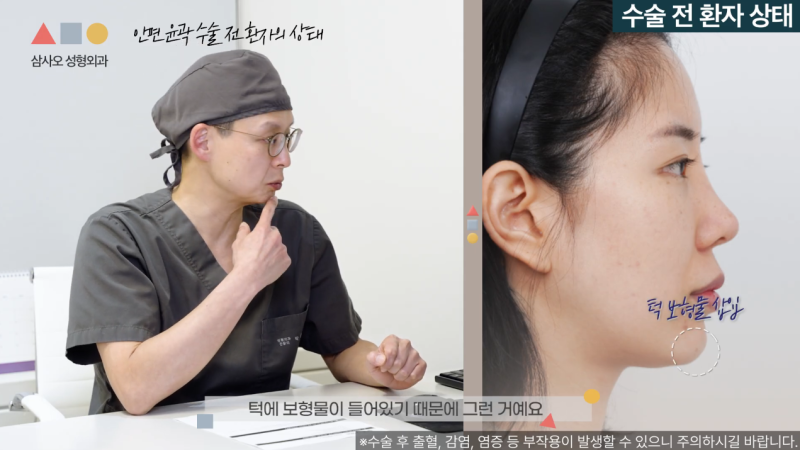
Changes in Facial Contours Through Malar Reduction and Genioplasty
The cheekbones, which are the center of the face, and the chin line, which balances the lower face, are key elements that determine one's overall impression. The case we are introducing today is of a patient who underwent both malar reduction and advancement genioplasty to simultaneously improve protruding cheekbones and the appearance of a weak chin.

1. Pre-operative Analysis: Limitations of the Existing Implant
This patient had a history of undergoing chin implant surgery in the past to improve the appearance of a protruding mouth. However, because the inserted implant was small, the feeling of a weak chin still remained, and the cheekbones protruded unevenly from both the frontal and 45-degree angles, resulting in an uneven facial contour.
Additionally, the nasolabial folds appeared sunken, which made the mouth look even more protruded. To resolve this, we established a combined surgical plan that included fundamental skeletal improvement rather than a simple implant replacement.
- Removal of the existing chin implant and fixation screws
- Advancement genioplasty to directly pull the bone forward
- Malar reduction to smoothly refine the contours
- Paranasal bone grafting utilizing autologous tissue excised from the cheekbones
2. Precise Diagnosis and Surgical Points
As a result of X-ray and CT examinations, a small implant of about 3mm was previously inserted at the tip of the chin, but it was insufficient to provide the three-dimensional effect the patient desired.
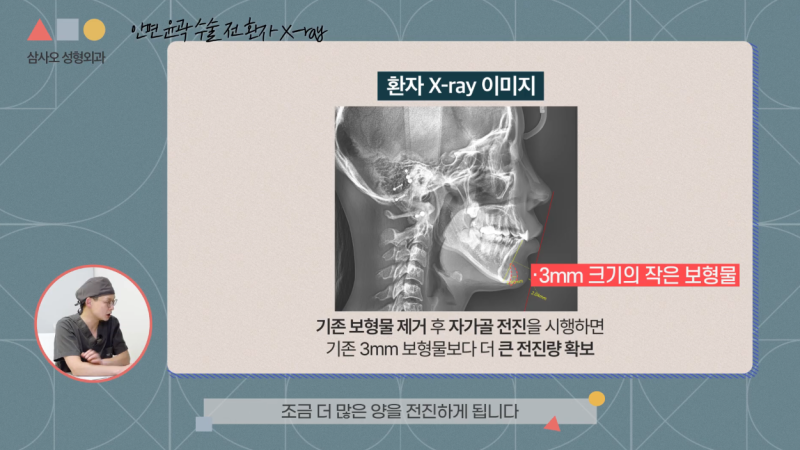
Advancement Genioplasty Using Autologous Bone
After removing the existing implant, the patient's own lower jawbone was osteotomized and advanced by a sufficient amount compared to the implant. It was then firmly fixed with plates and screws to form a natural line without any foreign body sensation. Any step deformity (staircase effect) that could occur after the osteotomy was smoothed into a seamless jawline through contouring osteotomy.
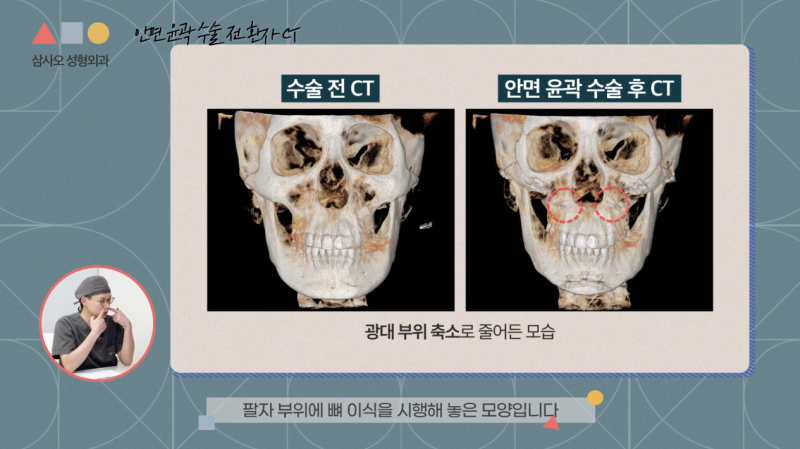
Recycling Cheekbone: Paranasal Bone Grafting
We concurrently performed a paranasal bone graft, which involves transplanting the excess bone removed during the malar reduction into the nasolabial fold area instead of discarding it. This has superior biocompatibility compared to artificial implants and helps create a three-dimensional mid-face by enhancing the volume in the nasolabial fold area.
3. Post-operative Progress and Recovery Process
As confirmed through a CT scan immediately after surgery, the wide lower face width was reduced, and the tip of the chin naturally protruded forward, completing a three-dimensional profile.
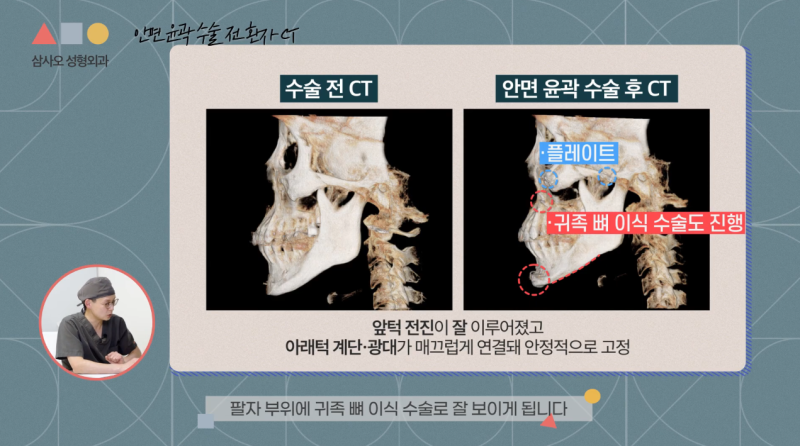
Summary of Changes by Period
- 2 Months Post-op: This is the period when major swelling gradually subsides and the contours are revealed. You can feel that the uneven cheekbone line has become smoother.
- 6 Months to 1 Year Post-op: This is the period when minor swelling completely disappears and the bone tissue stabilizes. You can expect visual improvements, such as a slimmer chin tip and a reduced facial size.

4. Precautions for Facial Contouring Surgery
Since facial contouring surgery is a highly difficult procedure that deals with bones, it is essential to accurately identify the location of the nerve lines. Additionally, temporary sensory loss, swelling, and bruising may occur after surgery, but these usually alleviate over time. Because the appropriate surgical method varies depending on each patient's individual skeletal structure, an in-depth consultation with a specialist must precede the surgery.
Frequently Asked Questions
Can I remove an existing chin implant and undergo genioplasty (chin advancement surgery)?
Yes, it is possible. After removing the existing implant and fixation screws, the surgery can be performed by cutting and advancing your own lower jawbone forward. This allows for a natural chin line without a foreign body sensation.
Can the bone resected during zygoma reduction surgery be used in other areas?
Yes, the resected autologous tissue can be used for paranasal augmentation (귀족 뼈 이식). If the excess bone remaining from zygoma reduction surgery is grafted into the sunken nasolabial folds, it offers superior biocompatibility compared to artificial implants and helps create a more three-dimensional face by enhancing the volume of the mid-face.
When does the swelling completely subside after facial contouring surgery?
It usually takes about 6 months to 1 year. Significant swelling gradually subsides around 2 months post-surgery, allowing you to feel a softer contour, and after 6 months to 1 year, residual swelling completely disappears, bone tissue stabilizes, and you can see a slimmer chin.
Will there be a step or unevenness in the bone after genioplasty?
Unevenness can be prevented through a refining osteotomy process. Any step or unevenness that may occur after advancing the bone is smoothly contoured during the surgery to create a natural jawline.
Are there any side effects to be aware of during facial contouring surgery?
Yes, temporary sensory loss, swelling, or bruising may occur. As it is a bone surgery, it is crucial to accurately identify the location of nerve lines, and these symptoms generally subside naturally over time. You must consult sufficiently with a specialist.