2026-10-20
Why Are Men's Nasolabial Folds Getting Deeper? Samsao Lifting
Explains why men's nasolabial folds deepen with age due to skin elasticity loss, volume reduction, and tissue sagging, and introduces Samsao's SMAS Volume Lift approach.

Hello, this is Samsao Plastic Surgery.
Many men feel that their nasolabial folds have deepened over the years and that their overall facial impression has changed. Nasolabial folds are the lines that run from the sides of the nose to the corners of the mouth. The deeper they become, the more tired or older they can make a person look.
In men, nasolabial folds are not simply wrinkles on the skin's surface. Several factors can act together, including loss of skin elasticity, decreased facial volume, and tissue sagging. For this reason, it is important to accurately identify what is causing the folds to deepen and to consider an improvement approach that suits each person's facial condition.
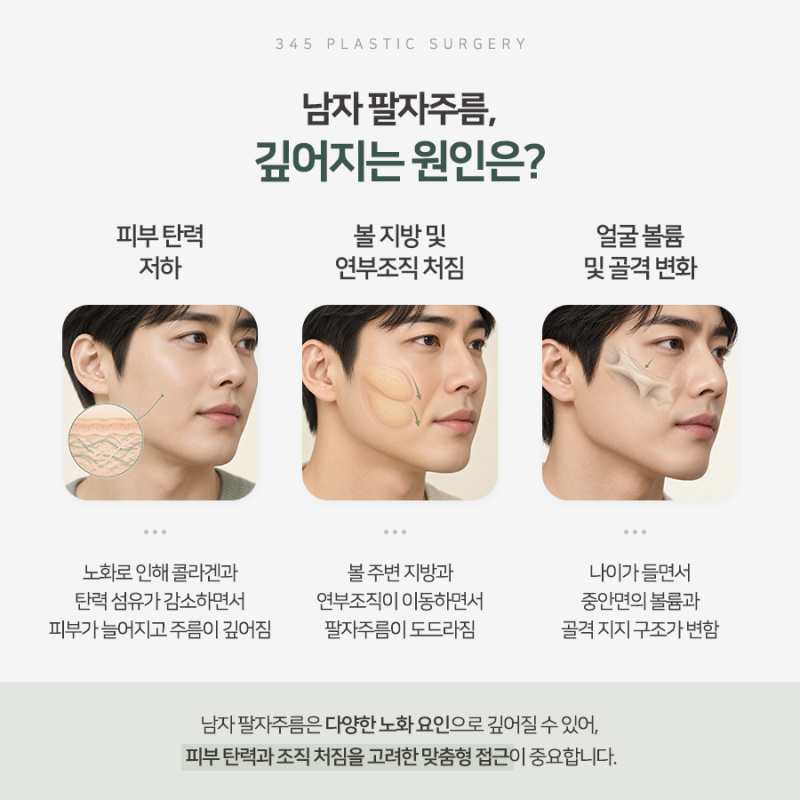
What Causes Men's Nasolabial Folds to Deepen?
Men's nasolabial folds can gradually deepen due to the loss of skin elasticity and tissue changes that come with aging. As we age, collagen and elastic fibers decline, and the skin begins to sag. At the same time, the fat and soft tissue around the cheeks shift downward, making the nasolabial folds more pronounced.
In addition, a loss of facial volume and changes in the underlying bone structure can also contribute to deeper folds. That is why a comprehensive approach that considers not only skin elasticity but also volume loss and tissue sagging is important.

Nasolabial folds can deepen even further when sagging of the surrounding tissue works alongside simple volume loss. Restoring volume alone may not sufficiently correct the sagging, while lifting the tissue alone may leave a volume deficit behind. Therefore, a combined approach that fills in lost volume while lifting sagging tissue is essential.
For men in particular, the improvement plan should take into account the existing facial contours and overall impression, and be tailored to each person's volume distribution and degree of sagging.

Remove, Fill, and Lift: Samsao SMAS Volume Lift
Samsao Plastic Surgery's SMAS Volume Lift is a surgical method that addresses both volume loss and tissue sagging in the face.
Rather than simply pulling on the surface of the skin, this approach lifts sagging tissue by taking into account the SMAS layer beneath the skin. The direction and extent of the lift are planned according to the facial contours and degree of sagging. Along with this, areas with insufficient volume can be supplemented with autologous fat grafting, while excess fat that has accumulated unnecessarily can be removed through liposuction.

SMAS Volume Lift requires a detailed surgical plan that accounts for the structure of the facial tissue and the degree of sagging. The condition of the skin and the SMAS layer is evaluated, and sagging tissue is lifted in the appropriate direction to create a natural facial contour.
When liposuction or fat grafting is needed, fat is harvested through micro-cannulas, purified, and then used to restore volume to the areas that need it.

Why Is Recovery Faster with Samsao Lifting?
For lifting surgery, it is important to consider not only the improvement results but also the recovery process after surgery. Samsao Plastic Surgery focuses on minimizing unnecessary tissue damage and bleeding through meticulous dissection and hemostasis. In addition, we plan the scope of surgery according to each patient's degree of sagging, striving to reduce surgery time and the burden of recovery.

Samsao Plastic Surgery operates a variety of safety systems to closely monitor each patient's condition, from before surgery through the recovery period.
First, through the DOCTOR CALL system, the medical team in charge personally checks each patient's recovery progress after surgery and provides the necessary guidance. In addition, three anesthesiology and pain medicine specialists are stationed on site to monitor the patient's overall condition during surgery, including breathing, pulse, and blood pressure.

Improving men's nasolabial folds is not simply about erasing wrinkles or making the face look tight. It requires a process that naturally improves the balance between sagging and volume while preserving the face's existing features and masculine impression.
If you are concerned that your nasolabial folds are getting deeper, it is worth looking beyond the wrinkles themselves to examine the causes of volume loss and tissue sagging together, and consulting about the improvement method best suited to you 💚
Thank you 😉



Frequently Asked Questions
Why do men's nasolabial folds get deeper with age?
Skin elasticity declines and tissues change with aging, which can cause the folds to gradually deepen. As collagen and elastic fibers decrease, the skin loosens, and the fat and soft tissue around the cheeks shift downward, making the nasolabial folds more noticeable.
Is loss of skin elasticity the only reason nasolabial folds deepen?
No. In addition to reduced skin elasticity, loss of facial volume, changes in bone structure, and sagging of the surrounding tissue can all play a role.
How does the SMAS Volume Lift work?
Rather than only pulling the surface of the skin, this surgical method considers the SMAS layer beneath the skin to lift sagging tissue. The direction and extent of the lift are planned according to the facial contours and degree of sagging, and areas with insufficient volume are supplemented with autologous fat grafting.
Is removing wrinkles alone enough to improve men's nasolabial folds?
No. According to the article, what matters more is naturally improving the balance between sagging and volume, rather than simply erasing wrinkles or tightening the face.
How does Samsao Plastic Surgery monitor patients during and after surgery?
The medical team in charge checks each patient's recovery progress directly through the DOCTOR CALL system and provides the necessary guidance. During surgery, three anesthesiology and pain medicine specialists are stationed on site to monitor overall condition, including breathing, pulse, and blood pressure.