2026-09-12
Mini Facelift vs. Minimal Incision Facelift vs. Full Facelift: Differences and Ideal Candidates
Compare the key differences between a mini facelift, minimal incision facelift, and full facelift to find the most suitable procedure based on your degree of sagging and aesthetic goals.

Hello, this is 345 Plastic Surgery.
When facial sagging begins to bother you,
you naturally start considering a lifting procedure.
However, when researching the options, from a mini facelift to a minimal incision facelift
and a full facelift, the variety of techniques
can make it difficult to decide which surgery suits your needs.
Rather than choosing a lifting surgery simply based on age,
it is crucial to evaluate the current degree of skin and soft tissue sagging,
your specific areas of concern,
and the required extent of improvement.
Today, let's explore which lifting method to consider
based on the degree of facial sagging.
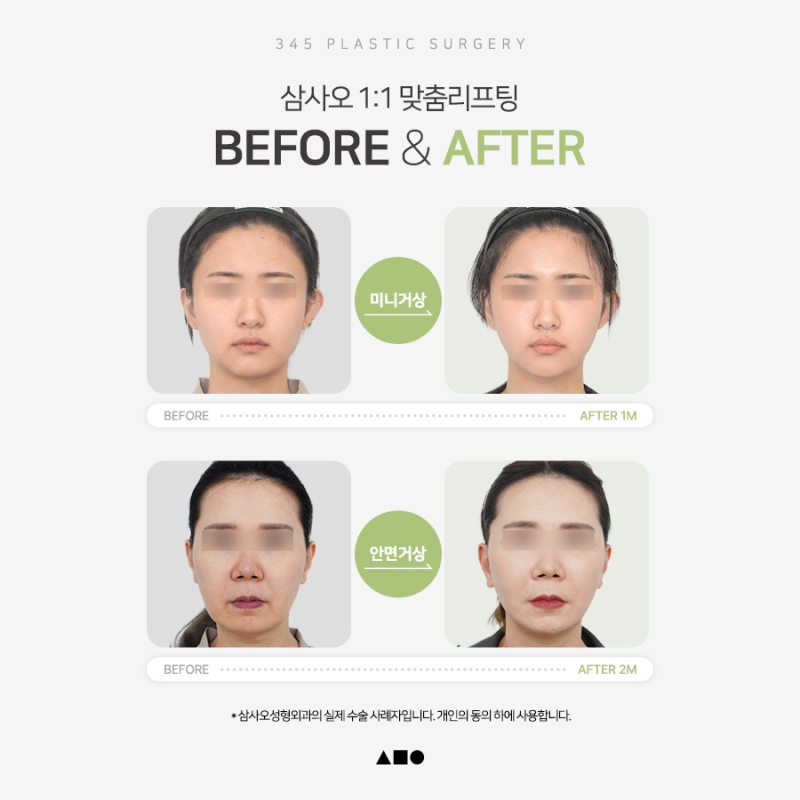
First, looking at real-life cases,
you can see that different lifting techniques
were applied according to the degree of sagging and specific problem areas.
For early-stage sagging, a mini facelift
focuses on targeted areas that require improvement,
while for widespread, advanced sagging across the face,
a full facelift can correct a broader scope.
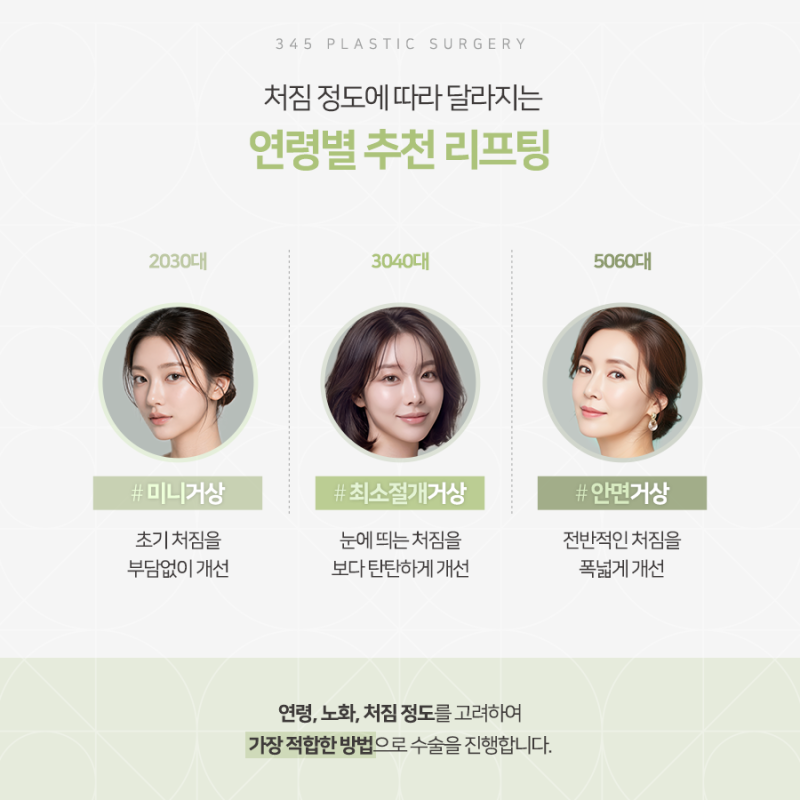
345 Plastic Surgery's age-tailored lifting solutions
take into account age, aging patterns, and the degree of laxity
to perform surgery using the most optimal approach.
✔️ Mini Facelift for 20s–30s
✔️ Minimal Incision Facelift for 30s–40s
✔️ Full Facelift for 50s–60s
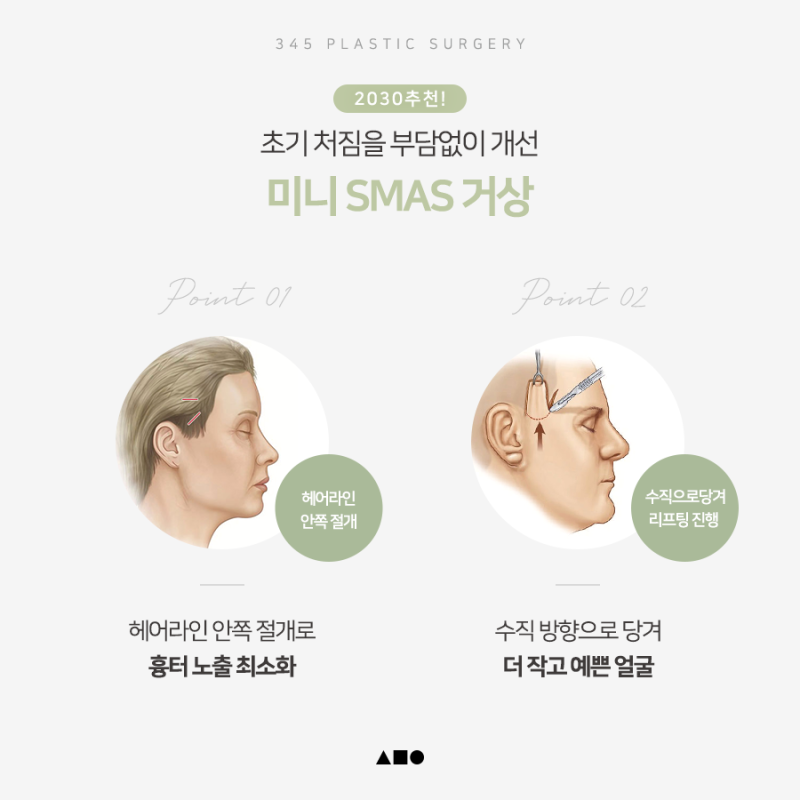
Mini SMAS Facelift for Early Sagging
If your skin laxity is not yet severe,
but your jawline has become less defined
or you notice your cheeks beginning to droop,
a mini facelift can be an excellent option.
Incisions are placed discreetly around the ear and along the inner hairline
to minimize the burden of visible scarring,
and the lax tissues are lifted
in a vertical direction.
Rather than performing extensive dissection across the entire face,
it focuses on targeted problem areas,
making it highly recommended for those wanting to correct early signs of aging.
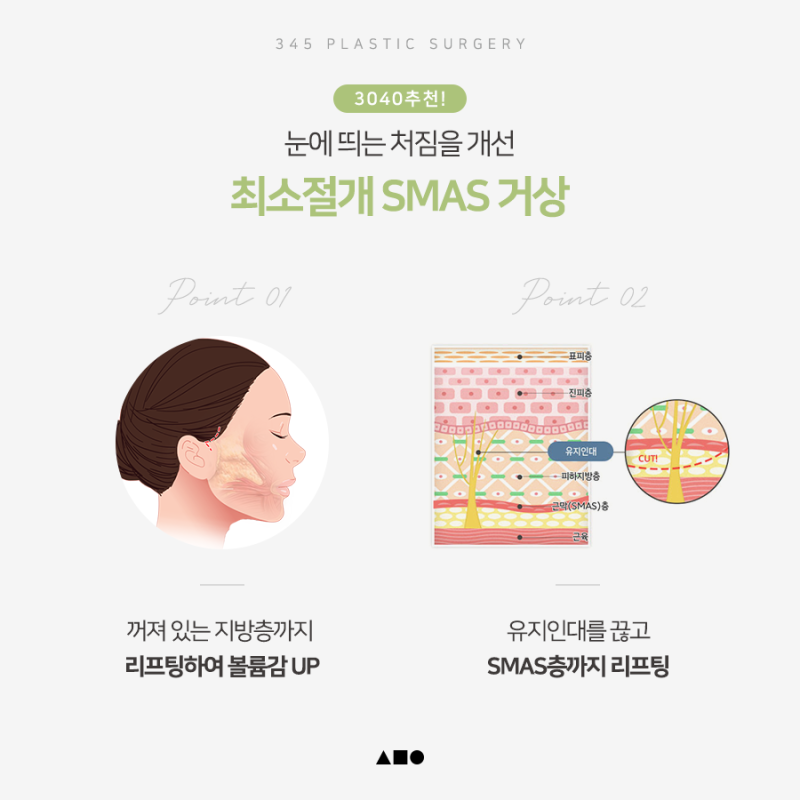
Minimal Incision SMAS Facelift for Noticeable Sagging
This method is recommended when drooping of the cheeks and jawline
becomes more clearly pronounced.
It simultaneously repositions deflated fat layers to restore volume,
releases the retaining ligaments,
and lifts down to the deeper SMAS layer.
Rather than merely pulling the superficial skin,
it addresses the underlying structural causes of laxity,
delivering a firmer, longer-lasting rejuvenation.
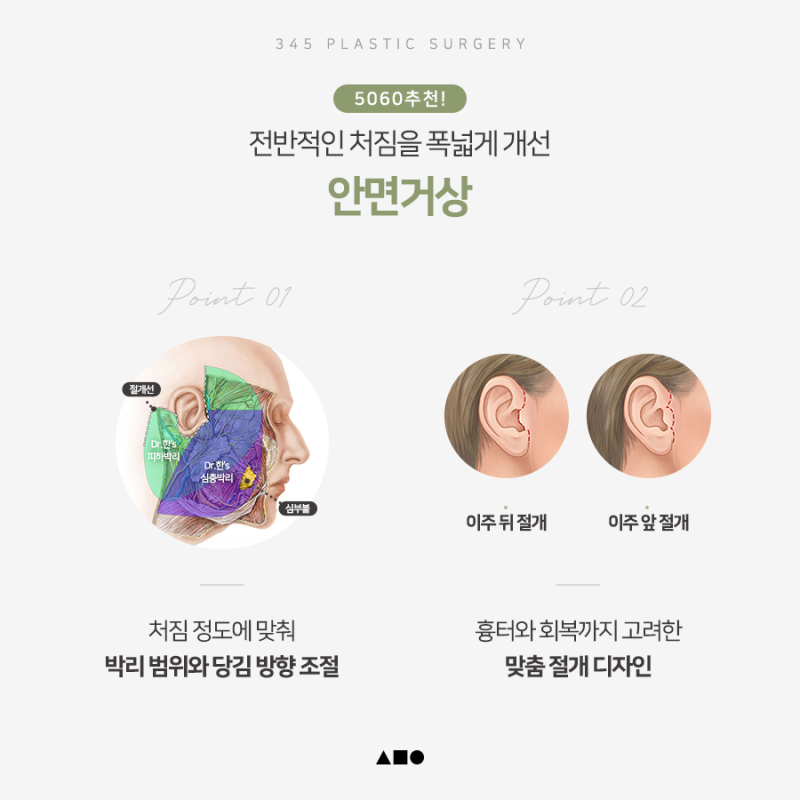
Full Facelift for Comprehensive, Overall Sagging
As aging progresses,
sagging rarely remains confined to a single area;
it often affects the entire face, including the midface, cheeks, and jawline.
A full facelift customizes the dissection range and lifting vectors
according to the degree of laxity,
repositioning the descended tissues.
Incisions are meticulously designed based on the necessary correction area,
balancing scar minimization and recovery times
tailored to the individual.

Because facial lifting involves tissue dissection and structural repositioning,
it is just as essential to verify the pre- and post-operative safety systems
as it is to plan the surgical procedure itself.
At 345 Plastic Surgery, we operate the Doctor Call system,
where the operating surgeon personally calls the patient the day after surgery
to monitor recovery and address any concerns.
Furthermore, three board-certified anesthesiologists are permanently on-site,
and all procedures are recorded via CCTV for patient review upon request.

Facial aging does not progress at the same rate
or in the same pattern for everyone.
For some, correcting targeted areas
with a mini facelift may be sufficient,
while for others, a broader intervention
like a minimal incision or full facelift
may be necessary.
If you are wondering which lifting technique
is best suited for you,
we encourage you to have an in-depth consultation
evaluating your current degree of sagging and aesthetic goals before deciding 💚
Thank you 🙂



Frequently Asked Questions
When is a mini facelift recommended?
It is ideal for early stages of aging when the jawline becomes blurred or the cheeks begin to sag slightly. With discrete incisions around the ear and inner hairline, scar visibility is minimized, and tissues in specific problem areas are lifted vertically without full facial dissection.
How does a minimal incision facelift differ from a mini facelift?
The key difference lies in addressing the retaining ligaments, SMAS layer, and deep fat compartments together. It is suitable when cheek and jawline laxity is more pronounced, lifting deflated fat layers to restore volume while tightening deep structures for firmer, more comprehensive correction.
What are the primary characteristics of a full facelift?
A full facelift repositions sagging tissues over a wide area across the entire face. The dissection range and pulling vectors are customized to treat widespread aging in the cheeks and jawline, featuring tailored incision designs to optimize scar healing and recovery.
How are post-operative recovery and patient safety managed?
We provide a Doctor Call system where the operating surgeon personally calls the patient the day after surgery to check progress. Additionally, three full-time anesthesiologists are on-site, and all operating rooms are monitored by CCTV available for patient review to ensure maximum safety.