2026-06-04
Men's Lifting: Customized Facelift Designed for Thicker Male Skin and Bone Structure
Unlike women, men have thicker skin and more developed soft tissues, requiring a different approach to lifting. We explore the differences between a Mini SMAS Lift and a Volume Lift tailored to individual aging stages to refine the jawline and improve sagging cheeks, along with key considerations for a safe surgery.

Hello. This is 345 Plastic Surgery. As we age, the loss of facial contours is a natural change that happens to everyone, regardless of gender. However, men have different skin characteristics than women, which must be carefully considered when planning a lifting procedure.
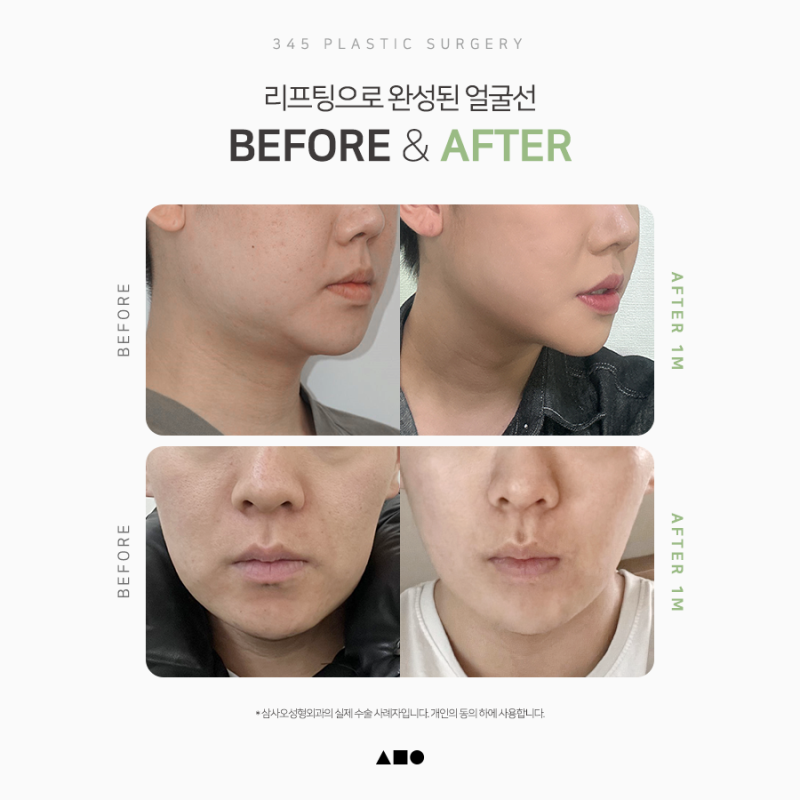
For men, it is not just the skin that sags; they have a relatively thicker skin layer and more developed soft tissues (blood vessels, muscles, etc.), resulting in a different pattern of sagging. Therefore, even for the same lifting procedure, a differentiated approach is necessary for men. Today, we will take a closer look at these characteristics and differences through before-and-after cases of men's lifting.
Key Points of Lifting Based on Male Skin Characteristics
The success of men's lifting does not stop at simply pulling the skin upward; it lies in enhancing the straight, distinct facial lines unique to men. In particular, the harmonious change of the following three elements must be ensured:
- Jawline Refinement: Redefines the collapsed mandibular line to create a sharp, distinct image.
- Improvement of Sagging Cheeks: Clears up buccal fat and sagging skin around the mouth to create a vibrant impression.
- Contour Line Changes: Aims for natural changes by considering the overall three-dimensional volume of the face.
Since men generally prefer a naturally refined look over an overly pulled, artificial appearance, a surgical design based on a meticulous analysis of the facial anatomical structure is essential.
Why is a Custom Lifting Design Needed for Men?
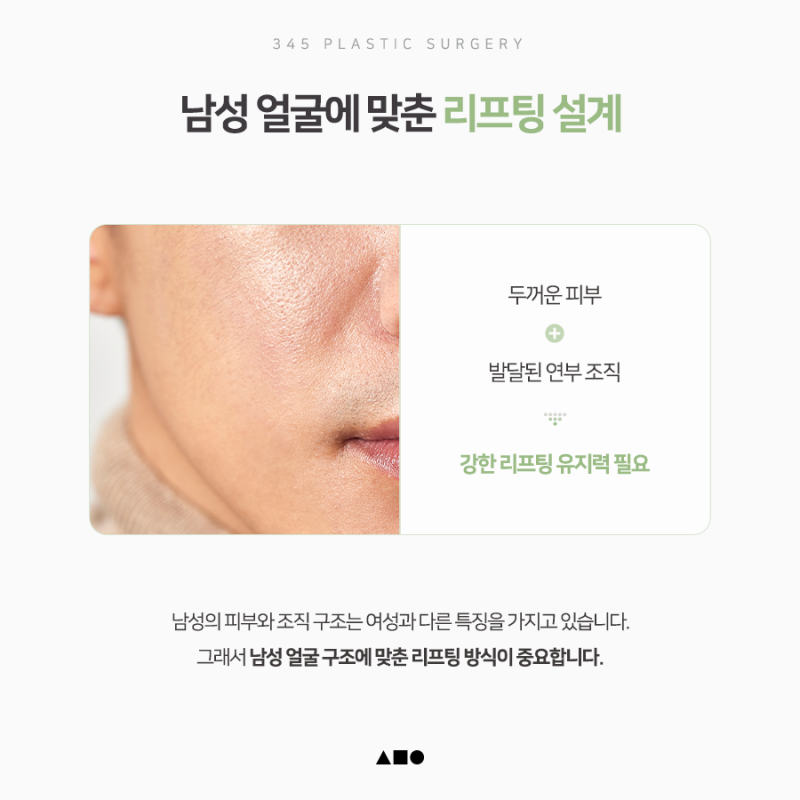
Male skin is thicker than female skin, and the internal soft tissues are more strongly developed. Due to these characteristics, conventional methods may lack sufficient holding power or fail to achieve the expected level of improvement. To resolve this, the following design principles must be applied:
- Securing Strong Holding Power: Strong fixation is required to reliably support the thicker tissues.
- Structural Pulling Direction: The vertical and diagonal pulling directions must be precisely adjusted to match the male skeletal structure.
Recommended Timing and Purpose of Men's Lifting by Age Group
Skin aging usually begins in earnest in one's 30s and accelerates after the 50s. Once aging has progressed significantly, the required intensity of the lifting inevitably increases. Therefore, starting care during the appropriate 'golden time' helps ensure a smoother recovery.
| Age Group | Main Purpose | Characteristics |
|---|---|---|
| 30s | Maintaining elasticity and preventing aging | Preventing early sagging and managing a slim jawline |
| 40s and above | Improving wrinkles and enhancing elasticity | Full-scale improvement of deepened nasolabial folds and collapsed jawlines |

345's Customized Facelift: Mini SMAS vs. Volume Lift
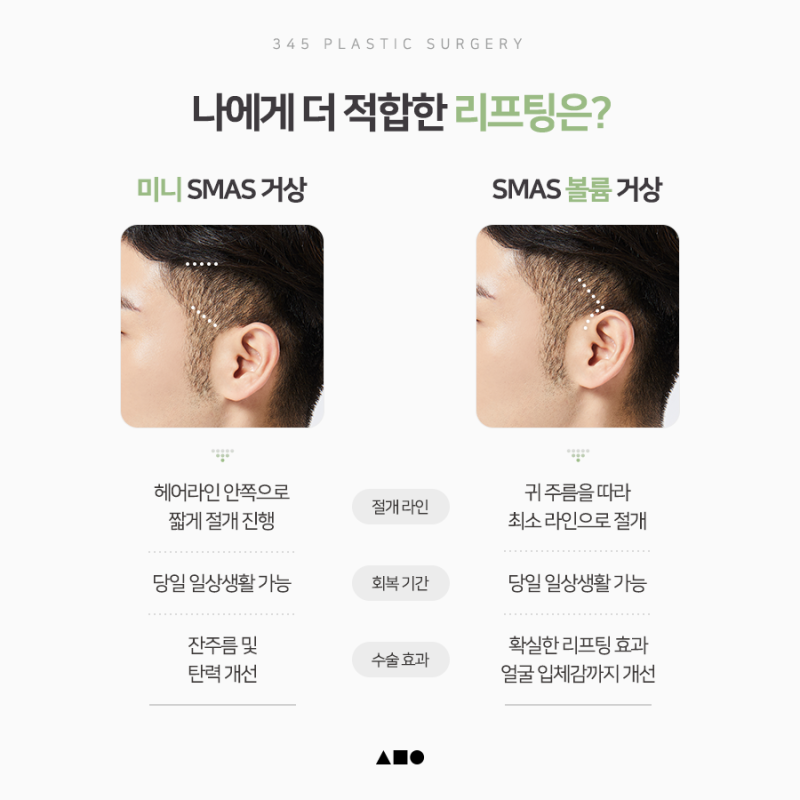
At our clinic, we perform two types of facelifts that directly address the SMAS (Superficial Musculoaponeurotic System) layer, depending on the degree of sagging and the patient's desired scope of improvement.

1. Mini SMAS Lift
This surgical method is performed through minimal incisions inside the hairline. It offers a relatively quick recovery and focuses on improving fine lines and restoring overall elasticity. It is highly preferred by men with active social and professional lives.
2. SMAS Volume Lift
This method involves precise incisions along the ear creases to dissect into deeper layers. It is suitable for severe sagging and helps improve the three-dimensional volume of the face along with the lifting effect.
345's Principles for Safe Surgery
Just as important as the results are the transparency and safety of the surgical process. 345 Plastic Surgery operates a systematic infrastructure so that patients can receive treatment with peace of mind.
- In-house Board-Certified Anesthesiologist: Dedicated to real-time monitoring throughout the entire surgical process.
- CCTV Operation: CCTVs are active in all operating rooms to provide a transparent surgical environment.
- Doctor Call System: We provide a reliable communication channel for post-operative care.

Men's lifting goes beyond a simple cosmetic procedure; it is a sophisticated surgery that must comprehensively consider anatomical structures and the state of aging. We recommend determining the most suitable method for your skin condition through a detailed consultation with a specialist.




Frequently Asked Questions
How does male lifting differ from female lifting?
Yes, there are differences because men have thicker skin and more developed soft tissues than women. Therefore, stronger fixation and precise pulling direction tailored to the skeletal structure are required to achieve the distinct linear and sharp facial lines unique to men.
Is there a recommended age to start male lifting?
Yes, it is recommended to start management from the age of 30, when skin aging begins in earnest. For those in their 30s, the goal is to maintain elasticity and prevent initial sagging, while for those 40 and older, lifting is recommended to actively improve deep nasolabial folds and a collapsed jawline.
What are the characteristics of Mini SMAS rhytidectomy?
Mini SMAS rhytidectomy is a surgery performed through a minimal incision inside the hairline, allowing for relatively fast recovery. It primarily focuses on improving fine wrinkles and restoring overall elasticity, making it suitable for men with active social lives.
What surgical method is suitable for severe sagging?
For severe sagging, SMAS Volume Rhytidectomy, which involves an incision along the ear crease line, is suitable. This method dissects deeper layers of the skin, helping to improve not only the lifting effect but also the three-dimensional volume of the face.
Is there a safety system in place for surgery?
Yes, an anesthesiologist is always present to monitor the entire surgical process in real-time. Additionally, CCTV is operated in all operating rooms to provide a transparent environment, and a doctor call system supports reliable post-operative care.