2026-06-04
Men's Facial Contouring Surgery: A Guide to Natural Custom Designs Based on Individual Bone Structure
Men's facial contouring surgery requires different designs depending on the degree of bone development and the desired image (masculinity vs. softness). We introduce the principles of the 3-type facial contouring that harmoniously refines the square jaw, cheekbones, and chin, along with the customized approach containing the 27 years of know-how of 345 Plastic Surgery.

Men's Facial Contouring Surgery: How Does It Differ from Women's?
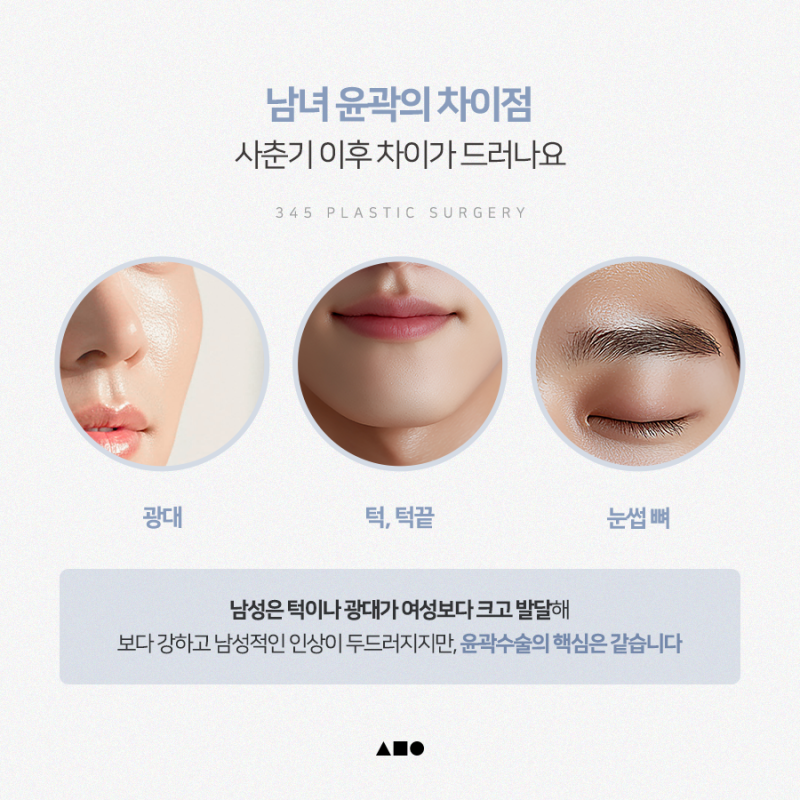
Recently, an increasing number of men are considering facial contouring surgery to soften a strong impression while maintaining their unique individuality. Since men tend to have more pronounced bone development in areas such as the cheekbones, jaw, chin, and brow bone after puberty, it is crucial to accurately understand these anatomical differences.
The core of facial contouring surgery is not simply shaving down a lot of bone, but finding harmony in the overall facial lines. While the basic surgical principles do not differ significantly between men and women, men require a meticulous design that reflects personal preferences—such as leaving an appropriate angle of the jaw to maintain masculine appeal, or smoothing out the overall contours to create a softer image.
The 3-Type Facial Contouring: Harmony of the Square Jaw, Cheekbones, and Chin
The procedure commonly referred to as "3-type contouring" improves the three main areas that determine the contours of the lower and middle face.
- Square Jaw Surgery: Refines the angular and widely developed mandibular angle to softly alleviate an overly strong impression.
- Cheekbone Reduction: Repositions and reduces protruding side cheekbones and 45-degree cheekbones, decreasing the facial width and creating a smoother line.
- Genioplasty (Chin Surgery): Adjusts the length or shifts the position of the chin to match the overall facial proportions, completing a three-dimensional effect from both the front and side profiles.
1:1 Customized Design Strategies Based on Style
The design direction for men's facial contouring is broadly divided into two categories depending on the patient's preferred image.
1. Design Emphasizing Masculine Appeal
Without excessively removing the bone structure of the cheekbones or jaw, the angles are appropriately preserved while only the bumpy lines are smoothed out. This allows the facial features to appear more defined, resulting in a refined and sophisticated impression.
2. Design for a Soft and Slender Line
The cheekbones and square jaw are more actively reduced to create a smooth face shape with distinct curves. This helps transform a previously sharp or strong image into a gentle and clean appearance.
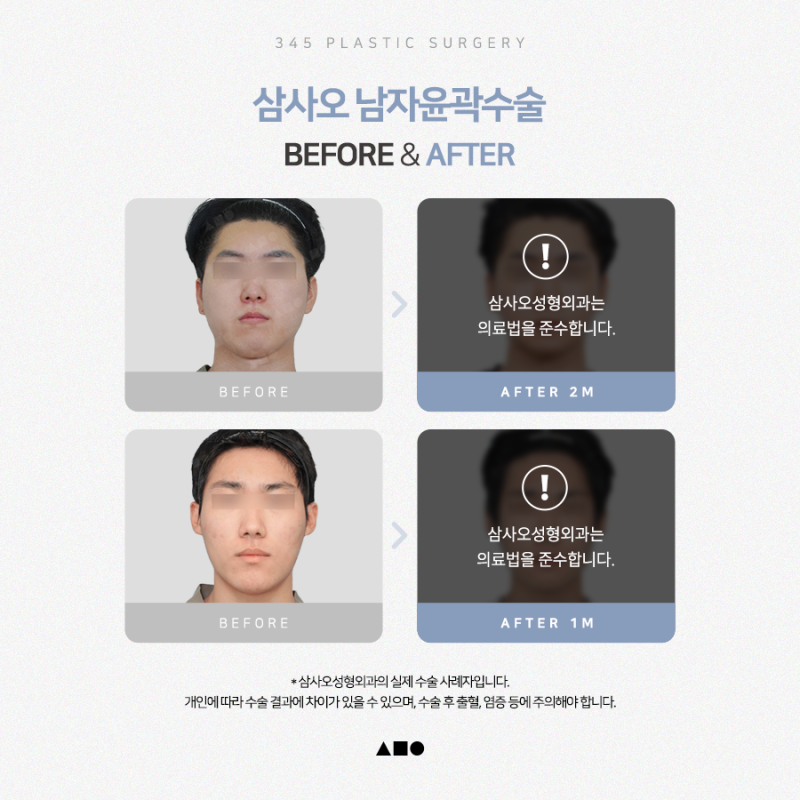
Safe Surgical Environment and Specialist Expertise
As facial contouring is a highly difficult surgery that deals with bones, it must be backed by the medical team's extensive experience and a robust safety system. At 345 Plastic Surgery, Chief Surgeon Dr. Park Jong-rim, who has been performing facial contouring surgeries for 27 years, personally handles everything from diagnosis to surgery, precisely analyzing each patient's bone density and the location of nerve lines.
In addition, a board-certified anesthesiologist is always on-site to monitor the patient's condition in real-time throughout the entire surgical process, maintaining a safe environment. Even after the surgery, we help ensure a stable recovery by managing swelling and pain through a systematic post-operative care program.
Frequently Asked Questions
How does male facial contouring surgery differ from female facial contouring surgery?
Yes, the design direction differs, considering the anatomical skeletal differences between men and women. For men, facial bones like the cheekbones and jawline develop more prominently after puberty, so personalized designs are applied, such as appropriately preserving the jaw angle to maintain masculinity or smoothing out curves.
What areas are included in the 3-point facial contouring surgery?
3-point facial contouring surgery includes square jaw, cheekbone, and chin surgeries. It consists of square jaw surgery to refine a wide and angular lower jaw, cheekbone surgery to reduce prominent cheekbones, and chin surgery to adjust the length or position according to facial proportions.
Is it possible to undergo facial contouring surgery while maintaining masculine charm?
Yes, it is possible. By not excessively removing the cheekbone or jawline structure and appropriately preserving the natural angles while only refining uneven lines, a customized design can maintain distinct features and a sophisticated impression.
I want to change to a softer impression; can facial contouring surgery improve this?
Yes, you can create a softer impression by actively improving the cheekbones and square jaw. By refining the face into a smooth shape with natural bone curves, it transforms a previously sharp or strong image into a gentle and neat atmosphere.
What should I check for safety during facial contouring surgery?
You must confirm the medical team's extensive surgical experience and the presence of an anesthesiologist. Facial contouring is a high-difficulty surgery involving bones, so a safety system that allows precise analysis of bone density and nerve line location, along with real-time monitoring, is essential.