2026-06-04
Finding the Ideal Facial Proportions with 3-Type Facial Contouring and a Core Guide to Surgical Methods by Area
3-type facial contouring (malar reduction, square jaw reduction, and genioplasty) is a surgery that creates a smooth facial line by analyzing individual bone structure and proportions. With 26 years of experience, 345 Plastic Surgery aims for natural changes while reducing concerns about cheek sagging or secondary angles through triple tight fixation and long-curve osteotomy.

Completing Your Own Ideal Facial Line with 3-Type Facial Contouring
Facial shape is a factor that greatly influences a person's overall impression. A small, slender face not only gives a sophisticated image but also improves overall proportions, providing a youthful effect. Recently, rather than simply shaving off a lot of bone to maximize the before-and-after difference, the trend is to prefer a natural yet three-dimensional line that considers the individual's bone structure, skin thickness, and the location of nerve lines.
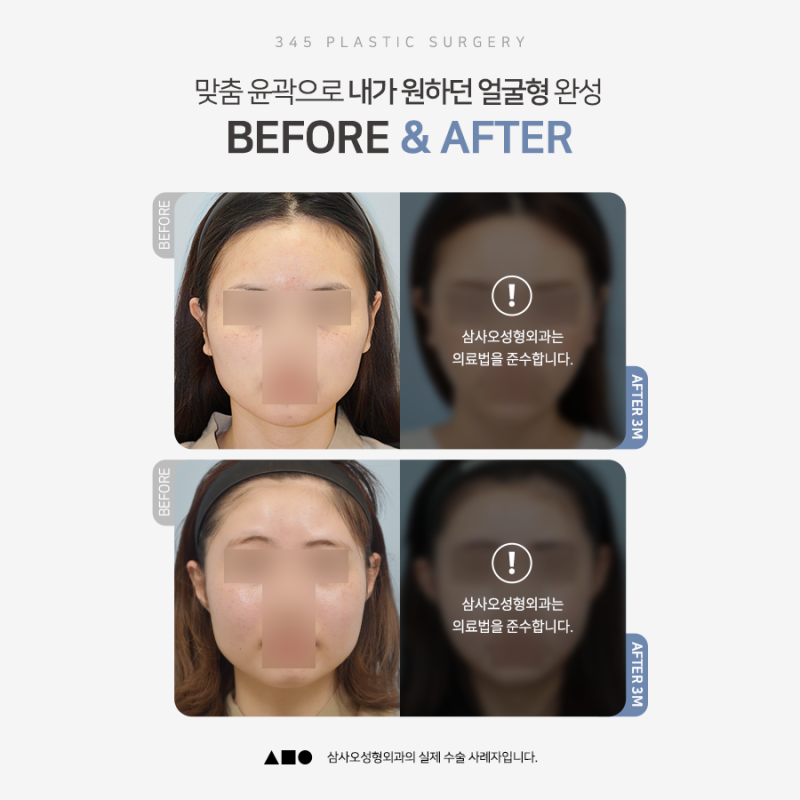
3-type facial contouring includes malar reduction, square jaw reduction, and genioplasty. At 345 Plastic Surgery, we perform customized surgeries considering the balance of each patient's facial features. Looking at actual cases, you can see that those who worried about large cheekbones and an angular jaw have gained a much softer impression after surgery.
1. Tight Fixation Malar Reduction: Enhancing Dimensionality and Preventing Cheek Sagging
Malar reduction (Malarplasty) is a method of fracturing the protruding cheekbone, pushing it inward, and then fixing it in place. Rather than simply making it flat, maintaining an appropriate sense of volume is essential to complete a three-dimensional face from any angle.
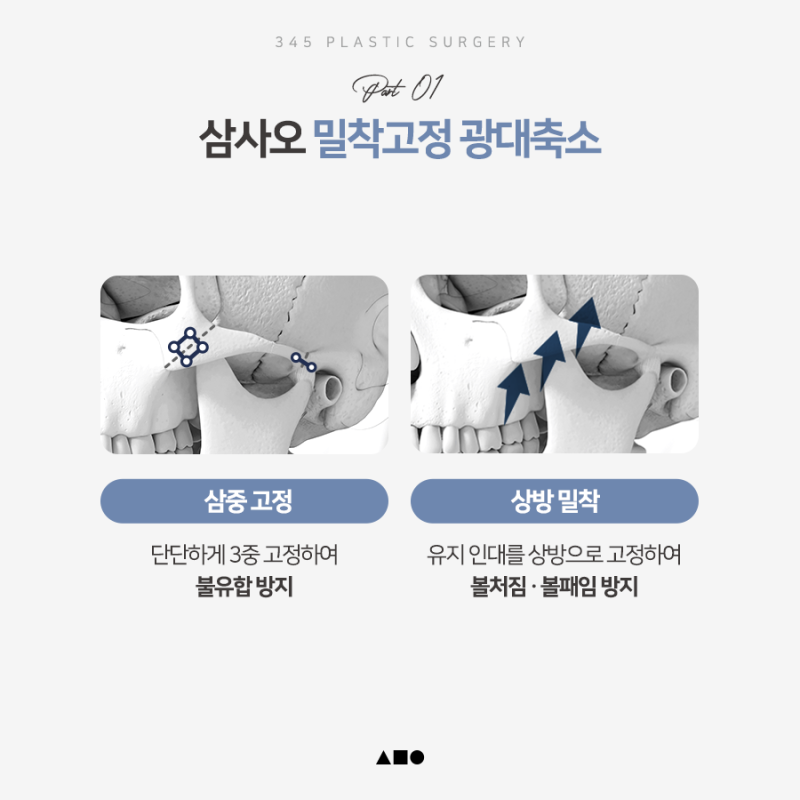
The 345 method precisely checks the contact surface between the bones and then firmly secures them with triple tight fixation. This helps lower the possibility of non-union (a phenomenon where bones fail to heal together) and focuses on alleviating cheek sagging or cheek hollowing—common concerns after cheekbone surgery—by fixing the retaining ligaments upward together.
2. Long-Curve Square Jaw Reduction: A Smooth Jawline Without Secondary Angles
The core of square jaw surgery (Mandibuloplasty) is to perform an osteotomy in a smooth curved shape from below the ear to the front jawline. Unlike the short osteotomy methods of the past, resecting with a long curve can proactively prevent the step phenomenon (secondary angle) where the jawline appears abruptly cut off after surgery.
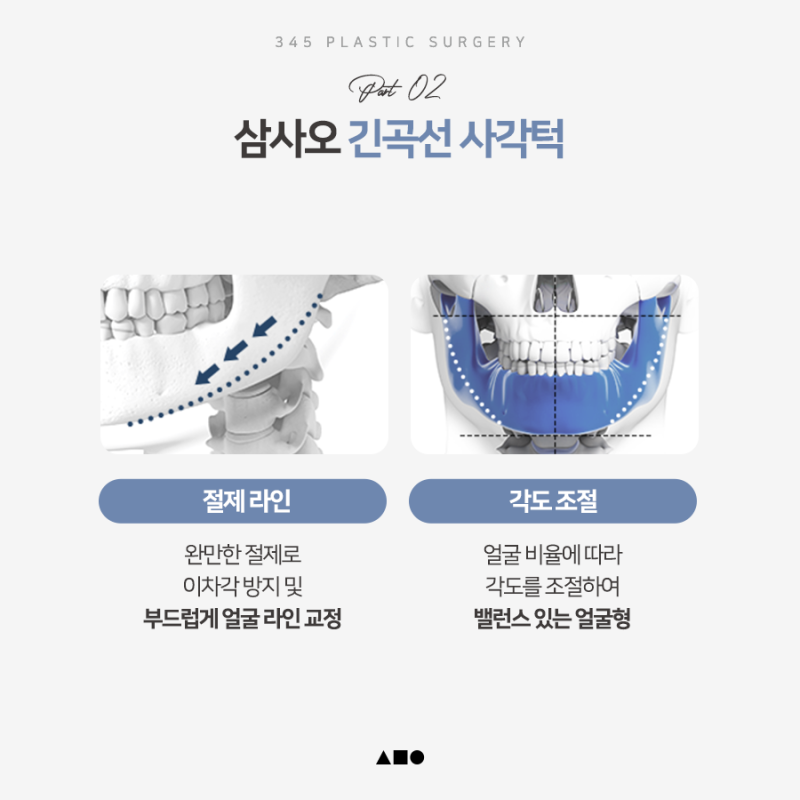
In addition, because the resection angle is adjusted according to the patient's facial proportions, you can expect the correction of left-right asymmetry and a more balanced lower facial line.
3. Genioplasty: T-Osteotomy and V-Osteotomy to Elevate Facial Perfection
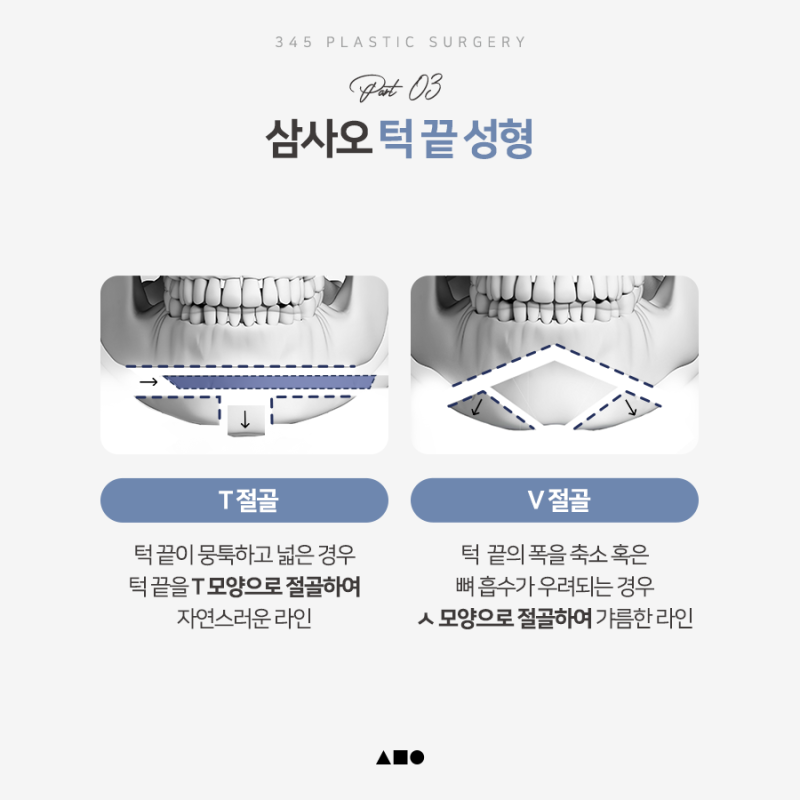
The position and length of the chin tip serve as the finishing touch to the overall facial shape. Genioplasty completes a slender V-line by re-correcting the position through osteotomy.
- T-Osteotomy: When the horizontal width of the chin is wide or blunt, the central bone is resected and gathered to create a slim line.
- V-Osteotomy: When the chin tip is long or bone resorption is a concern, an inverted-V shape osteotomy is performed to adjust the length.
A Systematic Recovery System that Prioritizes Safety
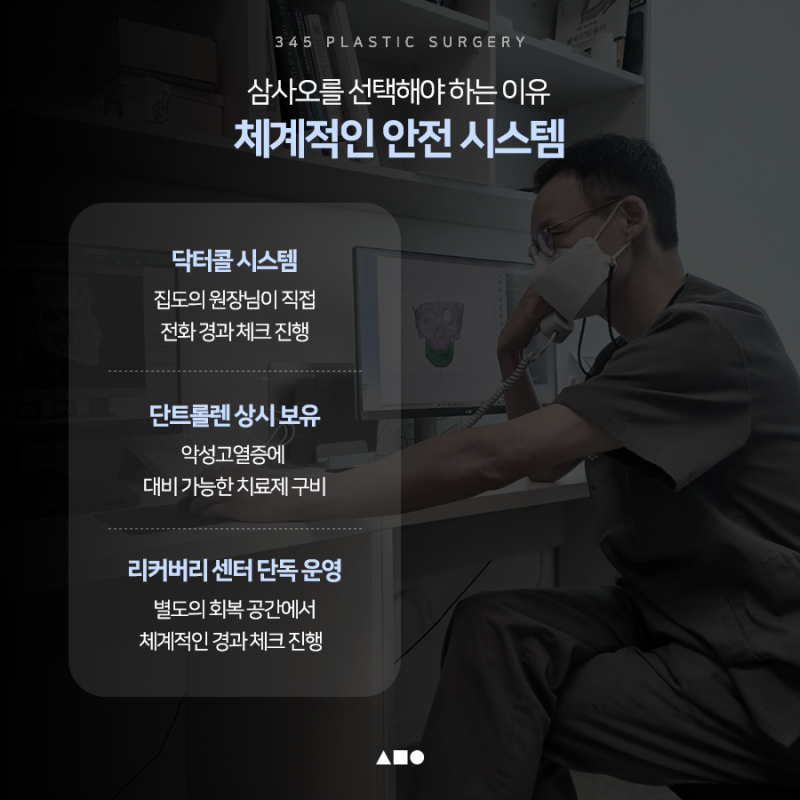
Since facial contouring is a highly difficult surgery dealing with bones, a safety system is essential. 345 Plastic Surgery operates a 'Doctor Call System' where the operating surgeon directly checks the progress within 24 hours after surgery. We also provide an environment where patients can focus solely on recovery with peace of mind through our dedicated recovery center and by always stocking Dantrolene in preparation for malignant hyperthermia.
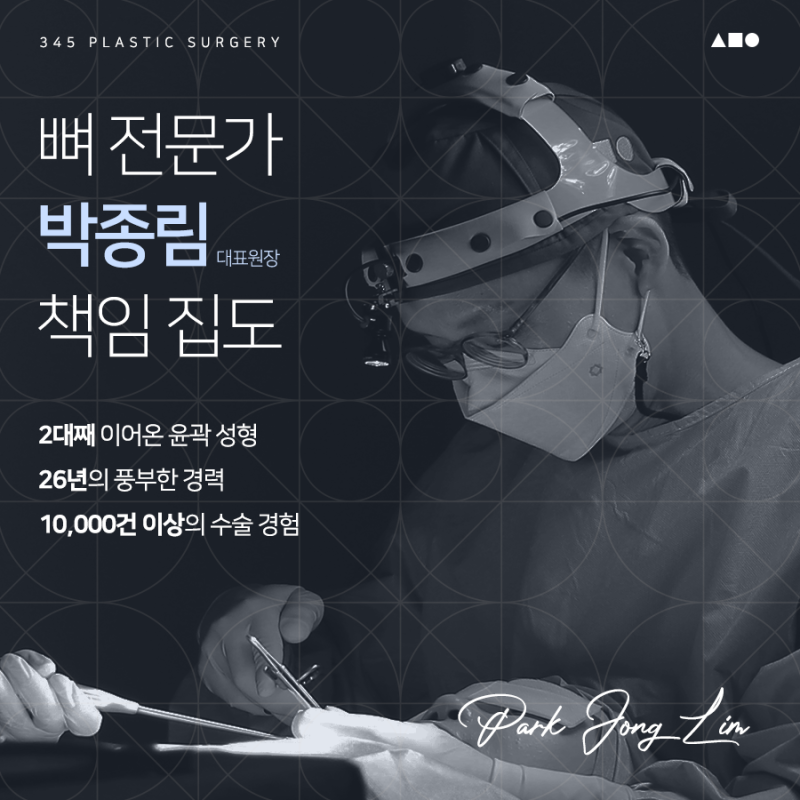
Dr. Park Jong-lim, with 26 years of experience, conducts everything from 1:1 consultations to responsible surgical execution. Based on his rich clinical experience of over 10,000 cases, he considers both functional and aesthetic satisfaction simultaneously.



Frequently Asked Questions
What areas are included in the 3-in-1 facial contouring surgery?
Yes, it includes three areas: cheekbone reduction, square jaw surgery, and chin genioplasty. The goal is not simply to shave off a lot of bone, but to create a natural and three-dimensional facial line by comprehensively considering each individual's bone structure, skin thickness, and nerve line position.
Can sagging cheeks be prevented after cheekbone reduction surgery?
Yes, it can be prevented. We use a method that precisely confirms the contact surfaces of the bones and then firmly fixes them in a triple-layered manner. We also focus on alleviating sagging cheeks or hollows, which are common concerns after surgery, by fixing the retaining ligaments upwards.
How can secondary angles be prevented during square jaw surgery?
It is prevented by performing a long-curve square jaw surgery that osteotomizes in a smooth curved line from behind the ear to the front chin line. Unlike the short osteotomy method of the past, because it is resected with a long curve, it prevents secondary angles, which are step-like appearances where the jawline abruptly breaks off after surgery, and creates a smooth line.
What surgical method is suitable if the chin is wide and blunt?
T-osteotomy is suitable. If the chin is wide or blunt, the central bone can be resected and the bones on both sides can be brought together to complete a slim V-line. On the other hand, if the chin is long or bone resorption is a concern, a ㅅ-shaped V-osteotomy is applied to adjust the length.
How is the post-operative safety management system operated?
We operate a doctor call system where the surgeon directly checks the progress within 24 hours after surgery. In addition, we always have dantrolene, an emergency treatment for malignant hyperthermia, and provide an environment where patients can recover with peace of mind through a dedicated recovery center.