2026-06-04
Facial Contouring Surgery: 3 Core Plastic Surgery Points for Harmonious Proportions
Facial contouring surgery for a small, slender face shape is not simply about shaving down a lot of bone; individual proportions and harmony are crucial. We summarize the characteristics of cheekbone reduction, long-curve square jaw reduction, and genioplasty, along with the importance of establishing a safe surgical plan using 3D-CT.

Why Personalized Facial Contouring Surgery is Necessary
Although beauty standards change over time, the preference for a small, slender face shape remains consistent. While there are non-surgical methods like beauty devices or meridian massages, facial contouring surgery is considered when a fundamental change in the skeletal structure itself is desired.
Facial contouring is a highly difficult surgery that refines the facial lines by resecting facial bones. Simply removing a large amount of bone does not guarantee satisfactory results. Since resected bone is difficult to restore, finding the optimal design that harmonizes with your facial features is of utmost importance.
3-Type Facial Contouring Solution Based on Face Shape Concerns
Facial contouring surgery is broadly divided into three areas, which can be performed individually or in combination depending on the patient's condition.
- Tight-Fixation Cheekbone Reduction: Suitable when the side cheekbones are developed, making the facial line appear bumpy or uneven.
- Long-Curve Square Jaw Reduction: Creates a smooth line when an angular jaw makes the impression look strong or the face appear large.
- Genioplasty (Chin Surgery): Completes the overall V-line by improving a receding, long, or wide chin.
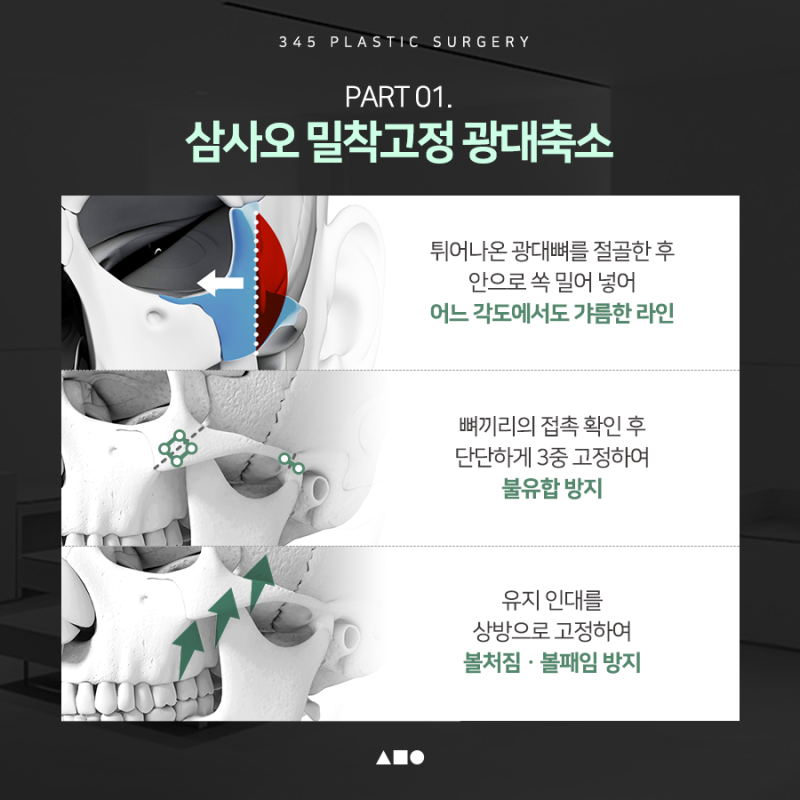
1. Cheekbone Reduction: Improving Frontal and Lateral Dimensionality
Tight-fixation cheekbone reduction is a method where the protruding cheekbone is fractured, moved inward, and fixed in place. Rather than simply reducing the size, a triple tight-fixation is performed to prevent nonunion (a condition where the bones fail to heal properly) that can occur after surgery.
Additionally, to prevent the cheek sagging (or cheek hollowing) phenomenon that many people worry about, the retaining ligaments are pulled upward and fixed, allowing you to expect a firm and elastic facial line.
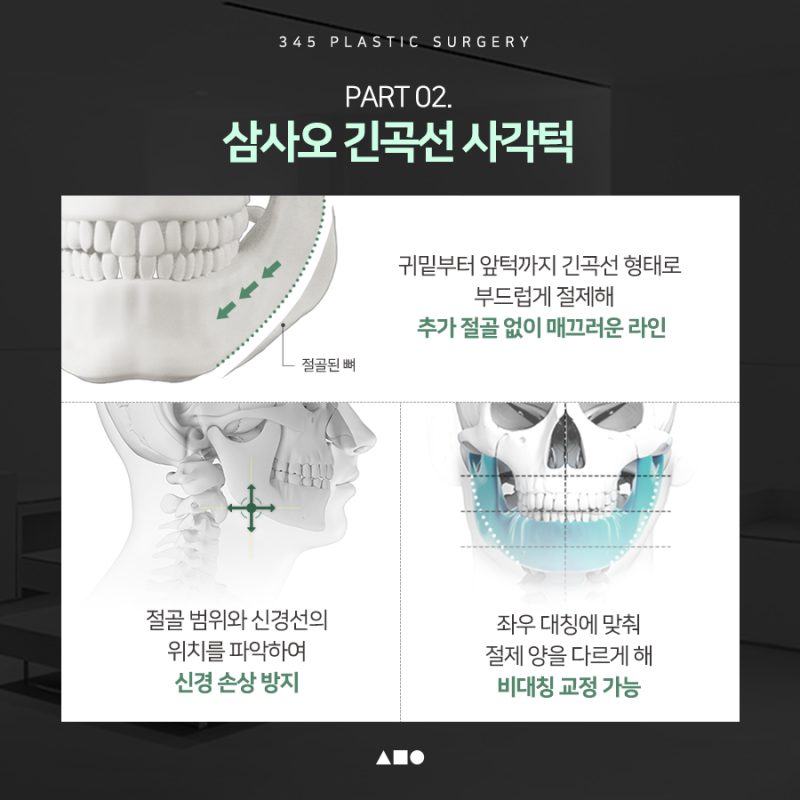
2. Long-Curve Square Jaw Reduction: The Core of a Smooth Jawline
For square jaw surgery, a 'long-curve resection' that cuts in a gentle, long curve from below the ear to the front chin is preferred. This prevents the stair-step phenomenon (secondary angle) that could occur in traditional surgical methods and is advantageous for creating a smooth jawline from any angle.
In particular, by accurately identifying the location of the inferior alveolar nerve (jaw nerve line) through 3D-CT imaging, the risk of nerve damage is lowered, and even left-right asymmetry can be meticulously corrected.
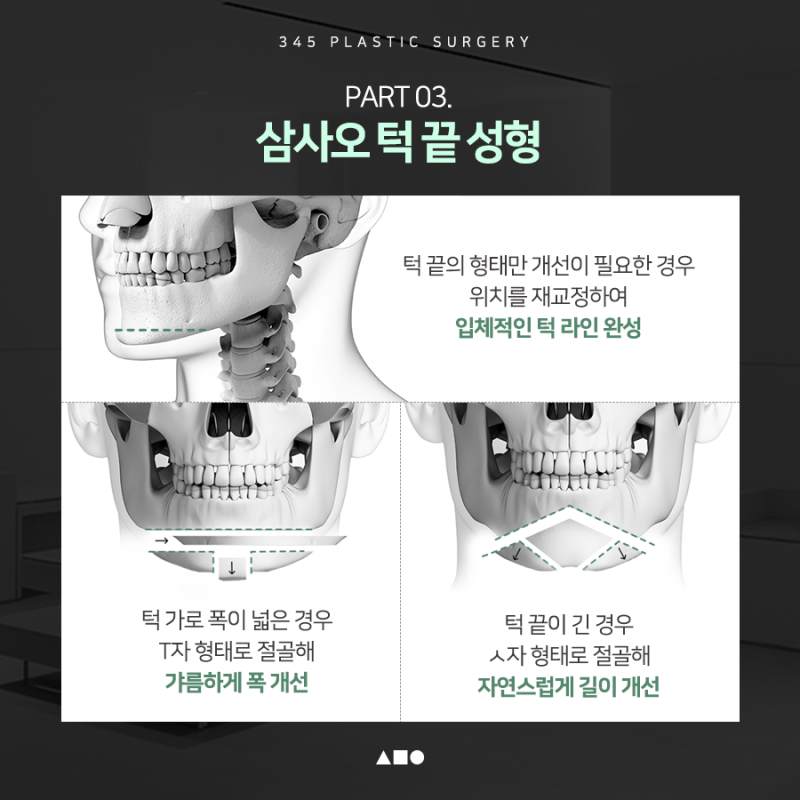
3. Genioplasty (Chin Surgery): The Completion of Facial Proportions
The tip of the chin greatly influences the overall impression with even the slightest change. Various osteotomy techniques are applied depending on the width and length of the chin, and whether advancement or setback is necessary.
- T-Osteotomy: If the tip of the chin is wide, the width is narrowed for a slimmer improvement.
- Inverted V-Osteotomy (ㅅ-Osteotomy): If the chin is too long, the length is reduced.
- Advancement/Setback: In cases of a receding chin or a protruding chin, the position of the chin tip is repositioned.
Safety Systems You Must Check Before Surgery
Since facial contouring surgery requires general anesthesia, checking the medical institution's safety facilities is essential. You must verify whether 24-hour CCTVs are operating, if Dantrolene is stocked for emergencies, and if a university hospital-level monitoring system is in place.
Above all, objectively understanding your skeletal structure and soft tissue condition through sufficient consultation with an experienced specialist, and choosing the solution that is absolutely necessary for you rather than an unreasonable surgery, is the shortcut to a good recovery and satisfactory results.

Frequently Asked Questions
Can cheek sagging be prevented after cheekbone reduction surgery?
Yes, it can be prevented. By applying a method that pulls up and fixes the retaining ligaments during surgery, you can prevent cheek sagging or hollowing and expect a more elastic face line.
Does square jaw surgery avoid secondary angles (step deformity)?
Yes, it can be prevented with long curve osteotomy. By resecting the bone in a gentle, long curve from behind the ear to the chin, you can prevent the step deformity that can occur with traditional surgical methods and create a smooth jawline.
Can a recessed chin or prognathism be improved with genioplasty?
Yes, it is possible. For a recessed chin or prognathism, advancement or setback genioplasty can be applied to reposition the chin forward or backward, improving overall facial proportions and creating a V-line.
What safety measures should be checked before facial contouring surgery?
Since general anesthesia is required, you must check the medical institution's emergency safety equipment. It is important to check whether 24-hour CCTV is in operation, whether dantrolene for malignant hyperthermia is available, and whether a university hospital-level monitoring system is in place.
What is the method to reduce the risk of nerve damage during square jaw surgery?
The risk can be reduced by precisely identifying the position of the inferior alveolar nerve (mandibular nerve line) through 3D-CT imaging. Accurately confirming the nerve line's position before surgery helps prevent nerve damage and meticulously correct left-right asymmetry.