2026-06-04
Escaping a Square Face! Real Case of a Female in Her 20s with 2-Type Facial Contouring (Square Jaw Reduction + Genioplasty)
This is a 2-type facial contouring surgery case of a female in her 20s who was concerned about her angular square jaw and protruding chin. Through precise CT analysis, we explain in detail the process of achieving a smooth jawline using only square jaw reduction and posterior chin movement, without the need for orthognathic surgery.
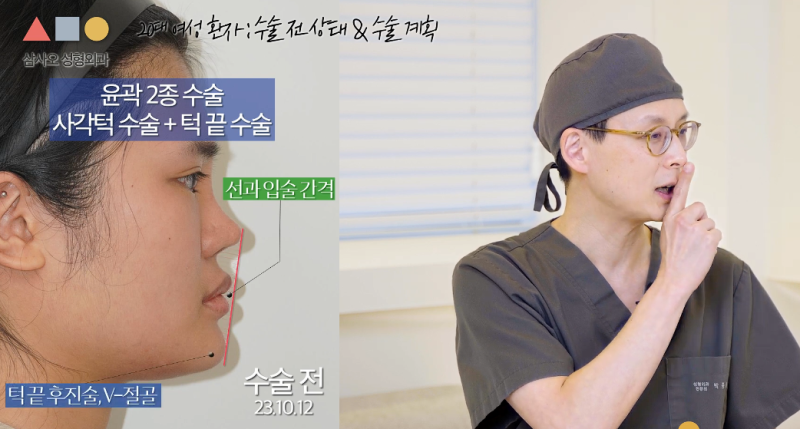
Square Face and Protruding Chin: The Importance of the 'Lower Face' in Determining Your Impression
The jawline is a core element that determines the overall impression of the face. If the lower face is wide or the chin protrudes, the face can easily look larger than it actually is, or give off a somewhat strong and masculine impression. The female patient in her 20s in this case had also been suffering from an appearance complex for a long time due to her angular square jaw and a chin shape that looked like a lantern jaw.

Pre-operative Precise Diagnosis: Why '2-Type Contouring' Instead of Orthognathic Surgery?
The patient showed a tendency toward a lantern jaw due to her forward-protruding chin, but fortunately, precise examination results showed that her dental occlusion was normal and the relationship between her upper and lower jaws was stable. Unless it is a case of malocclusion requiring skeletal repositioning like this, sufficient improvement for a softer impression can be expected just by refining the bone shape through Facial Contouring Surgery.

At 345 Plastic Surgery, we precisely analyzed the patient's bone thickness and the location of the nerve lines through CT and X-ray imaging to derive the following two core improvement points.
- Reduction of the widely flared mandibular angle (square jaw) line
- Posterior movement and width refinement of the protruding chin
Customized 2-Type Facial Contouring Surgery Plan (Square Jaw + Genioplasty)
We planned a 2-type contouring surgery considering both the patient's frontal and lateral lines. Rather than simply shaving the bone, we combined three techniques for a three-dimensional change.

- Mandibular Angle Resection: The lower surface of the angular square jaw is resected to create a smooth side profile.
- Cortical Bone Resection: The thickness of the outer layer of the bone (cortical bone) is reduced, giving the effect of a narrower jaw width when viewed from the front.
- Masseter Muscle Reduction: The volume of the developed jaw muscle (masseter) is adjusted to add slimness.
- Genioplasty: The protruding chin is moved backward and the chin width is gathered to match the golden ratio of the side profile connecting the nose tip, lips, and chin.
3 Months Post-Op: Swelling Recovery and Jawline Changes
Three months after facial contouring surgery is the period when most of the major swelling subsides and the overall contour is revealed. Although there are individual differences, minor swelling will gradually be absorbed over the next 6 months to a year, becoming even more natural.
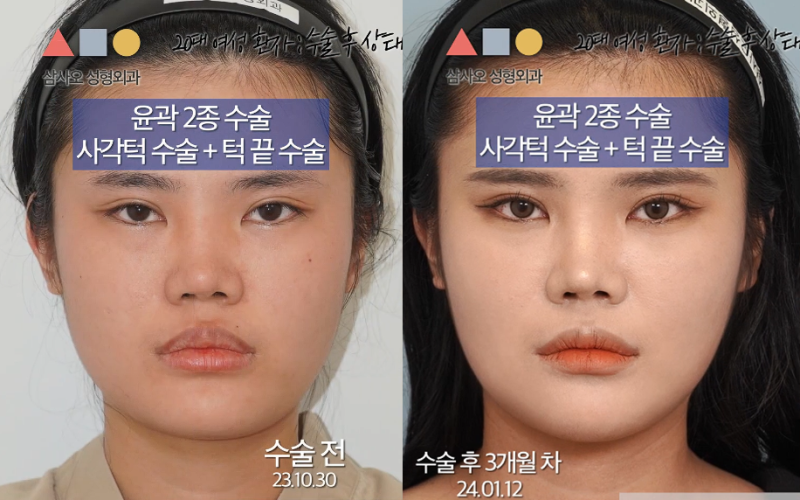
Looking at the frontal case, you can see that the width of the jaw has noticeably decreased compared to before the surgery. In the 45-degree and lateral profiles as well, the chin has appropriately moved backward, bringing it closer to the lips, resulting in a much softer and more feminine atmosphere.
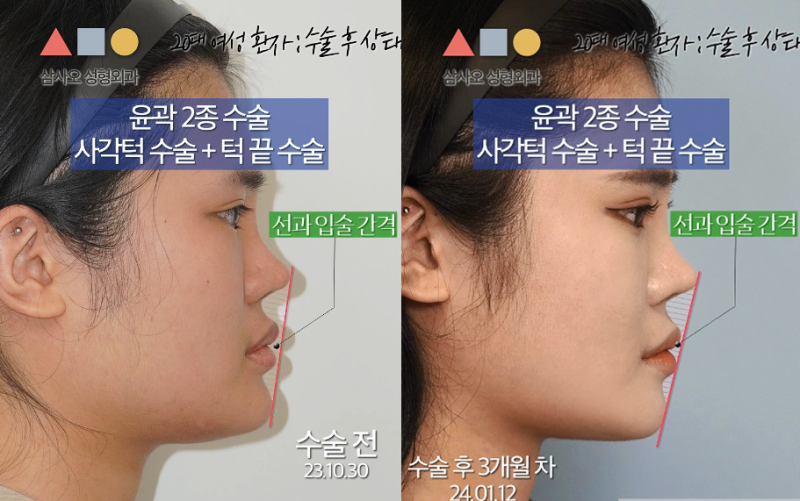
Why Facial Contouring Surgery Makes the Face Look Smaller in Person Than in Photos
Facial contouring surgery tends to have a more noticeable change in three-dimensional real life than in two-dimensional photos. This is because not only the horizontal width of the face but also the three-dimensional volume itself is reduced. The patient has found joy in looking in the mirror after surgery, and as her confidence was restored, her everyday facial expressions have become much brighter.

As facial contouring is a highly difficult surgery that deals with bones, consultation and precise diagnosis with experienced medical staff are essential. Establishing an optimal plan tailored to your own skeletal structure is the key to safe and satisfactory results.

Frequently Asked Questions
I have a prognathic jaw tendency, do I necessarily need bimaxillary surgery?
No, if your dental occlusion is normal, improvement is possible with only facial contouring surgery without bimaxillary surgery. If precise examination shows that the relationship between your upper and lower jaws is stable and there is no malocclusion, then simply refining the bone shape with square jaw and chin surgery can create a sufficiently soft impression.
What are the methods to enhance the frontal effect during square jaw surgery?
It is effective to perform cortical bone reduction and masseter muscle reduction along with mandibular angle resection. When cortical bone reduction, which reduces the thickness of the outer layer of the bone, and masseter muscle reduction, which reduces the volume of developed jaw muscles, are performed together, the jaw width appears much narrower and slimmer when viewed from the front.
When does the major swelling subside after facial contouring surgery?
Typically, most of the major swelling subsides about 3 months after surgery. From this period, the overall facial contour becomes clearer, and although there are individual differences, the remaining minor swelling gradually absorbs over the next 6 months to 1 year, completing a more natural jawline.
How is a protruding chin corrected with surgery?
A protruding chin is corrected through chin surgery that moves it backward and narrows its width. This allows for the golden ratio of the side profile connecting the nose tip, lips, and chin to be achieved, and the distance from the lips is appropriately adjusted, completing a softer and more feminine side profile.
Why does my face appear more slender in person than in photos after facial contouring surgery?
This is because not only the horizontal width of the face but also the three-dimensional volume itself is reduced. Facial contouring surgery refines the bone to change the 3D立体感, so the face tends to look smaller and the change feels greater when seen in person compared to a 2D photo.