2026-06-04
Essential Pre-Surgery Checklist for a Facelift in Your 40s: Q&A from Timing to Side Effects
Everything you need to know about facelift surgery to improve skin sagging and loss of elasticity that accelerates in your 40s. Based on frequently asked questions at 345 Plastic Surgery, we provide professional information on the optimal timing for surgery, the recovery process, side effect prevention, and the effects of combining it with fat grafting.
A Facelift in Your 40s: Is Now the Right Time?
As skin elasticity rapidly declines and facial sagging becomes more noticeable after the age of 40, interest in facelift surgery naturally increases. Many people think of it as a surgery reserved for those in their 50s and 60s, but there is actually no set age for the procedure. The most appropriate time is when the degree of sagging you perceive matches your actual skin condition.
Recently, there has been a growing trend of individuals in their late 40s considering the surgery due to early sagging caused by a decrease in facial volume after two-jaw (orthognathic) surgery or facial contouring surgery. However, if the sagging is not severe, it is advisable to first consider step-by-step alternatives such as a mini facelift or minimal incision lifting.
Complementary Procedures to Maximize Facelift Results: Fat Grafting and Liposuction
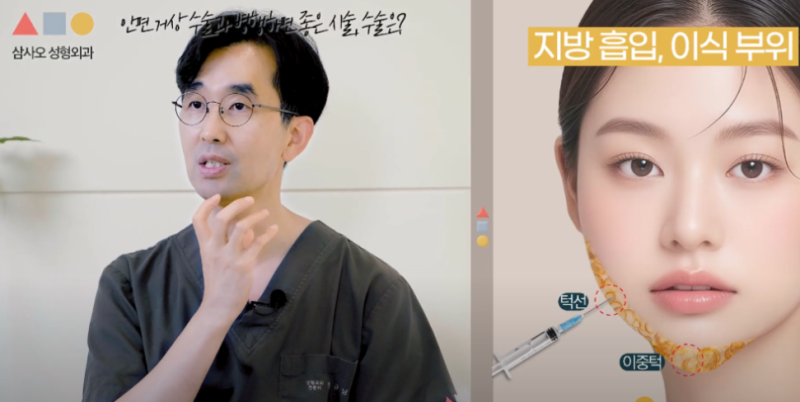
Aging is not just about skin sagging; it is also accompanied by a loss of volume in specific areas. In such cases, combining a facelift with fat grafting can yield much more three-dimensional and voluminous results.
- Liposuction: Removes excess fat accumulated along the jawline or under the chin, reducing the heaviness of the lower face.
- Fat Grafting: Utilizes the harvested fat to fill in sunken areas such as the cheeks or nasolabial folds, completing a natural and well-balanced facial contour.
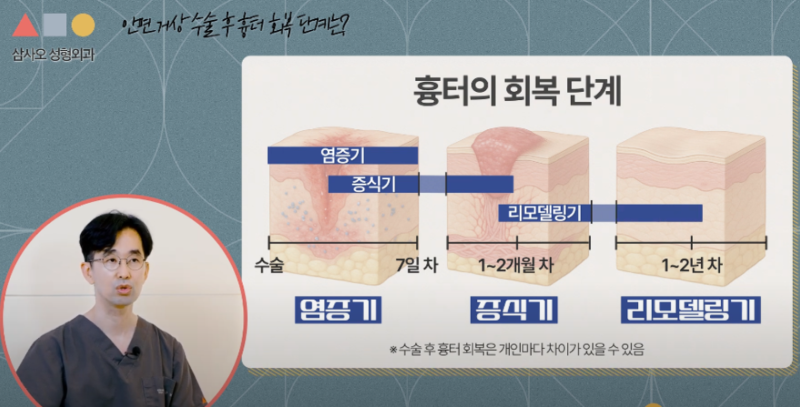
Post-Surgery Recovery Stages and Swelling Management
Swelling and bruising after a facelift vary greatly depending on individual constitution. Bruising can occur more easily in men, smokers, patients with high blood pressure, or those taking blood thinners like aspirin, making thorough consultation with the medical team essential beforehand.
The typical recovery process is as follows:
- Immediately post-surgery to a few weeks: The wounds heal, empty spaces are filled, and a slight pulling sensation may occur.
- 1 to 2 months (Proliferative phase): Scar tissue becomes firm, and a strong feeling of tightness or adhesion is common during this period.
- Thereafter: The tissues gradually become more flexible, the scars soften, and natural facial expressions become possible.
A Worry-Free Facelift: Drain Tubes and Ear Deformities
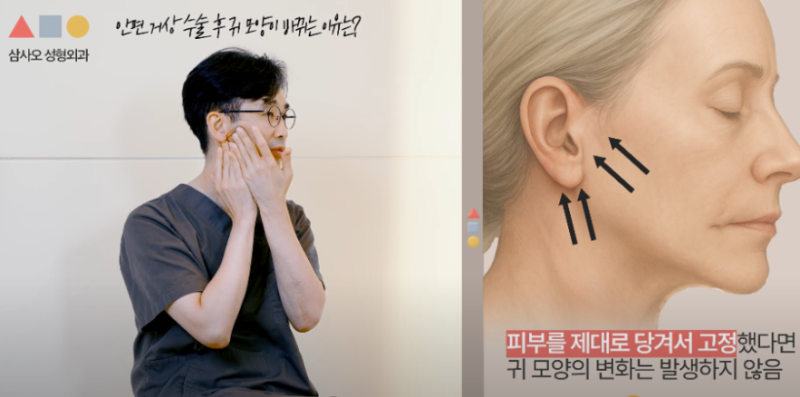
Drain tubes (hemovacs) used to prevent the accumulation of blood or fluids after surgery can cause considerable discomfort for patients. By minimizing the possibility of fluid accumulation through refined surgical techniques, a smooth recovery is possible even without drain tubes. Furthermore, the commonly feared 'ear deformity (such as pixie ear)' during a facelift occurs when the skin is excessively excised or the fixation is incomplete. Therefore, precise fixation based on anatomical structure is of utmost importance.
Differences in Results Based on Skin Elasticity and Tissue Characteristics
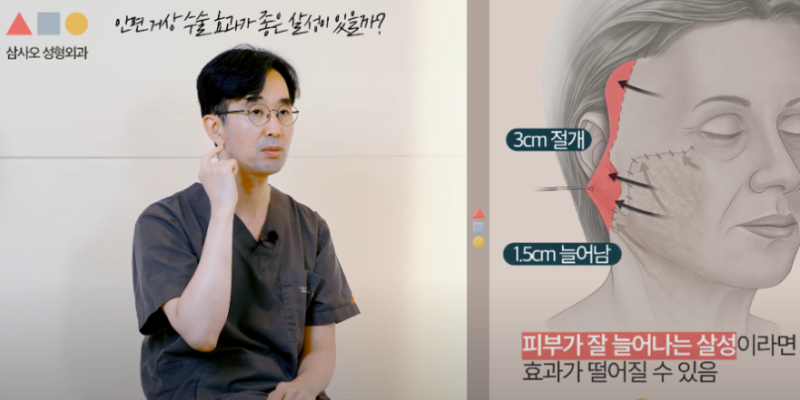
Surgical results are influenced by individual tissue characteristics, namely skin elasticity. Skin with good elasticity maintains the lifting effect for a long time, whereas skin with very weak elasticity may experience some re-stretching over time. Therefore, a specialist must identify these patient characteristics in advance and compensate for them using appropriate surgical techniques.
A facelift is a surgery that requires sophisticated skills, but rather than having vague fears, establishing a customized plan through an accurate diagnosis is the first step toward a safe and stable transformation.
Frequently Asked Questions
Is it okay to get a facelift in my 40s?
Yes, it is possible. There is no set age for a facelift; the most appropriate time is when the degree of sagging you feel matches your actual skin condition. Especially if you are in your late 40s and have experienced early sagging after facial contouring surgery, it is definitely worth considering.
Is it good to combine fat grafting with a facelift?
Yes, you can expect much more立体 results. This is because aging not only causes skin to sag but also causes volume loss in certain areas. By liposuctioning fat from under the chin and grafting fat into sunken cheeks or nasolabial folds, you can achieve a natural and balanced facial contour.
What is the recovery process like after surgery?
Typically, the first 1-2 months after surgery involve a proliferative phase where scar tissue becomes firm. Immediately after surgery and for several weeks, you may feel a pulling sensation as the wound heals, but after 2 months, the tissue gradually becomes more flexible, the scar softens, and natural expressions become possible.
I'm worried about ear shape deformities like 'pixie ear' after surgery.
Accurate anatomical fixation can prevent ear shape deformities. Side effects such as pixie ear primarily occur when the skin is excessively resected or fixation is incomplete. Therefore, it is very important to receive an accurate diagnosis and surgical plan from a skilled specialist.
Does the facelift effect last long even if my skin elasticity is weak?
If skin elasticity is weak, some elasticity may decrease again over time. While skin with good elasticity maintains the lifted effect for a long time, if the skin tissue is weak, a specialist should identify these characteristics in advance and compensate with surgical techniques to achieve stable results.