2026-06-04
Autologous Rib Cartilage Rhinoplasty: Features and Benefits for Reducing Implant Burden and Enhancing Support
An increasing number of people are seeking non-implant rhinoplasty due to an aversion to artificial implants or concerns about side effects. We explore in detail the features, harvesting sites, and advantages of autologous rib cartilage rhinoplasty, which utilizes your own tissue to enhance support and complete a natural nose line.

The Popularity of Non-Implant Rhinoplasty for a Natural Nose Line
Recent plastic surgery trends lean towards preferring a natural line that harmonizes with one's facial features, rather than the unconditionally high and flashy noses of the past. In particular, as more people worry about the psychological burden or side effects like inflammatory responses from inserting artificial implants such as silicone, there is a growing interest in non-implant rhinoplasty, which uses tissue harvested from one's own body.
Reflecting these patient concerns, 345 Plastic Surgery proposes personalized nose lines through autologous rib cartilage rhinoplasty, which secures both support and stability simultaneously.
What is Autologous Rib Cartilage Rhinoplasty?
Autologous rib cartilage rhinoplasty is a surgical method that harvests costal cartilage (rib cartilage) from the patient's own chest area to build the columella or shape the nasal tip. Because it does not use artificial implants, its greatest feature is excellent biocompatibility and the ability to reduce concerns about foreign body sensation.
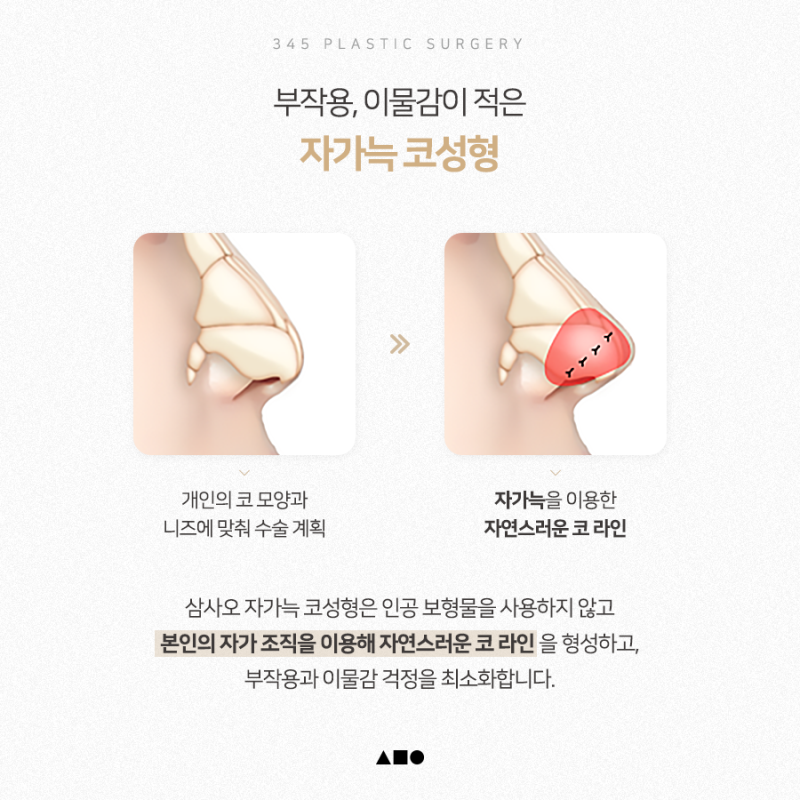
Looking at actual cases, we can confirm favorable progress where the nasal tip does not droop and is firmly maintained, while the overall nose line is smoothly refined when using autologous rib cartilage.
Harvesting Site and Excellent Support of Autologous Rib Cartilage
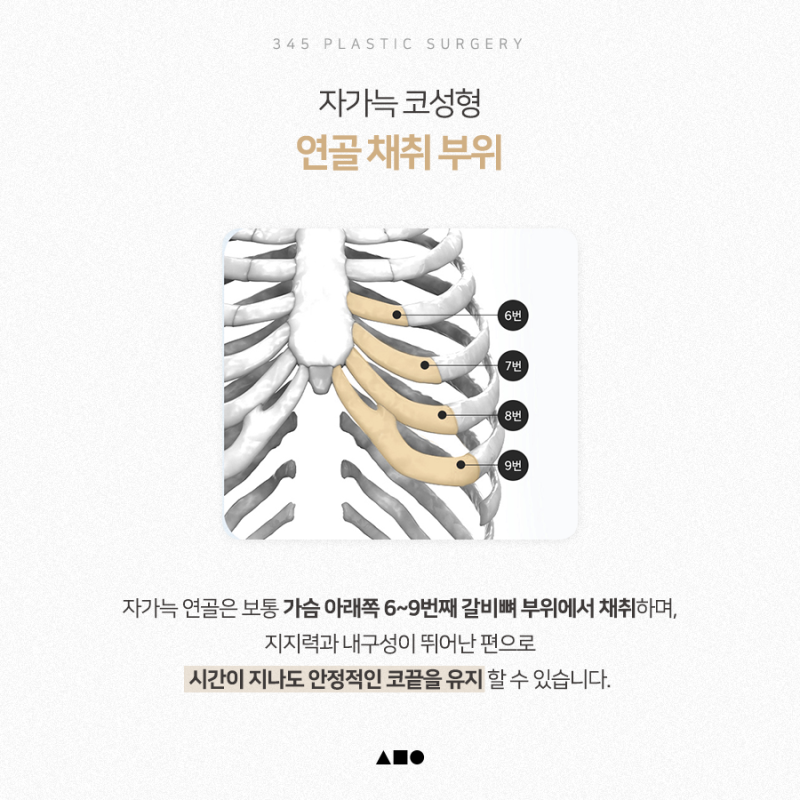
Autologous rib cartilage is usually harvested from the rib area between the 6th and 9th ribs in the lower chest. The cartilage in this area is abundant in quantity and firm in strength compared to other autologous tissues, making it highly advantageous for creating the supportive structure of the nose.
- Strong Support: It exerts robust strength when sufficiently raising the nasal tip or lengthening a short nose.
- Durability: With a low absorption rate over time, the likelihood of the nose shape deforming is relatively small.
- Safety: Since it is your own tissue, there is minimal immune rejection, and the possibility of inflammation can be lowered.
Harmonious Utilization of Various Autologous Tissues
For a successful rhinoplasty, it is important to appropriately mix and use autologous tissues suited to the characteristics of each area, in addition to autologous rib cartilage.
- Ear Cartilage: With its round shape and good elasticity, it is utilized to express the soft texture of the nasal tip and create natural movement.
- Septal Cartilage: It can be harvested from inside the nose, allowing for use without additional incisions, and helps lay the foundation for the columella.
Autologous Rib Cartilage Rhinoplasty is Recommended for These Individuals
Rhinoplasty greatly influences the overall impression even with minute differences in angle and height. If you have the following concerns, a consultation regarding the use of autologous rib cartilage can be helpful.
- If you are worried about foreign body sensation or implant visibility after using artificial implants
- If your nasal tip is low or drooping and requires a strong support structure
- If a sufficient amount of cartilage is needed for revision surgery due to capsular contracture
- If you want to maintain a natural yet prominent nose line for a long time
Since the internal structure of the nose, skin thickness, and cartilage condition vary for each individual, it is advisable to determine the surgical direction through a precise diagnosis with an experienced specialist. 345 Plastic Surgery prioritizes patient safety and performs meticulous surgeries based on the latest medical knowledge for harmonious results.



Frequently Asked Questions
What kind of surgery is autologous costal cartilage rhinoplasty?
Autologous costal cartilage rhinoplasty is a surgery that involves harvesting costal cartilage from the patient's own chest area to build the nasal columella or shape the nasal tip. It is characterized by excellent biocompatibility as no artificial implants are used, significantly reducing concerns about foreign body sensation or inflammation.
Where is autologous costal cartilage usually harvested from?
It is usually harvested from the rib area between the 6th and 9th ribs, located in the lower chest. The cartilage in this area is abundant and strong compared to other autologous tissues, making it very advantageous for creating a robust supporting structure for the nose.
What are the biggest advantages of autologous costal cartilage rhinoplasty?
The biggest advantages are its strong supportive power and high safety. Using firm costal cartilage allows for sufficient elevation of the nasal tip or extension of a short nose, maintaining a robust structure. Over time, the absorption rate is low, reducing the risk of shape deformation or human rejection reactions.
Can it be used with ear cartilage or septal cartilage?
Yes, it can be used together. For successful rhinoplasty, autologous tissues are mixed and used according to their specific characteristics for each area. Ear cartilage is used to express a soft texture at the nasal tip, while septal cartilage helps to lay the foundation for the nasal columella.
Who is autologous costal cartilage rhinoplasty recommended for?
It is recommended for those who are concerned about foreign body sensation or visibility after using artificial implants. It is also a very suitable surgical method for those who need a strong supporting structure due to a low nasal tip, or in cases of revision surgery due to contracture, where a sufficient amount of cartilage is required.