2026-06-04
Age-Customized Lifting: A Guide to Choosing Facelift Surgery for Sagging Facial Skin
Sagging jawlines and nasolabial folds that come with aging have limits to improvement through simple home care alone. From mini facelifts in your 20s to SMAS volume facelifts in your 50s, we introduce customized lifting solutions based on age and the degree of sagging. Discover how you can expect natural elasticity improvement through retaining ligament dissection and vertical lifting.
Hello. This is 345 Plastic Surgery. As time passes and skin elasticity decreases, you may experience changes such as a blurred jawline and sagging cheeks. In particular, when wrinkles around the mouth or the buccal fat (inner cheek fat) begin to sag, it can make your impression look darker, which is a common concern for many.
Recently, customized lifting, which goes beyond simply pulling the skin to precisely analyze an individual's age, skin condition, and the cause of sagging, has been gaining attention. At 345 Plastic Surgery, we propose the optimal solution by considering anatomical structures and the direction of aging.
1. Age-Customized Lifting Solutions
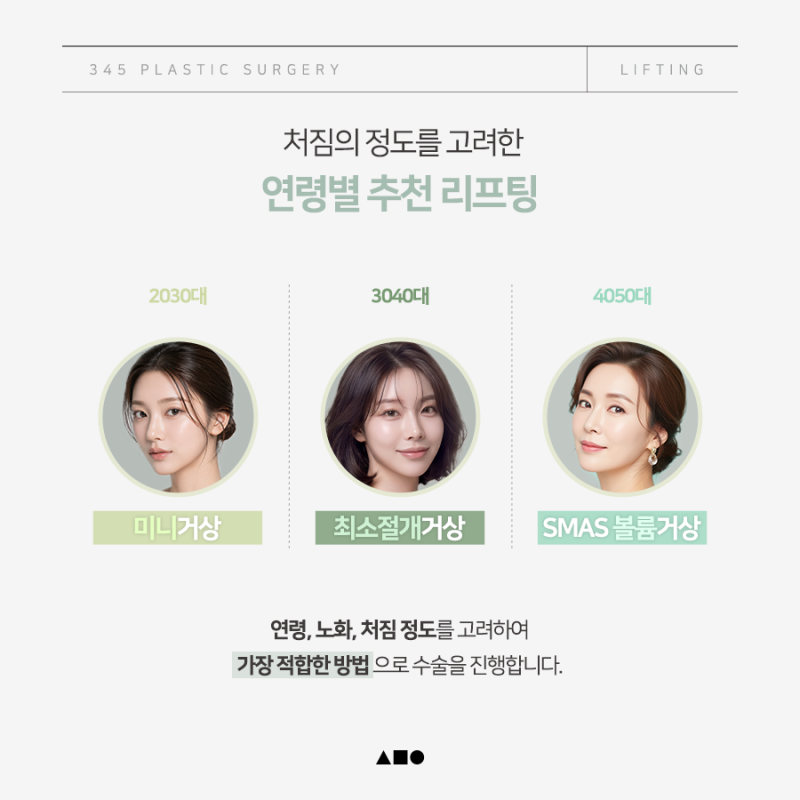
For lifting, you can expect more natural results when the approach is tailored to your age group and the degree of sagging in your skin tissues.
| Target Age | Recommended Procedure/Surgery | Key Features |
|---|---|---|
| 20s~30s | Mini Facelift | Improves mild sagging and refines facial contours |
| 30s~40s | Minimal Incision Facelift | Restores elasticity considering retaining ligaments and the SMAS layer |
| 40s~50s and above | SMAS Volume Facelift | Simultaneously improves deep sagging and volume loss |
Rather than simply preferring a major surgery, choosing the method best suited to your current facial condition is the key to achieving harmonious results.
2. Core Technique for Distinct Change: Retaining Ligament Dissection
Retaining ligaments are structures that anchor facial skin and fat tissues to the bones and muscles, preventing them from sagging downward. As we age, these ligaments loosen, causing the skin to sag.
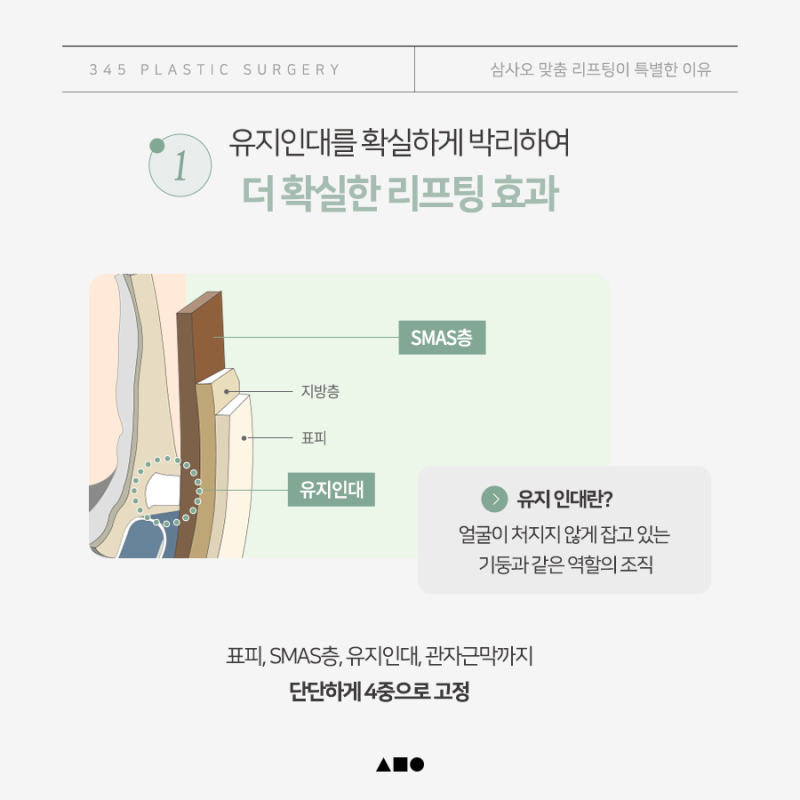
If the retaining ligaments are not properly dissected and only the epidermis is pulled tightly, the lifting effect can be limited and its duration shortened. At 345 Plastic Surgery, we aim for a robust lift by meticulously dissecting and securing not only the epidermis, fat layer, and SMAS (Superficial Musculoaponeurotic System) layer, but also the retaining ligaments.
3. Precise Incisions to Reduce the Burden of Scarring and Hair Loss
One of the biggest reasons people hesitate to undergo facelift surgery is the concern about scarring and hair loss. To alleviate this, we perform minimal incisions along the hair follicles inside the hairline.
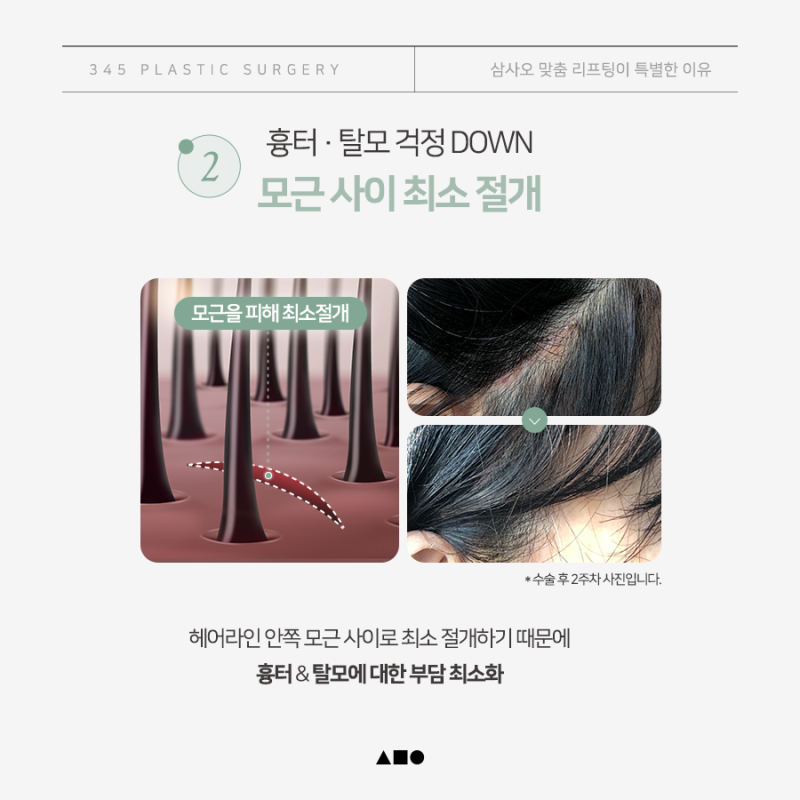
Because we approach precisely within the necessary range without making the incision line excessively long, the incision site is naturally hidden by the hair after surgery, relieving the psychological burden of scarring and hair loss.
4. Natural Vertical Lifting Without Accentuating the Cheekbones
The direction of pulling during a lift is a crucial factor that determines the impression of the result. Pulling excessively in a diagonal direction can make the cheekbones stand out or make the face look wider.
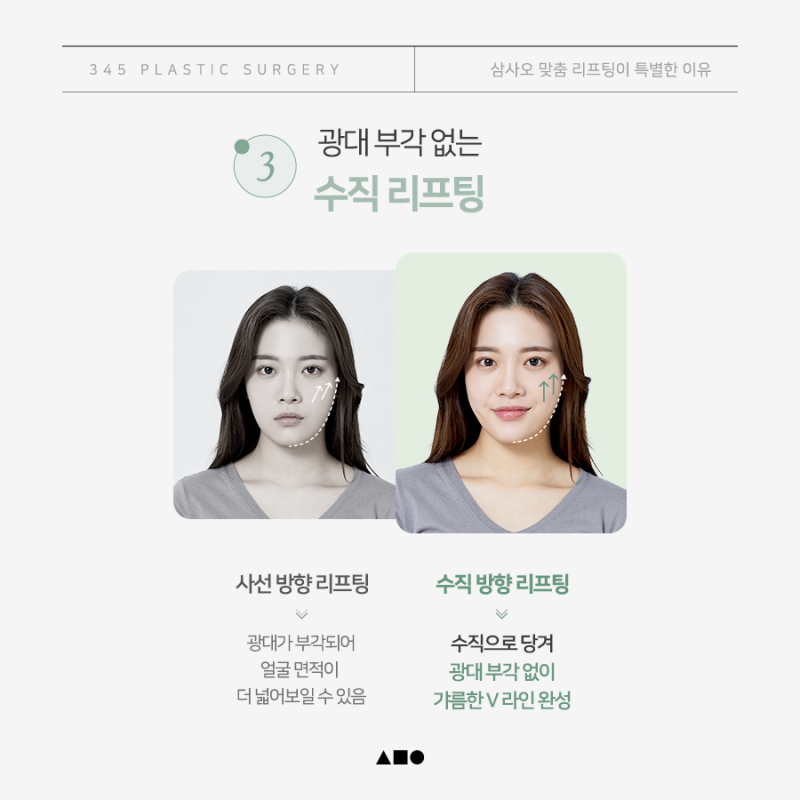
345 Plastic Surgery designs the lift focusing on a vertical direction—opposite to the sagging—to help reduce cheekbone accentuation and sharply refine the jawline. Through this, we achieve a natural, three-dimensional volume that doesn't look artificial, as if it were your original face.
5. Systematic System for Safety and Recovery
Just as important as the surgical results are a safe process and quick recovery. 345 Plastic Surgery adheres to the following systems for our patients' peace of mind.
- Doctor Call System: The day after surgery, the operating surgeon personally checks your progress to ensure there are no abnormalities.
- Resident Specialist: An anesthesiologist is on-site to monitor the entire surgical process.
- Transparent Operation: We provide a trustworthy surgical environment through the operation of CCTV in the operating rooms.
Since everyone has a different facial skeletal structure and pattern of skin aging, we encourage you to establish the most suitable lifting plan for yourself through precise diagnosis and thorough consultation.

Frequently Asked Questions
Are there different lifting surgery methods suitable for different age groups?
Yes, it varies depending on age and the degree of skin sagging. For those in their 20s and 30s, mini-lifts to improve mild sagging are suitable; for those in their 30s and 40s, minimal incision lifts; and for those 40s to 50s and older, SMAS volume lifts to improve deep sagging are appropriate.
Why is retaining ligament dissection important during a facelift?
Proper dissection of the retaining ligaments is crucial for a firm and long-lasting lift. If only the epidermis is pulled, the effect may be limited, so it is important to meticulously dissect and fix not only the fat layer and SMAS layer but also the retaining ligaments.
Will there be severe scars or hair loss after the surgery?
No, the burden of scars and hair loss can be significantly reduced. Minimal incisions are made only within the necessary range, following the hair follicles inside the hairline, so the incision site is naturally covered by hair after the surgery.
I'm worried that my cheekbones might look more prominent after the lift.
Vertical lifting can prevent the accentuation of cheekbones. By designing the lift vertically, in the opposite direction of sagging, rather than pulling diagonally, it reduces cheekbone prominence while creating a sharp and natural jawline.
Is there a safety system in place during the surgery?
Yes, we operate a systematic safety system. An anesthesiologist is present to monitor the entire process, and we provide CCTV operation in the operating room and a Doctor Call system where the surgeon directly checks the progress the day after the surgery.