2026-06-04
Worried About Cheek Sagging After Zygoma Reduction? 'Gwang-fting' Combines Zygoma Reduction and Lifting Simultaneously
Introducing 345 Plastic Surgery's 'Gwang-fting,' which combines zygoma reduction with customized lifting to solve cheek sagging—the biggest concern for patients in their 30s and 40s considering cheekbone reduction. Discover how you can expect both a smooth facial contour and elasticity simultaneously through triple bone fixation and SMAS layer lifting, along with age-optimized lifting solutions.
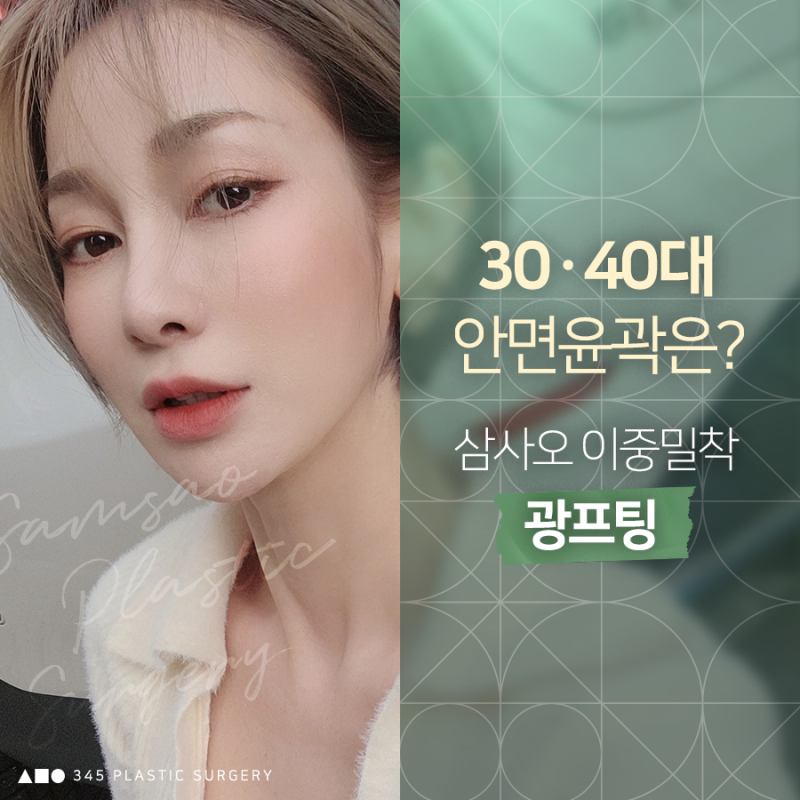
Cheek Sagging After Zygoma Reduction: Why Does It Happen and How Can It Be Prevented?
If the cheekbones located in the mid-face are excessively prominent, the facial contour can appear bumpy from the front, often giving off a rather strong impression. For this reason, there is growing interest in Zygoma Reduction among patients in their 30s and 40s who desire a smooth, oval-shaped face.
However, the most hesitant factor before deciding on surgery is the post-operative cheek sagging phenomenon. Especially for age groups where skin elasticity has already begun to decline, there is a common concern that the remaining soft tissue will sag downwards after the bone volume is reduced. To get straight to the point, if the osteotomized cheekbones are firmly triple-fixed and the soft tissues are pulled upward and secured simultaneously, it can significantly help prevent such sagging.
345's 'Dual-Adhesion Gwang-fting': The Principle of Increasing Adhesion Between Bone and Skin
345 Plastic Surgery's 'Gwang-fting' applies an upward dual-adhesion method that considers the adhesion and angle of the skin and bone during the zygoma reduction process. This is a three-dimensional approach that preemptively accounts for potential future sagging.
Core Surgical Process of Gwang-fting
- Three-Dimensional Osteotomy and Repositioning: The protruding cheekbones are osteotomized and moved inward to create a slender line.
- Rigid Triple Fixation: After accurately confirming the contact surface between the bones, they are triple-fixed to prevent non-union, a phenomenon where the bones fail to fuse.
- Retaining Ligament Dissection and Upward Fixation: By meticulously dissecting the retaining ligaments that support the soft tissues and pulling them upward for fixation, the prevention of cheek sagging and cheek hollowing can be expected.
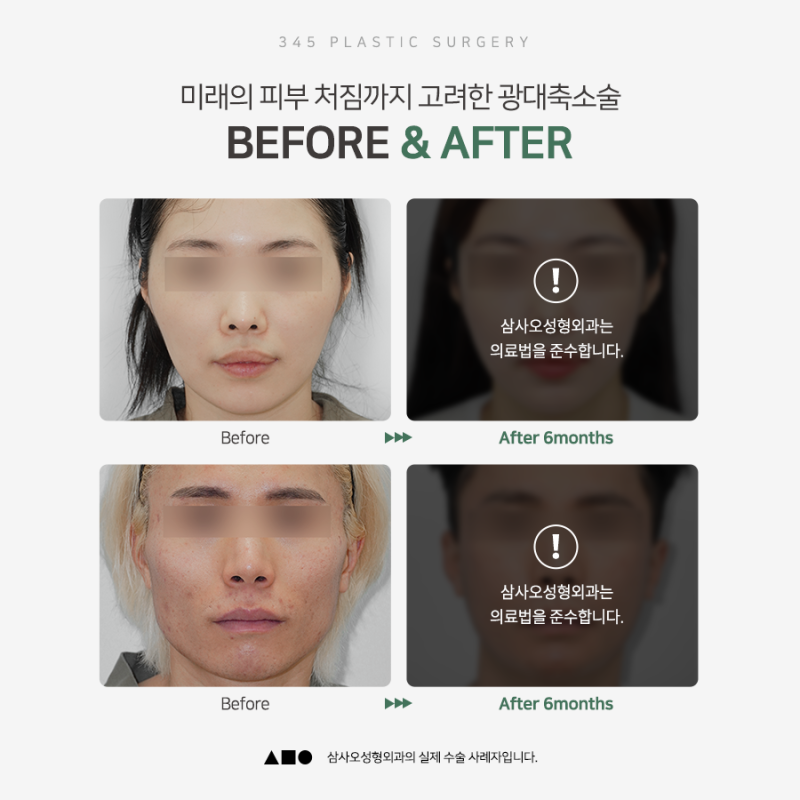
Customized Lifting Solutions Based on Age-Specific Skin Conditions
Since the degree of skin sagging, skin type, and thickness vary from person to person, the lifting method must also be individualized. At 345, we propose optimized lifting solutions based on the patient's age group and skin condition.
| Target Age | Recommended Lifting Method | Characteristics |
|---|---|---|
| 20s-30s | SMAS Mini Lifting | Fast recovery through micro-incisions, minimal swelling and bruising |
| 30s-40s | SMAS Minimal Incision Lifting | Induces a quadruple lifting effect with minimal incisions, distinct elasticity improvement |
| 40s-50s | SMAS Volume Lift | Combines lifting and facial fat repositioning to create a three-dimensional effect |
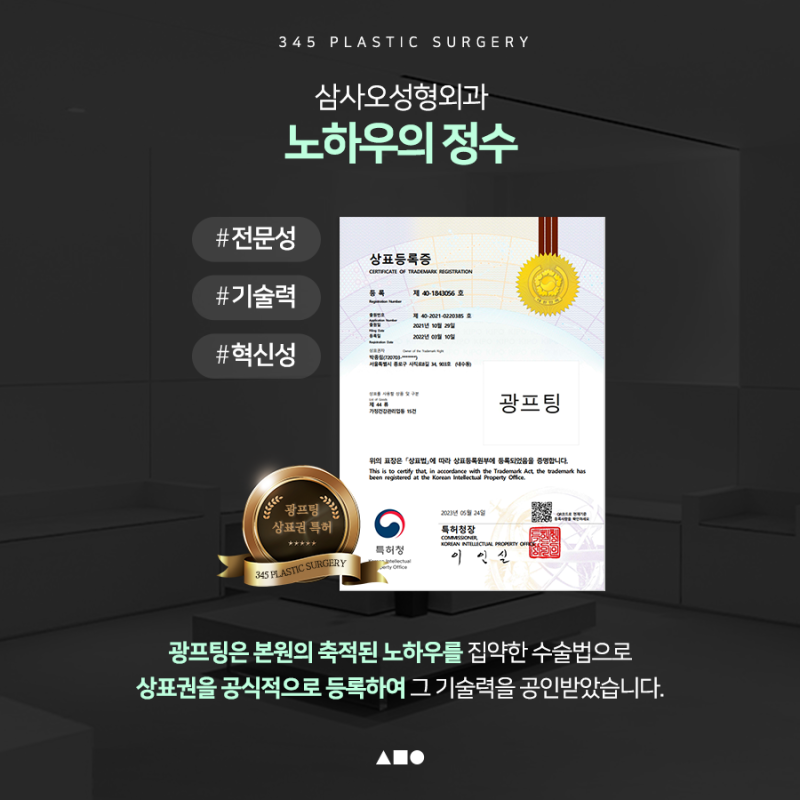
A 2-Doctor Collaborative System Adding Expertise and Safety
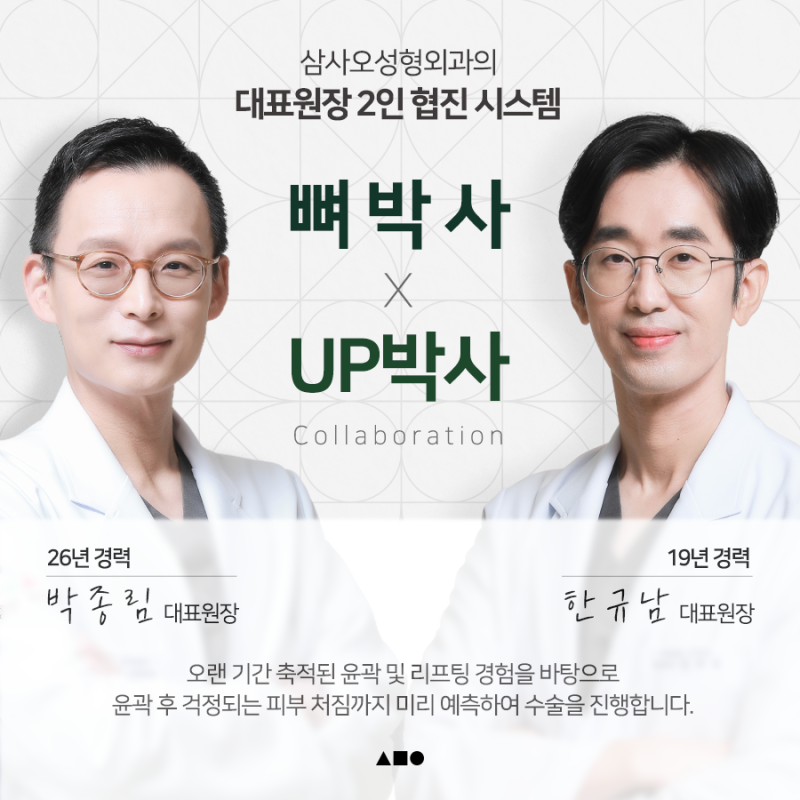
Gwang-fting is our proprietary surgical method, officially trademarked by integrating our accumulated clinical know-how. In particular, we have further strengthened our technical prowess and safety through a collaborative system of two representative directors: the 'Bone Doctor,' who possesses expertise in facial contouring, and the 'UP Doctor,' who specializes in lifting and rhytidectomy.
If you want to improve your facial contour through zygoma reduction while simultaneously preserving skin elasticity, it is important to establish the most suitable plan for yourself through a consultation with experienced medical professionals. Based on a combined experience of over 45 years, 345 Plastic Surgery strives to provide the best possible results for each individual.
Frequently Asked Questions
Why does cheek sagging occur after zygoma reduction surgery?
It occurs because the remaining soft tissue sags downward after the bone volume is reduced. Especially when bone is reduced in an age group where skin elasticity has started to decline, the weakened supporting skin and tissue are susceptible to cheek sagging due to the effects of gravity.
What is the principle of Gwangp-ting surgery that prevents cheek sagging?
It is a method of firmly fixing the osteotomized zygoma with a triple fixation and pulling the soft tissue upwards to fix it. It precisely matches the contact surfaces of the bones to prevent non-union, and meticulously dissects and pulls the retaining ligaments upwards to fix them, preventing cheek sagging and hollowing.
What lifting method is suitable for people in their 30s and 40s?
We recommend the SMAS minimal incision lifting method. Through minimal incision, it induces a quadruple lifting effect, allowing for clear improvement in elasticity, and is customized considering the individual's degree of skin sagging, skin type, and thickness.
Who performs Gwangp-ting surgery?
It is performed by two directors in collaboration: a facial contouring specialist and a lifting specialist. The representative directors in the fields of facial contouring, which deals with bones, and lifting and rhytidectomy, which deals with soft tissues, leverage their respective expertise to further enhance the surgical technique and safety.