2026-06-04
Enjoy Working Out? A Guide to the Benefits and Fast Recovery of Subfascial Breast Augmentation
Discover the characteristics of subfascial breast augmentation, ideal for fitness enthusiasts or those seeking a quick return to daily life. We detail the pros and cons of this surgical method, which reduces pain by inserting the implant beneath the pectoralis major fascia and prevents animation deformity (implant movement during exercise).

Exercise and Breast Augmentation: Why is Choosing the Right Surgical Method Important?
Recently, there has been an increase in inquiries about breast augmentation among those who professionally maintain their bodies, such as yoga and Pilates instructors. The biggest concerns for fitness enthusiasts are 'when can I start working out after surgery?' and 'will my breasts look unnatural when I exercise?'. For those with frequent muscle movement, a method that reduces muscle damage can be more advantageous than conventional surgical techniques.
What is Subfascial Breast Augmentation?
Subfascial breast augmentation is a method where the implant is inserted beneath the 'fascia,' a thin membrane enveloping the pectoralis major muscle, by meticulously dissecting it. Unlike the traditional submuscular approach, the key is that it does not incise or damage the muscle itself.
Key Benefits of Subfascial Surgery
- Reduced Pain and Fast Recovery: Since the muscle is not directly incised, postoperative pain is relatively low, and the time required to return to daily life and recover can be shortened.
- Prevention of Animation Deformity: 'Animation deformity' refers to a phenomenon where the force of the muscle during upper body exercise is transferred to the implant, causing the breast to distort or the implant to be pulled upward. Subfascial surgery is effective in preventing this discomfort because the implant is positioned above the muscle.
- Natural Movement: The implant is positioned independently of muscle movement, allowing it to maintain a natural shape even during active movements.
Considerations for Subfascial Surgery
Every surgical method has its pros and cons depending on an individual's physical condition. In the case of subfascial surgery, for those with very low body fat and thin skin, there is a possibility that the edges of the implant may be somewhat visible. However, this can be adequately compensated for by selecting an appropriate implant (such as Motiva) tailored to the patient's body type and utilizing the dissection skills of an experienced surgeon.
Pre- and Post-Surgery Checklist (A Must-Read for Fitness Enthusiasts)
| Category | Details |
|---|---|
| Adjusting Workout Schedules | Consultation is recommended at least 3-6 months in advance if you have a body profile shoot or competition scheduled. |
| Animation Deformity | Subfascial surgery can be advantageous if the pectoralis major muscle is highly developed. |
| Recovery Period | Although there are individual differences, faster recovery can be expected compared to submuscular surgery. |
| Caution for Side Effects | Be aware of the possibility of general breast surgery side effects such as contracture, seroma, and asymmetry. |

The Importance of Choosing Medical Staff with Extensive Clinical Experience
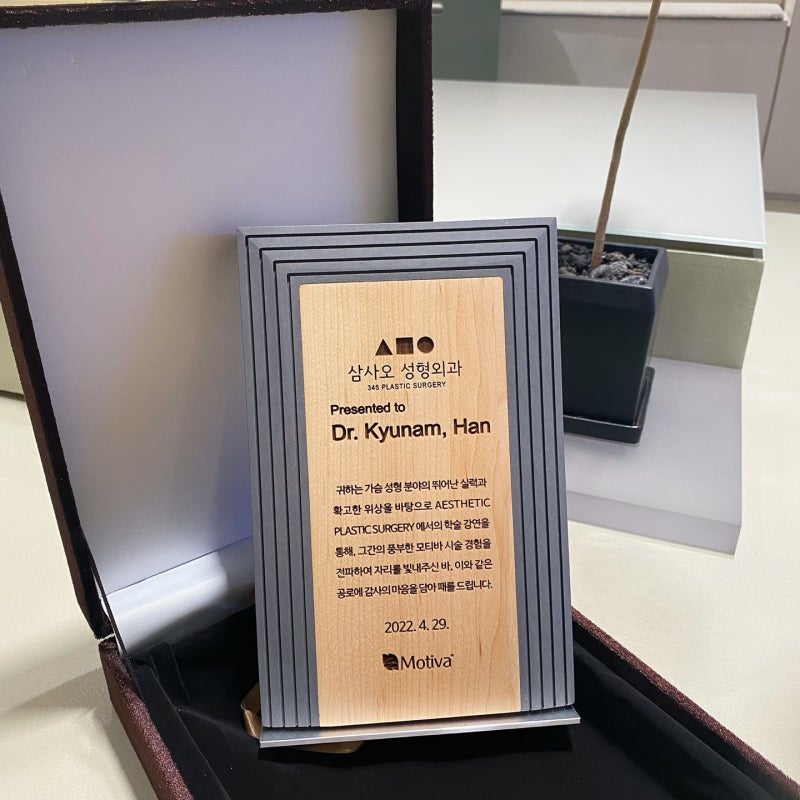
Subfascial breast augmentation is a highly difficult surgery that requires precise dissection of the thin space between the muscle and the fascia. Dr. Kyu-Nam Han of 345 Plastic Surgery has been continuously sharing his research results on 'subfascial breast augmentation' through academic activities such as the APS (Aesthetic Plastic Surgery) society, earning recognition for his expertise. A customized plan that considers an individual's lifestyle, exercise intensity, and skin characteristics determines the satisfaction of the results.
Frequently Asked Questions
What is subfascial breast augmentation?
Yes, it is a surgical method that involves dissecting the thin fascia covering the pectoralis major muscle (breast muscle) and inserting an implant underneath it. The biggest difference from traditional methods is that it does not incise or damage the muscle itself.
Will my breast shape look awkward when I exercise?
No, it will not look awkward and will maintain a natural shape. In subfascial surgery, the implant is positioned above the muscle, effectively preventing animation deformity where the breast distorts or moves upward during upper body exercises.
How long is the recovery period after surgery?
You can expect a relatively faster recovery compared to submuscular augmentation. Since the muscle is not directly incised, there is less post-operative pain, which shortens the time to return to daily life.
Is surgery possible even if I have low body fat and thin skin?
Yes, it is possible, but there is a possibility that the edges of the implant may be somewhat visible. To compensate for this, it is necessary to select an appropriate implant for the patient's body type and perform the surgery using the precise dissection technique of a skilled surgeon.
When should I have surgery if I have a body profile photoshoot or competition coming up?
It is recommended to consult with medical staff at least 3 to 6 months in advance. It is important to determine the most appropriate surgical timing by coordinating your individual recovery speed and exercise schedule for satisfactory results.