2026-06-04
One-Side Eyelid Revision for Asymmetry: How to Reduce Costs and Restore Balance
If only one side's line loosens or asymmetry occurs after double eyelid surgery, you can achieve natural symmetry through a one-side eyelid revision instead of operating on both sides. This article provides professional information on cases requiring surgery, difficulty level, appropriate timing, and precautions.

Common Types Requiring One-Side Eyelid Revision
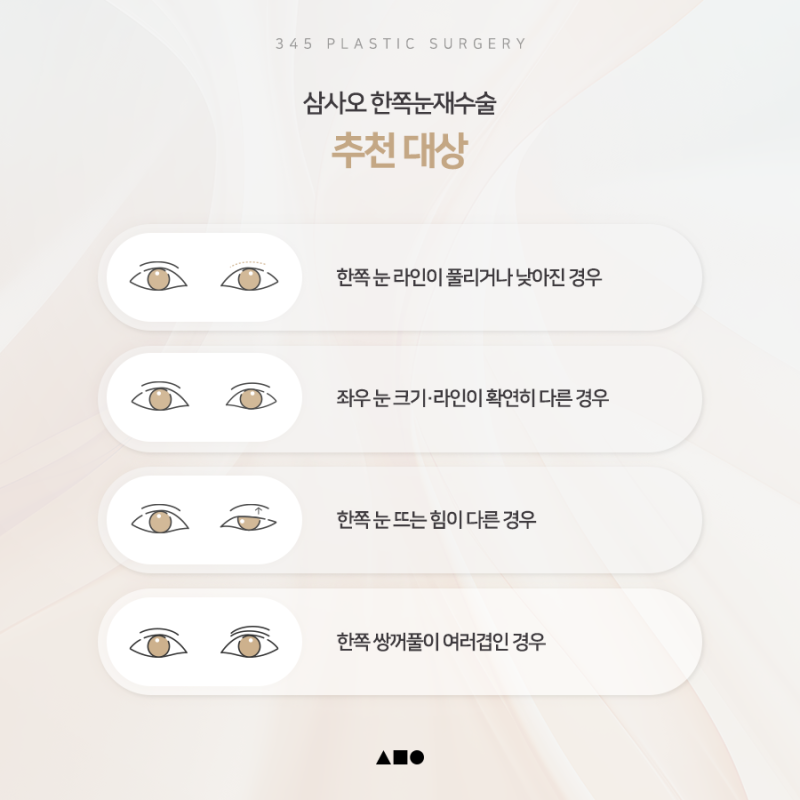
Unexpected changes can occur over time after your initial double eyelid surgery. In particular, if the balance between both sides is broken, your overall impression can look unnatural. You may want to consider a one-side eyelid revision if you are experiencing the following situations:
- Loss of line on one side: When one double eyelid becomes loosened or noticeably lowered.
- Significant asymmetry: When the size of the left and right eyes or the height of the lines are distinctly different.
- Difference in ptosis (drooping eyelid): When the strength of the muscle opening one eye differs from the other side.
- Multiple folds: When multiple overlapping lines form on only one eyelid, creating a messy appearance.
One-Side Correction is Trickier Than Both Sides: The Key is 'Symmetrical Design'
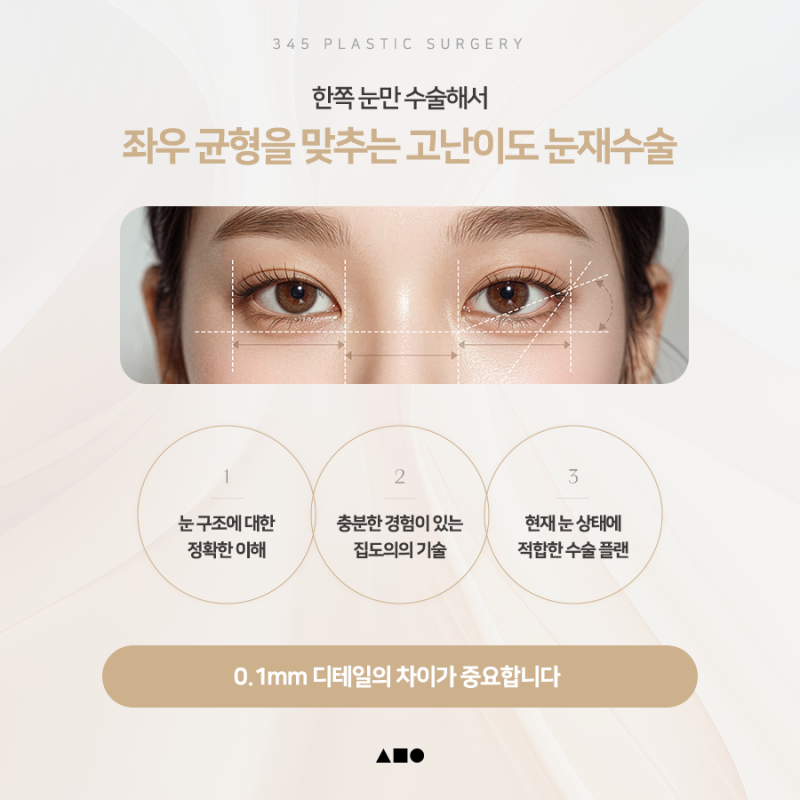
Many people think operating on just one side is simpler, but medically, it is actually a highly difficult procedure. This is because the surgeon must accurately analyze the line, depth, and degree of adhesion of the already completed opposite eye and design the revision to 'replicate' it accordingly.
For a successful correction, an anatomical understanding of the existing eye structure is essential, along with the design capability to select the optimal surgical method (such as the non-incisional or incisional method) tailored to the patient's current eye condition.
Improvement Effects Seen Through Before and After Cases of One-Side Eyelid Revision
Looking at actual cases of one-side eyelid revision performed at 345, you can see that the asymmetrical eye shape has become much more refined. Through before and after photos, you can confirm that correcting just one line can make the overall impression significantly clearer and more defined.
Surgical Timing: The Golden Time for Stable Results
Revision surgery is not something that can be done immediately just because you want it. If revision surgery is forced before the tissues have sufficiently recovered, scarring may worsen, or the results may be unsatisfactory.
- At least 6 months elapsed: It typically takes about 6 months to 1 year for the tissues to fully stabilize after the initial surgery.
- Confirmation of swelling subsidence: All residual swelling must be gone to accurately measure the line height.
- Softening of scar tissue: The appropriate time is when the scar tissue at the surgical site is no longer hard and has softened.

Precautions and Recovery Management for a Successful Revision Surgery
After revision surgery, temporary swelling or bruising may occur depending on the individual. This is a process of gradual improvement, and it is important to strictly follow the precautions provided by the clinic. Rather than attempting an unreasonable early correction, finding the appropriate timing and surgical method for your current condition through thorough consultation with a specialist is the best way to aid a smooth recovery.
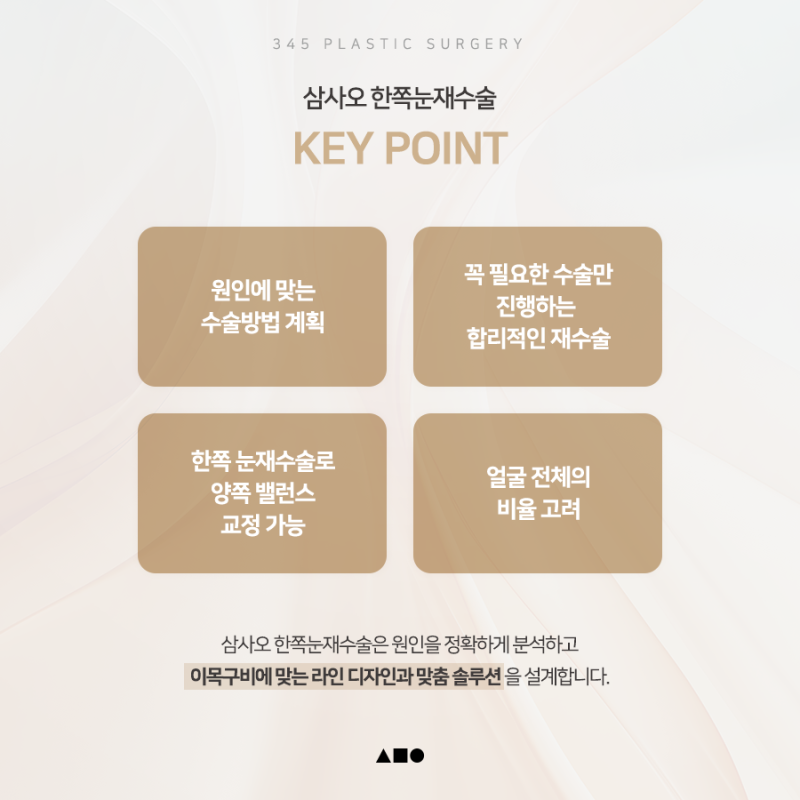
The eyes are a sensitive area where even a minute 1mm difference can drastically change your image. Even if your concern is only with one eye, precisely analyzing the cause and performing only the necessary treatment is the core of revision surgery.

Frequently Asked Questions
When is the best time to perform single-eye revision surgery?
The best time is at least 6 months to 1 year after the initial surgery. This is because accurate measurement of the line height is possible only after the tissues have fully recovered and all residual swelling has subsided, and stable results can be achieved only when the scar tissue in the surgical area has softened.
Is operating on only one eye simpler than operating on both eyes?
No, it is actually considered a more medically challenging surgery. This is because it requires precise analysis of the line, depth, and degree of adhesion of the already completed opposite eye to design a symmetrical match, almost like a replication.
In what cases is single-eye revision surgery necessary?
Revision surgery may be considered if one eyelid crease has loosened or lowered, if there is a noticeable asymmetry in eye size or line height between the left and right eyes, if there is a difference in ptosis in one eye, or if a double crease has occurred only on one eyelid.
What should I be careful about during the recovery process after revision surgery?
It is most important to strictly follow the precautions provided by the hospital. Temporary swelling or bruising may occur after surgery depending on individual differences, but these will gradually improve. Recovery management should be done according to the specialist's instructions rather than attempting premature correction.