2026-06-04
Natural Nasal Tip Surgery Methods and Comparative Analysis of Autologous Tissue Materials (Septal and Ear Cartilage)
Learn about nasal tip surgery using only autologous tissues without artificial implants. We analyze the characteristics of septal cartilage, ear cartilage, and autologous rib cartilage, and explain the natural progression and recovery process up to 6 months post-surgery through 345 Plastic Surgery's 'Yeonye Nose' cases.

Nasal Tip Surgery Without Artificial Implants: Why Autologous Tissue?
The recent trend in rhinoplasty focuses not just on increasing height as in the past, but on creating a natural nose line that harmonizes best with your face. In particular, as more people feel psychological burden or aversion towards artificial implants like silicone or Gore-Tex, methods utilizing autologous tissue harvested from one's own body are gaining attention.
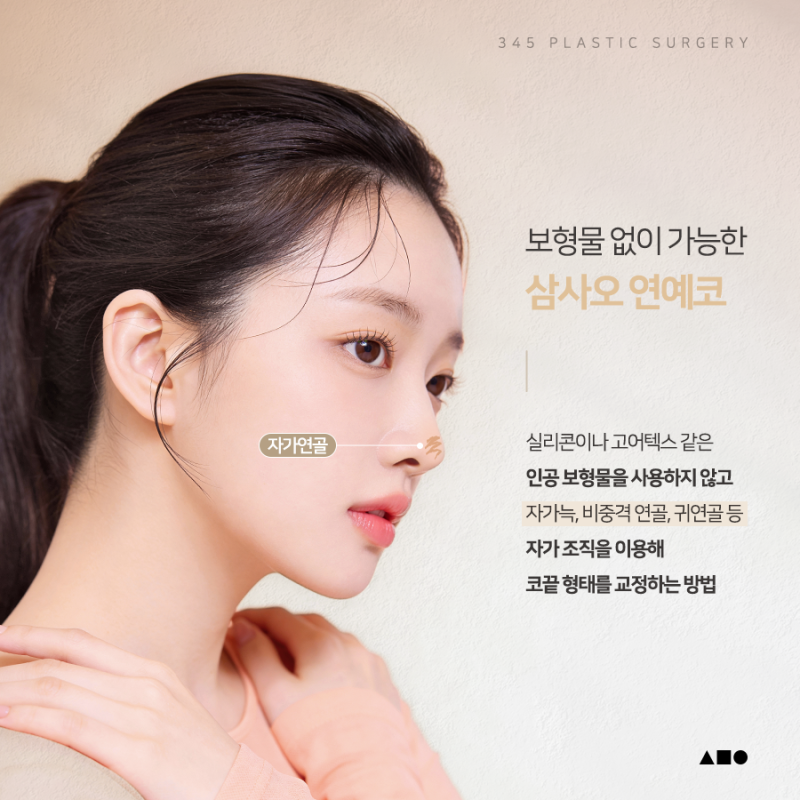
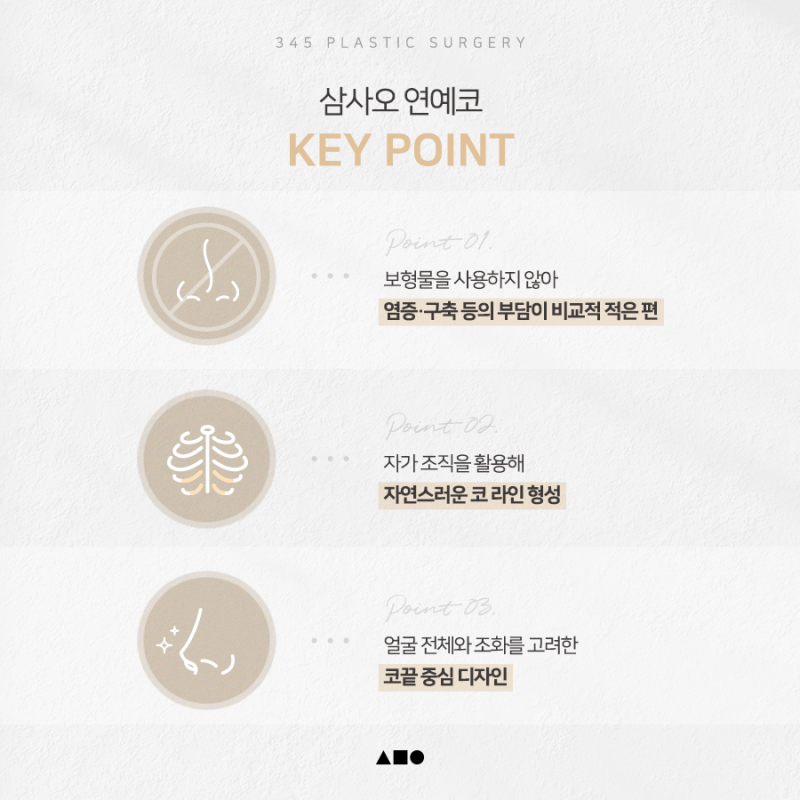
Reflecting these patient needs, the 'Yeonye Nose' surgery performed at 345 Plastic Surgery designs the nasal tip structure using only autologous tissue without any implants. This has the advantage of reducing any artificial feeling and settling naturally like your own nose over time.
Comparison of 3 Major Autologous Tissues Used in Nasal Tip Surgery
During nasal tip surgery, the appropriate material varies depending on the patient's nasal structure, skin thickness, and cartilage condition. The characteristics of representative autologous tissue materials are as follows:
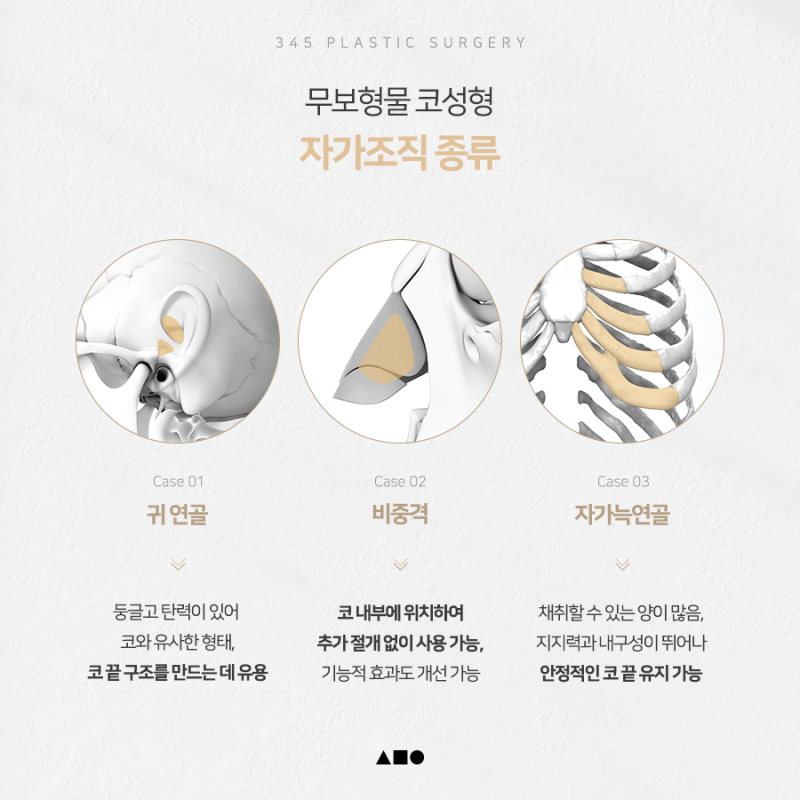
- Ear Cartilage: It has excellent elasticity and a curved shape, making it advantageous for expressing the soft curves of the nasal tip.
- Septal Cartilage: Harvested from the partition wall inside the nose, it has good supporting power and is effective for building the strut of the nasal tip or adjusting its angle.
- Autologous Rib Cartilage: It provides an ample harvestable amount and very strong support, making it ideal for firmly elevating the nasal tip or forming a stable structure during revision rhinoplasty.
Since each cartilage has different unique characteristics, it is important to select the optimal material through a meticulous analysis before surgery.
345 'Yeonye Nose' Real Cases and Swelling Progression
Implant-free rhinoplasty shows its true value as the tissues stabilize over time rather than immediately after surgery. The photos below show the progress of actual patients who underwent the 'Yeonye Nose' surgery at 345 Plastic Surgery.
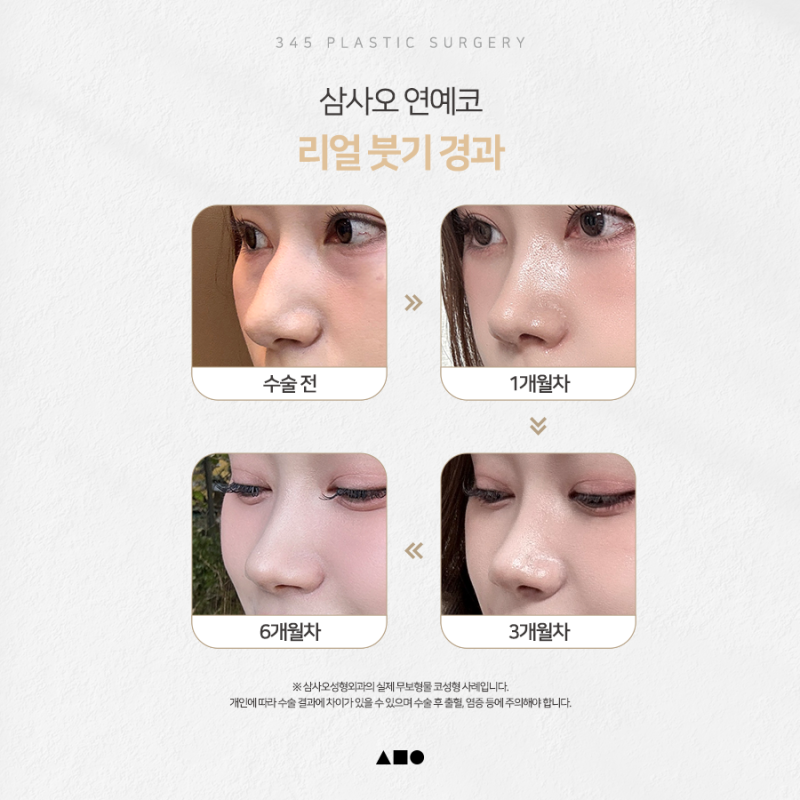
There may be swelling immediately after surgery, but you can see the nasal tip line gradually becoming slimmer and settling naturally as the residual swelling subsides over 3 to 6 months. Because artificial implants are not used, concerns about foreign body sensation are low, and the movement is relatively natural even when facial expressions change.
4 Factors to Consider When Designing Nasal Tip Surgery
For a successful nasal tip rhinoplasty, it is necessary to analyze the harmony of the entire face rather than just looking at the nose.
- Internal Nasal Structure: Checking for functional abnormalities such as a deviated septum.
- Skin Thickness: Applying different surgical methods depending on whether the nasal tip skin is thin or thick.
- Cartilage Development: Assessing the strength of the existing cartilage to provide support.
- Facial Feature Proportions: Analyzing the angles with the forehead, philtrum, and lip lines.
Implant-Free Nasal Tip Surgery is Recommended for:
- Those who have a high nasal bridge but a bulbous or wide nasal tip.
- Those who prefer a natural change that looks like their own nose over artificial flashiness.
- Those who are worried about inflammation or contracture (skin shrinkage) caused by the insertion of artificial implants like silicone.
- Those who want a refined nasal tip line that matches the overall balance of their face.
Rhinoplasty is not simply a technique of raising the height, but a process of safely rearranging the structure based on anatomical understanding. We hope you choose the most suitable nasal tip surgery method for yourself through a personalized diagnosis.
Frequently Asked Questions
What types of autologous tissues are used in non-implant rhinoplasty for the nasal tip?
Mainly three types are used: ear cartilage, septal cartilage, and autologous costal cartilage. Ear cartilage is advantageous for creating soft curves, septal cartilage is effective for building a nasal tip column, and autologous costal cartilage is suitable for forming a robust structure due to its strong support.
When does the swelling completely subside after nasal tip surgery?
Residual swelling usually subsides gradually over 3 to 6 months. Immediately after surgery, there is some swelling, but over time, the tissues stabilize, making the nasal tip line slimmer and settling naturally like your own nose.
What are the advantages of using autologous tissue instead of artificial implants?
The biggest advantage is the reduced concern about foreign body sensation, inflammation, or contracture. Since artificial implants like silicone or Gore-Tex are not used, there is less psychological burden, and movements are relatively natural when making facial expressions.
Who is recommended for non-implant nasal tip surgery?
It is recommended for those who have a high nasal bridge but a blunt or wide nasal tip. It is also a suitable surgical method for those who desire a natural change that feels like their original nose rather than an artificial look, or those concerned about side effects from artificial implant insertion.
What factors should be considered when designing nasal tip surgery?
The internal structure of the nose, skin thickness, the development status of existing cartilage, and the proportions of facial features should be comprehensively considered. It is important to check for functional abnormalities such as septal deviation and analyze the overall facial harmony to apply a customized surgical method.