2026-06-04
Mini-Facelift vs. Facelift: What's the Difference? A Complete Guide to Effects and Recovery Time
We provide a detailed comparison of the features of a mini-facelift—an option when skin elasticity decreases—and how it differs from a traditional facelift. From the advantages of a mini-facelift, such as smaller incisions and faster recovery, to the principles of SMAS layer fixation and recommended candidates, our expert editors have summarized it all for you.

Concerns About Decreased Skin Elasticity? A Mini-Facelift Could Be the Answer
When you feel your skin elasticity isn't what it used to be, you don't necessarily have to consider an extensive traditional facelift. The mini-facelift at 345 Plastic Surgery delicately lifts only the necessary areas, offering natural and effective results even with a small incision.
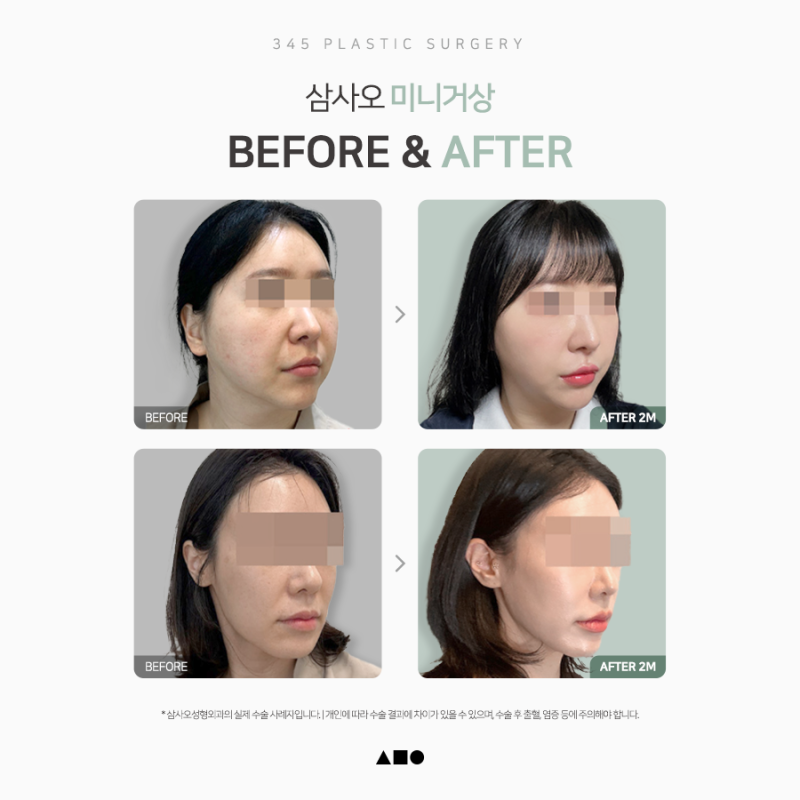
Looking at the actual case above, you can see a more defined facial contour post-surgery, along with softened nasolabial folds and a smoothly refined jawline. Rather than undergoing excessive surgery, it is important to choose the scope that is right for you.
What is a Mini-Facelift? A Lifting Solution with Less Scarring Burden
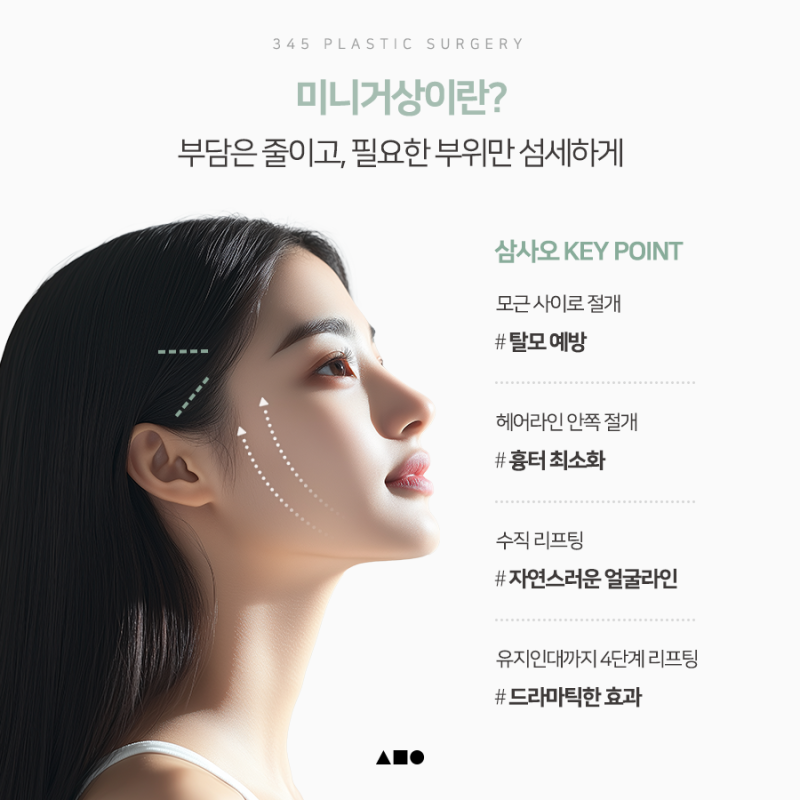
A mini-facelift is meticulously performed by making incisions between the hair follicles or along the inside of the hairline to reduce concerns about hair loss and ensure scars remain inconspicuous. Rather than simply pulling the surface of the skin, it secures the deep retaining ligaments to create a firmer and more natural contour.
Mini-Facelift vs. Traditional Facelift: What's the Difference?
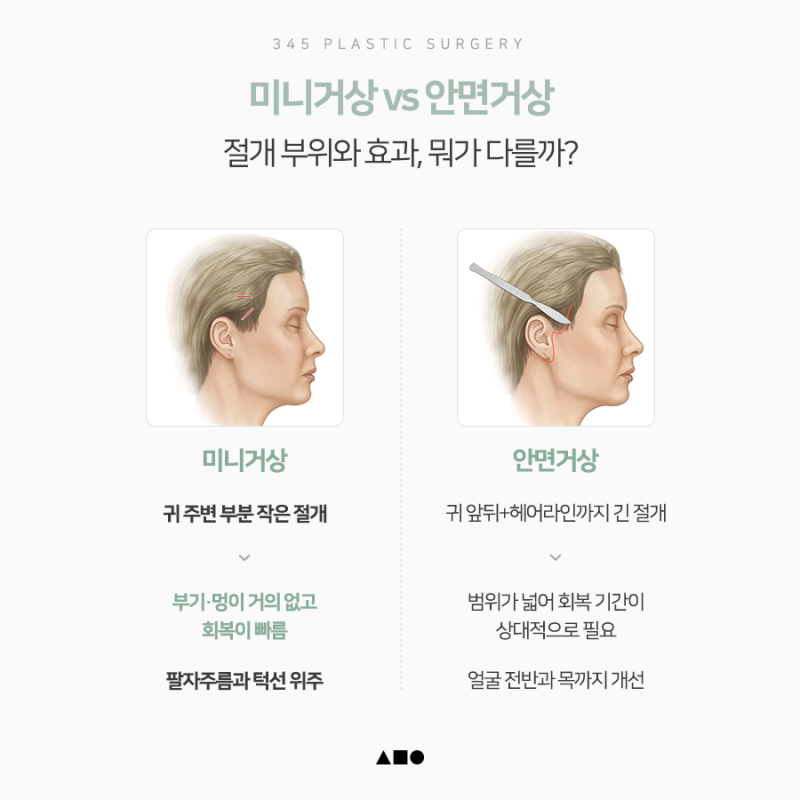
The biggest differences between the two surgeries are the extent of the incision and the target areas for improvement. A mini-facelift is performed with only a small incision around the ear, resulting in less bruising and swelling, and a relatively faster recovery speed.
| Category | Mini-Facelift | Traditional Facelift |
|---|---|---|
| Incision Scope | Small incision around the ear or hairline | Extensive incision from the front to the back of the ear |
| Main Target Areas | Primarily nasolabial folds and jawline | Entire face, including sagging cheeks and neck wrinkles |
| Recovery Time | Relatively short (quick return to daily life) | Relatively long (requires sufficient rest) |
| Recommended For | Those concerned with partial sagging | Those with severe, overall skin aging |
345 Plastic Surgery's Exclusive 4-Step Precision Fixation Lifting
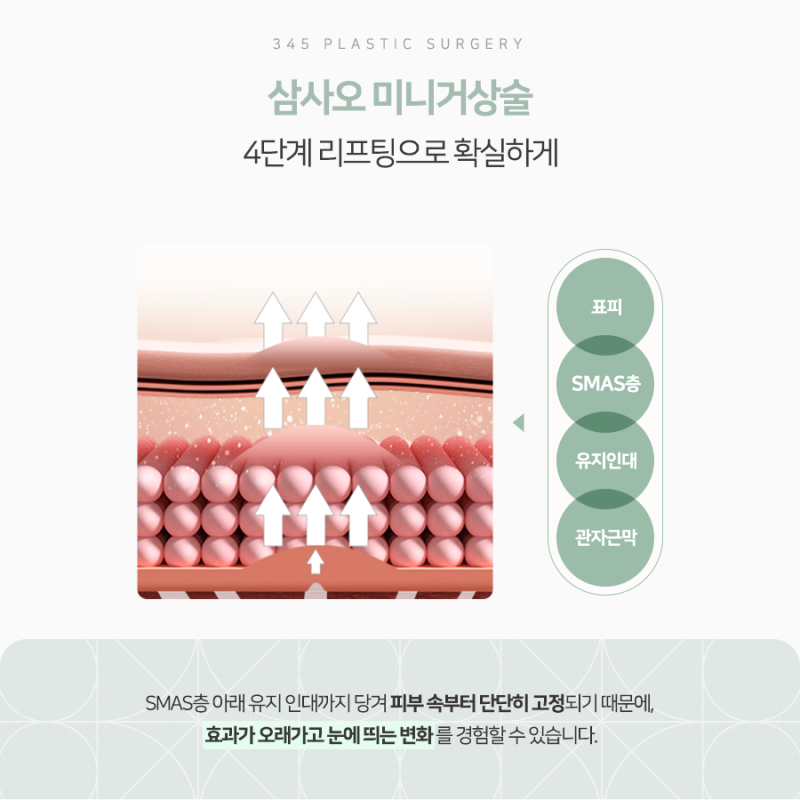
The mini-facelift at 345 Plastic Surgery is characterized by meticulously pulling and fixing four layers: the epidermis, the SMAS layer, the retaining ligaments, and the temporal fascia. This precise fixation method extends the longevity of the lift and delivers noticeably improved results.
Recommended Candidates and Precautions for a Mini-Facelift
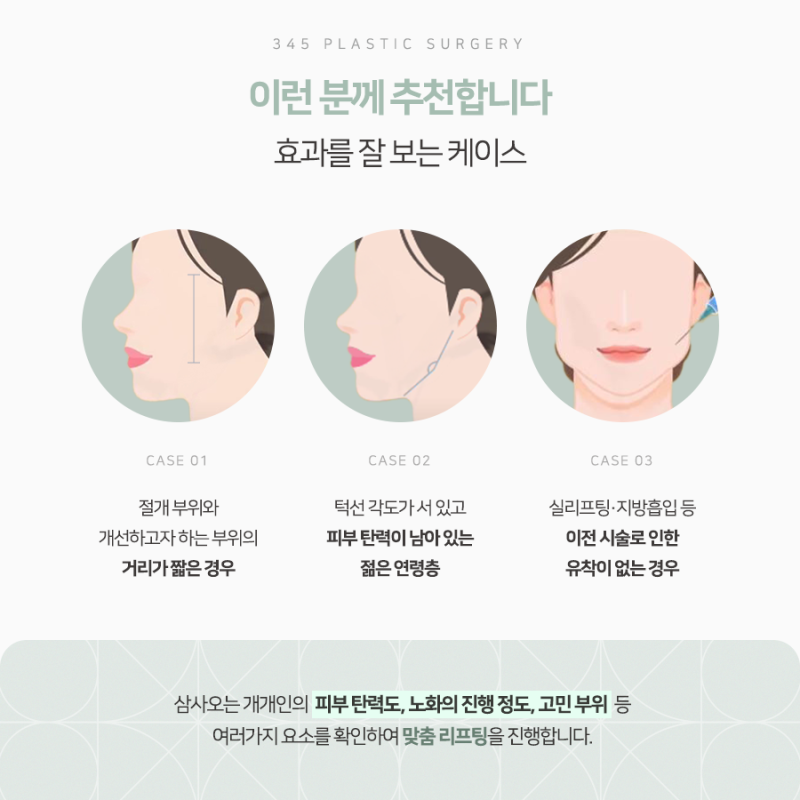
A mini-facelift is not the right answer for everyone. Suitability is determined based on your individual skin condition.
- When the distance between the incision site and the area to be improved is relatively short
- When the jawline angle is defined and some skin elasticity remains
- When there are no internal adhesions from previous thread lifts or liposuction
- When a quick recovery is needed to return to daily life
Professional System Established for Safe Surgery
The most important aspect of plastic surgery is safety. At 345 Plastic Surgery, three board-certified anesthesiologists are on staff to monitor the patient's breathing, pulse, and blood pressure in real-time during surgery. We provide a reassuring surgical environment through a thorough safety management system.

1:1 Customized Diagnosis by an Experienced Specialist
Dr. Han Kyu-nam, the Chief Surgeon and a lifting specialist with 20 years of experience, has a wealth of experience with over 3,000 surgical cases. He researches the optimal lifting plan tailored to each individual's condition so that natural beauty can be maintained over time.

If you are struggling with a sagging facial contour, we encourage you to find the lifting solution you truly need through a precise diagnosis.



Frequently Asked Questions
What is the biggest difference between a mini facelift and a full facelift?
The incision range and main areas of improvement differ. A mini facelift involves a small incision around the ear to improve nasolabial folds and the jawline, with a faster recovery. In contrast, a full facelift involves extensive incisions in front of and behind the ear, suitable for improving severe overall facial aging, such as sagging cheeks and neck wrinkles.
Does a mini facelift leave a lot of scars?
No, the scar burden is relatively low. The surgery is meticulously performed with small incisions between hair follicles, inside the hairline, or around the ear, making scars less noticeable, thus alleviating concerns about hair loss or scarring.
Who is a mini facelift recommended for?
It is recommended for those who need improvement in partial sagging and desire a quick return to daily life. It is particularly suitable for individuals whose jawline angle is still defined, who retain some skin elasticity, and who do not have internal adhesions from previous thread lifts or liposuction.
Does Samsaoh Plastic Surgery have a unique method to enhance the lifting effect?
Yes, we perform a 4-stage precise fixation lifting. We don't just pull the outer skin; we meticulously lift and fix the epidermis, SMAS layer, retaining ligaments, and temporal fascia in a total of 4 stages, resulting in a longer-lasting lifting effect and excellent improvement.
Is anesthesia administered safely during surgery?
Yes, it is administered very safely. There are three anesthesiologists residing in the hospital, and we have established a safety management system that thoroughly monitors the patient's respiration, pulse, and blood pressure in real-time during surgery, so you can rest assured.