2026-06-04
Will Lateral Canthoplasty Revert? A Complete Guide to Dual Canthoplasty Effects and Preventing Re-adhesion
We address concerns about re-adhesion after lateral canthoplasty and explain the principles and effects of dual canthoplasty, which combines epicanthoplasty and lateral canthoplasty. From improving the epicanthic fold to extending the horizontal length of the eyes, we guide you through safe surgical methods and recovery processes tailored to your individual eye structure.

Dual Canthoplasty for Refreshing Eyes: Recommended for These Individuals
During eye surgery consultations, the most common question we receive is whether lateral canthoplasty (lateral epicanthoplasty) will revert and close back up over time. Many people especially want to enlarge their eyes in conjunction with double eyelid surgery. The 345 Dual Canthoplasty is an excellent option that offers positive changes for those with the following concerns.
- If your eyes still look stuffy or small even after double eyelid surgery
- If you want to change the size of your eyes while forming a double eyelid line
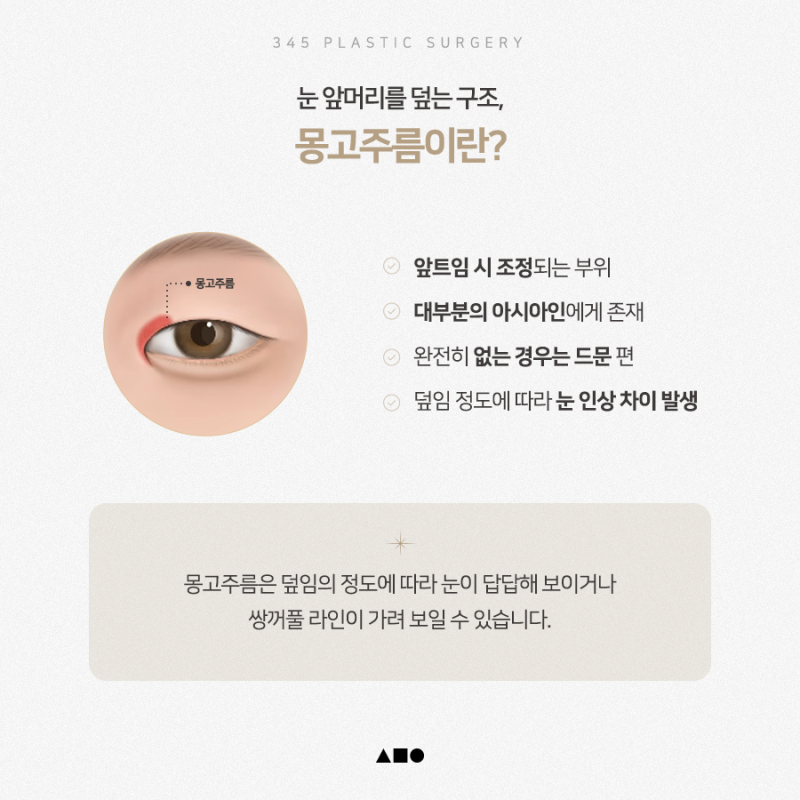
- If your eyes look blocked due to a severe epicanthic fold (Mongolian fold) covering the inner corners
- If your overall impression appears stuffy due to a short horizontal eye length
Will Lateral Canthoplasty Really Revert Over Time?
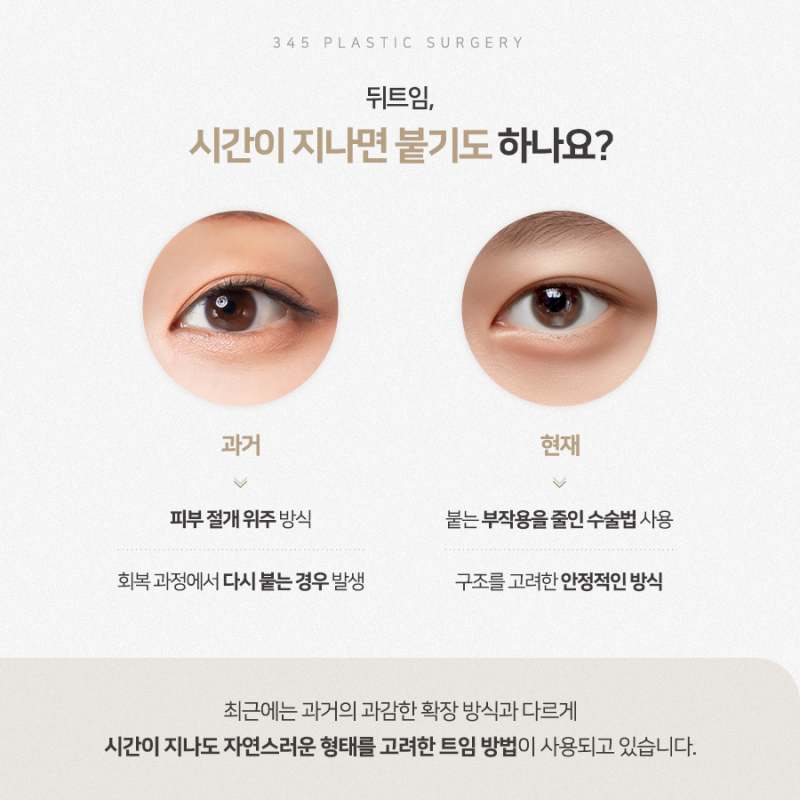
The 're-adhesion after lateral canthoplasty' phenomenon that many people worry about often stemmed from surgical methods used in the past. Previously, the surgery was mainly performed with simple skin incisions, which sometimes caused side effects where the tissues pulled together and re-adhered during the healing process.
However, recently, surgeries are performed with careful consideration of the anatomical structure around the eyes. Rather than simply cutting the skin, we use a method that meticulously fixates the inner conjunctiva of the outer eye corner and repositions the tissues. Through this, we can maintain a natural shape over time and significantly lower the chances of re-adhesion. The key is not excessive extension, but finding a stable range within your own eye structure.
What is the Difference Between Epicanthoplasty and Lateral Canthoplasty?
The core of canthoplasty is to complement the 'horizontal length' rather than the vertical width of the eyes. However, epicanthoplasty and lateral canthoplasty differ in their principles and perceived effects.
| Category | Epicanthoplasty | Lateral Canthoplasty (Lateral Epicanthoplasty) |
|---|---|---|
| Primary Target | Stuffy inner eye corners due to severe epicanthic folds | Upward-slanting outer corners or short horizontal eye length |
| Surgical Principle | Removes the epicanthic fold to expose the inner corner | Moves and expands the outer corner backward |
| Perceived Effect | Relatively distinct change in impression | Soft and gentle improvement of the eye shape |
Because epicanthoplasty exposes the inner corner of the eye that was hidden by the epicanthic fold, the change in horizontal length is felt immediately and distinctly. On the other hand, lateral canthoplasty adjusts the direction of the outer corner and extends its length, playing a role in softly balancing the overall shape of the eyes.
Synergy Effects of Dual Canthoplasty Seen Through Real Cases
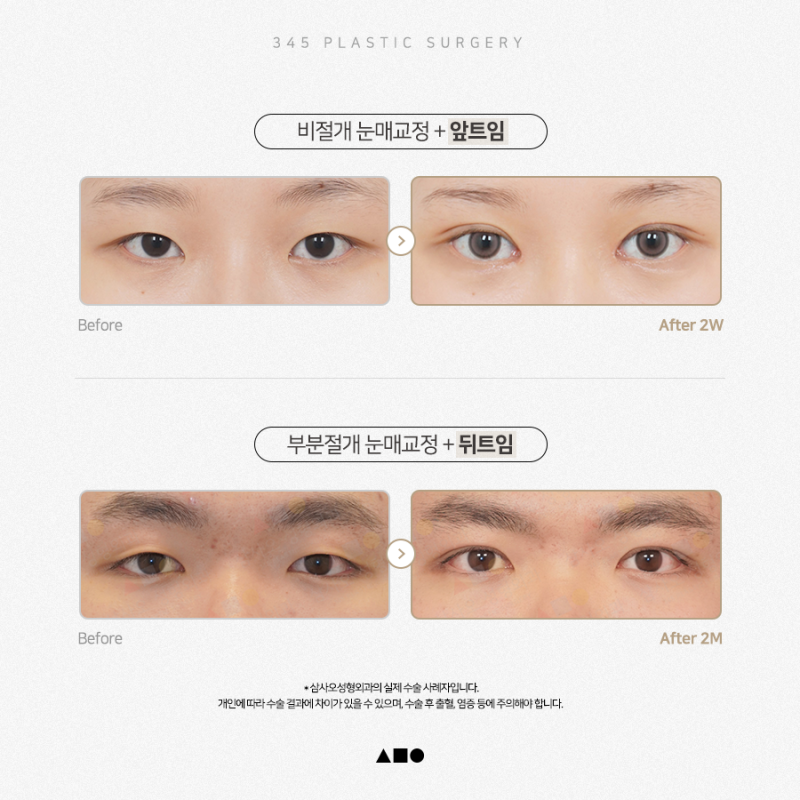
Canthoplasty can be performed alone, but visual satisfaction increases when combined with ptosis correction. For example, if non-incisional ptosis correction and epicanthoplasty are performed together, the inner corners of the eyes open up, making the impression look much more defined.
Additionally, when partial-incision ptosis correction and lateral canthoplasty are combined, you can expect the effect of gently lowering upward-slanting outer corners, improving a fierce-looking impression into a milder one. Since the appropriate direction and angle of canthoplasty differ depending on each individual's eye shape, a detailed consultation with a specialist is essential.
Safe Eye Surgery System at 345 Plastic Surgery
In plastic surgery, safety during the process and recovery stages is just as important as the results. 345 Plastic Surgery has established an environment where patients can receive treatment with peace of mind.
- 3 Resident Anesthesiologists: We maintain a safe anesthesia environment through real-time monitoring during all surgeries.
- Doctor Call System: After surgery, the operating surgeon personally checks the recovery status by phone to relieve the patient's anxiety.
- Operating Room CCTV Access: We provide a transparent surgical environment free from worries about ghost surgeries, and viewing is available for all operating rooms.
If you are worried about the horizontal length of your eyes or a stuffy impression, we recommend getting a consultation to find out which canthoplasty method is most optimized for your eye structure.


Frequently Asked Questions
Will the outer canthoplasty surgery reattach later?
No, recent surgical methods can significantly reduce the reattachment phenomenon. In the past, the procedure mainly involved skin incision, which led to re-adhesion side effects, but currently, the inner conjunctiva of the outer corner of the eye is meticulously fixed and tissues are rearranged to maintain a natural shape over time.
What is the biggest difference between epicanthoplasty and outer canthoplasty?
There is a significant difference in the surgical area and the perceived effect. Epicanthoplasty removes the Mongolian fold at the inner corner of the eye, providing an immediate and distinct change in impression. In contrast, outer canthoplasty adjusts the direction of the outer corner of the eye and extends its length, serving to gently improve the overall eye shape.
Who is dual canthoplasty recommended for?
It is recommended for those whose eyes appear stuffy due to short horizontal length. Additionally, positive effects can be expected if the eyes still look blocked after double eyelid surgery, or if you want to simultaneously form a double eyelid line and enlarge the overall eye size.
Can canthoplasty and ptosis correction be done together?
Yes, combining them further enhances visual satisfaction. Performing non-incisional ptosis correction and epicanthoplasty together can sharpen the impression, and combining partial incisional ptosis correction with outer canthoplasty can lower upturned eye corners, softening a fierce impression.
What should I check for safe eye surgery?
It is advisable to check for the presence of an anesthesiologist and the installation of CCTV in the operating room. You should proceed after detailed consultation with a specialist in a place equipped with a transparent surgical environment where an anesthesiologist monitors in real-time and proxy surgeries are prevented.