2026-06-04
Facial Contouring Revision: Timing, Causes, and Why You Should Wait 6 Months
We explore revision surgery considered when the results of facial contouring surgery are unsatisfactory or functional issues arise. From a plastic surgeon's perspective, we provide a detailed explanation of solutions for major causes such as overcorrection, undercorrection, and non-union, why a recovery period of 6 months to a year is typically required, and exceptional situations that require immediate surgery.

Why Consider Facial Contouring Revision?
Facial contouring surgery is a highly difficult procedure that refines the overall facial lines to create a soft and sophisticated image. However, some people consider facial contouring revision when the post-operative results differ from their expectations or unexpected discomfort arises.
Revision surgery is not simply repeating the previous process; it is a highly delicate procedure that requires accurately analyzing the causes of the initial surgery's failure and considering the condition of the remaining skeletal structure and soft tissues. Today, we will look at the typical situations that require revision surgery and the most appropriate timing for it.
3 Typical Cases Requiring Facial Contouring Revision
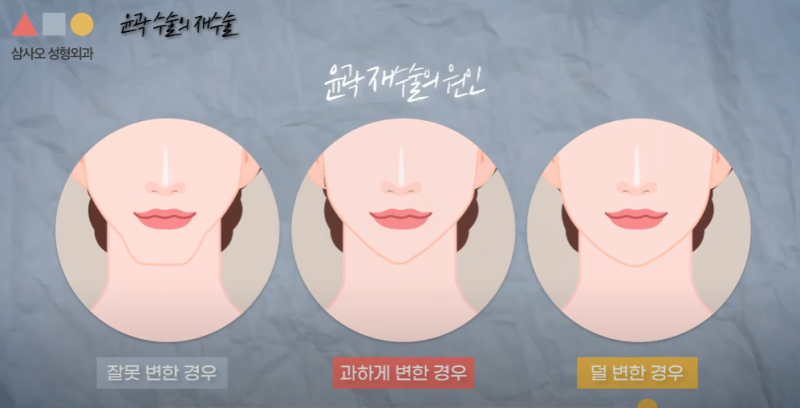
The reasons for deciding on revision surgery are broadly divided into three categories based on the degree of change and the state of fixation.
1. Undercorrection: When Changes Are Minimal
This occurs when the amount of bone reduction is insufficient, making it hard to feel the improvement, such as "I reduced my cheekbones, but the frontal effect is lacking," or "My jaw still looks wide even after square jaw surgery." In these cases, improvement can be expected through additional osteotomy or shaving.
2. Overcorrection: When Resection Is Excessive
This happens when too much bone is shaved off during square jaw surgery, causing the angle below the ear to disappear completely (often called a 'dog jaw'), or making the facial line look caved in. This can cause not only an unnatural appearance but also psychological distress, requiring precise restoration or supplementation.
3. Incorrect Deformation and Fixation Abnormalities
This is the type that requires the most careful attention. It occurs when the cut bones fail to heal together properly, resulting in non-union, or when fixation devices like screws and plates break or loosen due to excessive mastication (chewing). In such cases, the process of realigning the bones and firmly refixing them is essential.
Facial Contouring Revision Timing: When is the 'Golden Time'?
Although many patients want a quick correction, careful timing is crucial for revision surgery.
| Category | Recommended Timing | Reason |
|---|---|---|
| General Revision | 6 months to 1 year later | The period when scar tissue and soft tissues soften and the bones stabilize |
| Fixation Device Abnormality | Immediately upon discovery | Prompt refixation is required if the fixation loosens or the bones separate |
| Early Side Effects | Immediately, based on a specialist's judgment | Emergency surgery in case of severe hematoma (blood clots) or inflammation |
Typically, revision surgery for aesthetic improvement is recommended after 6 months, when the tissues in the surgical area have sufficiently recovered and are in a state that is easy to manipulate again. However, if functional problems occur, such as loosening of the fixation pins, you must visit the clinic immediately for treatment, regardless of how much time has passed.
Advice for a Safe Revision Surgery
Facial contouring revision is more difficult than the initial surgery and involves many variables to consider. It is necessary to precisely analyze how much bone remains from the previous surgery and the location of the nerve lines through CT scans. Above all, fully consulting with a specialist about the cause of your dissatisfaction and setting realistic improvement goals is the first step toward a favorable prognosis.

Frequently Asked Questions
When is the best time to undergo facial contouring revision surgery?
Generally, it is best to wait 6 months to 1 year after the initial surgery. By this time, scar tissue and soft tissues in the surgical area will have softened, and the bone will have stabilized, making it easier to manipulate again.
My fixation pins seem to have come loose, do I still need to wait 6 months?
No, you should visit the hospital immediately. If there is an issue with the fixation device, causing the bone to separate or pins to loosen, it is safest to get immediate re-fixation regardless of the time elapsed since the surgery.
After jaw reduction surgery, the angle behind my ears has completely disappeared. Is restoration possible?
Yes, precise restoration or supplementary surgery is possible. If over-correction occurred where too much bone was removed, causing the angle behind the ears to disappear, you can consult with a specialist to plan a restoration to improve the unnatural appearance.
What must be confirmed before facial contouring revision surgery?
It is essential to accurately confirm the amount of remaining bone from the previous surgery and the location of the nerve lines. For this, precise analysis such as CT scans is crucial, and it is important to consult with a specialist about the reasons for your dissatisfaction to set realistic goals.