2026-06-04
How to Maintain Facelift Results Longer? The Core Guide to SMAS Layer Lifting
The key to a facelift is not simply pulling the skin, but properly securing it from the SMAS (fascia) layer. We provide detailed information on the importance of setting a vertical lifting direction and volume correction according to each individual's facial structure and degree of aging, as well as aftercare methods to maintain the post-surgical changes.

Why Analysis Beyond Simple Skin Sagging is Necessary Before a Facelift
The changes that appear on the face as we age are not limited to simply sagging skin. The SMAS (fascia layer) beneath the skin weakens, and as the weight of fat and gravity are added, the overall impression of the entire face changes. At 345 Plastic Surgery, our top priority when considering a facelift is to accurately assess the patient's current condition and the desired degree of change.
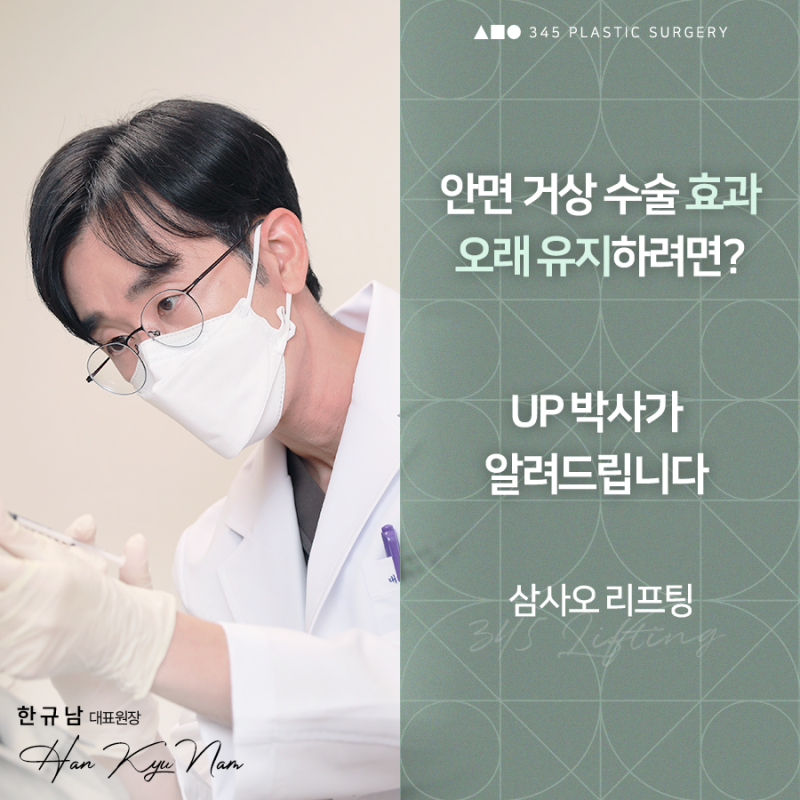
Even if elasticity is restored from a 50-something to a 40-something level through lifting surgery, deeply set wrinkles may still remain. In particular, areas with mixed structural factors, such as nasolabial folds or marionette lines, may have limitations with lifting alone. Therefore, combining procedures that add volume, such as fat grafting or fillers, helps create harmonious results.
The Core of SMAS Lifting: The Importance of Vertical Fixation
The basic principle of a facelift is to properly dissect and lift the SMAS (Superficial Musculo-Aponeurotic System), and then securely fixate it. At this time, the extent of dissection and the direction of pulling must be meticulously adjusted according to the patient's facial shape.

For Koreans, the cheekbones are often somewhat prominent, making the lifting direction crucial. If pulled excessively in a diagonal direction, there is a risk of emphasizing the cheekbone area, making the face look wider. Since gravity acts vertically downward, the technical point is to use a 'vertical lift' that counters this as a foundation, achieving natural elasticity without widening the facial width.
Comprehensive Management Strategies to Maintain Facelift Results Longer

Just as important as a precise surgery are the aftercare and maintenance strategies. This is because aging over time is accompanied not only by sagging but also by changes in facial bone structure and fat loss. The recommended methods for maintaining surgical results in the long term are as follows:
- Volume Reinforcement: Complement the lifting effect by filling in sunken areas through fat grafting or fillers.
- Energy-Based Device Management: Periodically undergo radiofrequency and ultrasound lifting treatments such as Ulthera, Thermage, and Shurink.
- Additional Lifting: If necessary, combine with light thread lifting to maintain elasticity.

In reality, an 'actually sagging state' and a 'sagging appearance' can be different. Therefore, consulting with medical professionals who have extensive clinical experience to establish an optimized, customized plan for yourself is the first step to achieving safe and satisfactory results.
Frequently Asked Questions
Can deep wrinkles all disappear with a facelift alone?
No, there may be limitations with lifting alone. For deep wrinkles with structural factors, such as nasolabial folds or marionette lines, combining a facelift with volume-filling procedures like fat grafting or fillers can achieve more harmonious and natural results.
Why is vertical fixation important during SMAS lifting?
It is to achieve natural elasticity against gravity without making the face appear wider. Koreans often have somewhat prominent cheekbones, so excessive diagonal pulling risks accentuating the cheekbones; thus, vertical lifting is recommended.
How can I maintain the effects of a facelift for a long time?
It is recommended to continue with consistent complex management after surgery. Supplementing lost volume with fat grafting or fillers, and regularly undergoing high-frequency and ultrasound device treatments like Ultherapy, Thermage, and Shurink, can help maintain the lifting effect long-term.
Can I receive additional thread lifting after surgery?
Yes, it is possible. If additional elasticity maintenance is deemed necessary over time after a facelift, combining it with a light thread lift can help complement and maintain the surgical effects.