2026-06-04
Facelift Reviews in Your 50s: Effects, Process, and Why 4-Layer SMAS Lifting is Important
Rapid facial sagging that occurs in your 50s cannot be fully addressed by simple lifting procedures alone. We explore in detail how to regain a youthful appearance from 10 years ago through the principles and actual cases of a FULL Facelift, which improves not only the skin's surface but also the deep SMAS (fascia) layer.
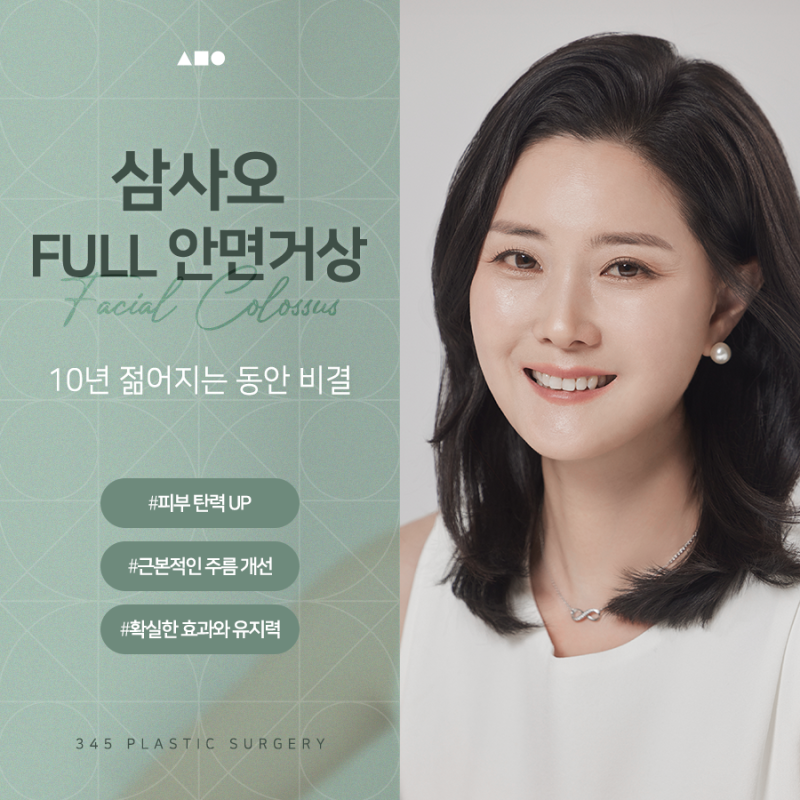
Deepening Facial Sagging with Age: Why is a Facelift Necessary?
As you enter middle age, skin elasticity drops rapidly, and nasolabial folds, jowls (bulldog cheeks), and neck wrinkles begin to stand out. Since aging progresses not only on the skin's surface but also down to the fascia layer in your 50s and beyond, non-surgical treatments like lasers or thread lifts often fall short of expectations.
To improve this fundamental sagging, the method you can consider is a FULL Facelift. This is a surgery that directly pulls the sagging skin and removes the excess tissue to create a firm facial line.
The Core of 345's FULL Facelift: 4-Layer SMAS Lifting Method
While traditional facelifts only pulled the outer surface of the skin, 345 Plastic Surgery's lifting targets the root cause of aging. The SMAS (Superficial Musculoaponeurotic System) layer is a thin membrane wrapping the muscles under the skin. Properly securing this area ensures a longer-lasting result and prevents unnatural facial expressions.
- 4-Layer Pulling System: By independently dissecting and pulling a total of 4 layers—the epidermis, SMAS layer, retaining ligaments, and temporal fascia—you can expect powerful fixation.
- Wide Dissection Range: Extensive dissection from the nasolabial folds to the neckline ensures overall facial harmony.
- Three-Dimensional Design: Rather than simply pulling upwards, a customized design is created to match each individual's bone structure and angle of sagging.
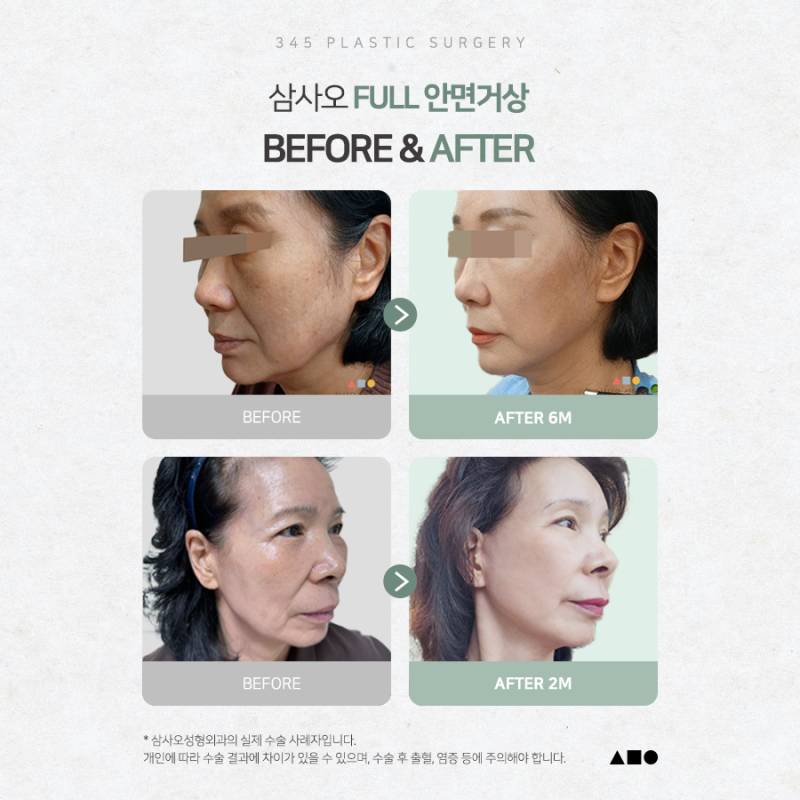
Precise Incision and Suturing Know-How: Relieving Worries About 'Pixie Ears'
One of the biggest concerns for those hesitating to get a facelift is scarring and the 'pixie ear' phenomenon, where the earlobe is stretched long. To prevent this, the surgeon's skilled suturing technique is essential.
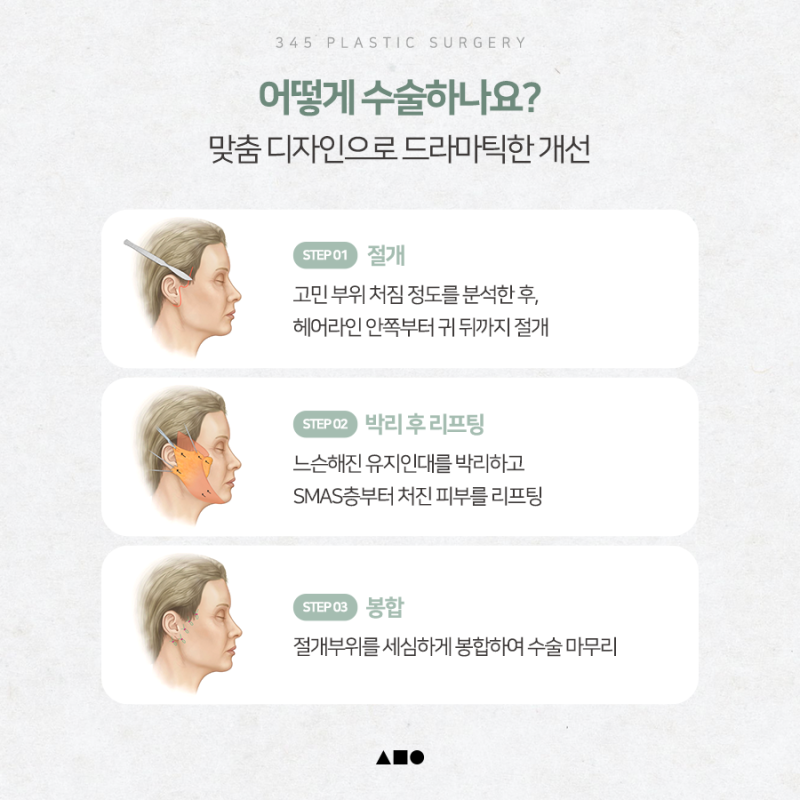
The incision line is delicately made from inside the hairline and along the front and back of the ear. Instead of forcibly pulling the skin to suture it, the tension is sufficiently distributed and secured within the internal tissue (SMAS). Thanks to this, the burden of scarring is reduced, a natural earlobe shape is maintained, and a stable recovery is possible.
345 Plastic Surgery's 3 Principles for Safe Results
Safety is just as important as surgical satisfaction. 345 Plastic Surgery implements patient-centered care by establishing university hospital-level safety equipment and systems.
- 3 Resident Anesthesiologists: The anesthesia status is monitored in real-time throughout the entire surgical process.
- DOCTOR CALL System: After surgery, the operating surgeon personally checks the progress to meticulously confirm if there are any abnormalities.
- 1:1 Customized Aftercare: We provide systematic care tailored to each individual's recovery speed to help them quickly return to their daily lives.
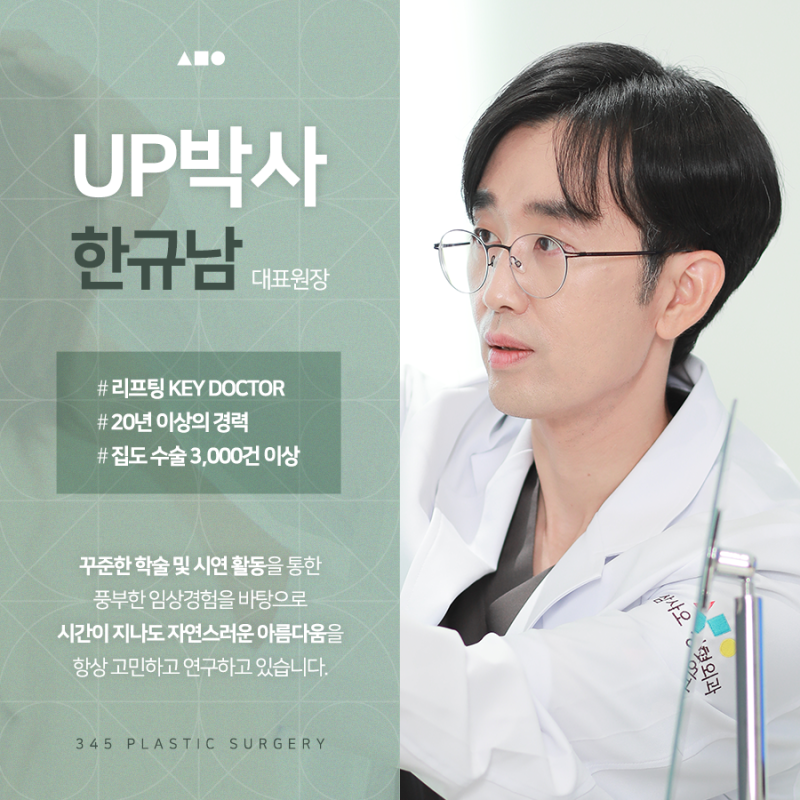
Dr. Han Kyu-nam, a lifting Key Doctor with over 20 years of experience, accurately analyzes the mechanisms of aging to propose the most suitable solution for each patient. Rather than excessive surgery, he aims for natural improvements that enhance your inherent beauty.

Frequently Asked Questions
Why is a facelift necessary after the age of 50?
Yes, after the age of 50, aging progresses to the SMAS layer. Non-surgical methods like laser or thread lifts alone make it difficult to improve deep sagging, so a FULL facelift, which directly pulls the sagging skin and removes excess tissue, can be a fundamental solution.
How is the SMAS layer 4-layer lifting performed?
It is a method that independently dissects and pulls a total of four layers: the epidermis, SMAS layer, retaining ligaments, and temporal fascia. Instead of just pulling the surface of the skin, it properly fixes the SMAS layer, which is the fundamental cause of aging, resulting in a longer-lasting effect and natural facial expressions.
Will there be a 'pixie ear' deformity after a facelift?
No, a 'pixie ear' phenomenon can be prevented through precise suturing techniques. Instead of forcibly pulling and suturing the skin, the force is sufficiently distributed and fixed in the internal SMAS layer, allowing for a natural earlobe shape and reducing the burden of scars.
Is anesthesia administered safely during surgery?
Yes, three anesthesiologists are on-site to monitor the patient's anesthetic state in real-time throughout the entire surgical process. We are equipped with university hospital-level safety equipment and systems to ensure patients can undergo surgery in a safer environment.
How is post-operative care managed?
After surgery, a DOCTOR CALL system is operated where the operating surgeon directly checks the progress. Additionally, we provide 1:1 customized post-operative care tailored to each patient's recovery speed to help them return to daily life quickly with systematic care.