2026-06-04
Worried About Sagging Skin After Dieting? SMAS Facelift to Resolve Premature Aging After Weight Loss
Facial sagging and wrinkles after rapid weight loss are not just skin-deep problems. We introduce the principles of customized lifting that pulls from the SMAS layer to fundamentally resolve skin elasticity that couldn't keep up with the speed of fat loss, along with age-specific solutions.

Slimmer Body After Dieting, But Why Does the Face Look Older?
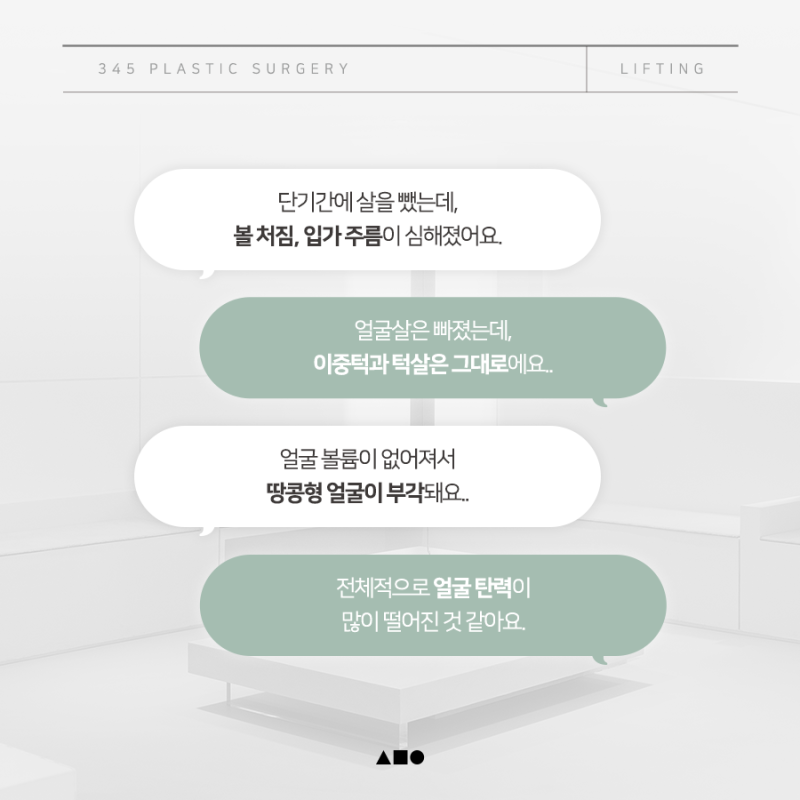
Many people successfully lose weight through dieting, only to be dismayed when they look in the mirror and see themselves looking older than before. This happens because the fat that maintained facial volume is lost during rapid weight loss, and the skin loses its elasticity as it fails to keep up with the speed of this change.
As cheek fat diminishes, the areas around the cheekbones become hollow, and the sagging skin forms jowls around the mouth or a double chin. This phenomenon of sagging skin after dieting has limits to how much it can be improved with simple home care or cosmetics alone, requiring a lifting approach that considers the deep tissues of the skin.
The Key is Improving the SMAS Layer, Not Just a Simple Skin Lift
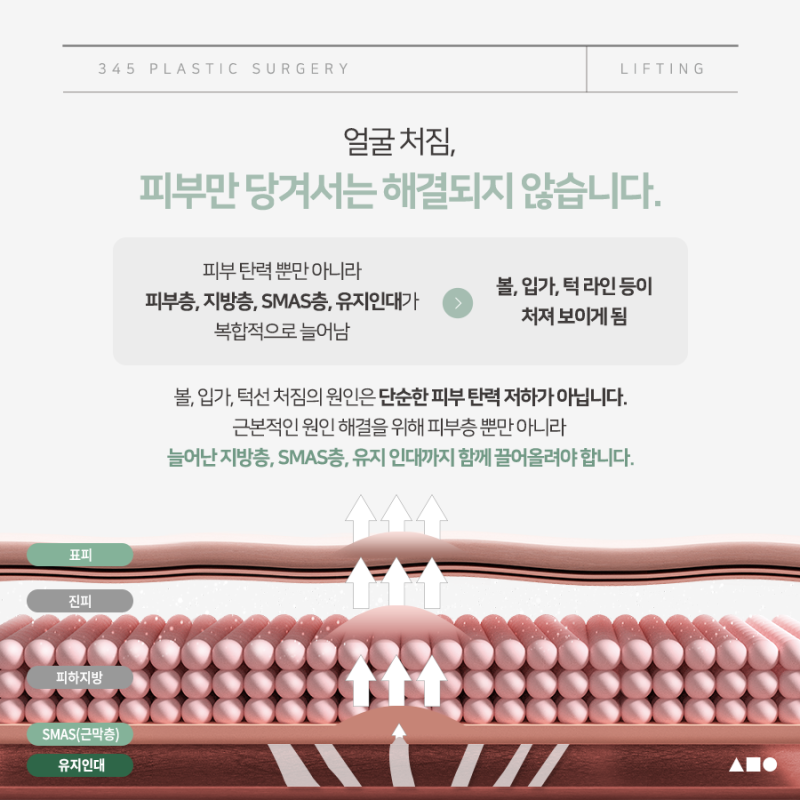
To effectively improve sagging caused by dieting, it is necessary to correct not only the outer surface of the skin but also the subcutaneous fat layer, the SMAS (Superficial Musculoaponeurotic System) layer, and the retaining ligaments that support them.
The SMAS layer is a thin membrane surrounding the muscles and is a core structure that determines facial elasticity. 345 Plastic Surgery's N-Lifting SMAS Facelift firmly pulls up and secures from this SMAS layer, helping to restore natural, non-artificial facial contours.
Customized N-Lifting Solutions Based on Age and Degree of Sagging
Since the degree of sagging and skin condition after dieting varies from person to person, a detailed surgical plan tailored to the concerns of each age group is crucial.
- N3 SMAS Facelift (Recommended for 30s): Refines a collapsed jawline and maintains volume to prevent early signs of sagging and create a well-defined line.
- N4 SMAS Facelift (Recommended for 40s): Improves deepening nasolabial folds and wrinkles around the mouth, focusing on restoring skin elasticity and maintaining facial dimensionality.
- N5 SMAS Facelift (Recommended for 50s and above): A comprehensive lifting procedure that improves overall facial sagging and removes drooping tissues such as buccal fat to restore elasticity down to the deep layers.
345 Plastic Surgery's Systematic System for Safe Recovery
In lifting surgeries, the safety of the process and post-operative care are just as important as the results. At 345 Plastic Surgery, we have established an environment where patients can receive treatment with peace of mind.
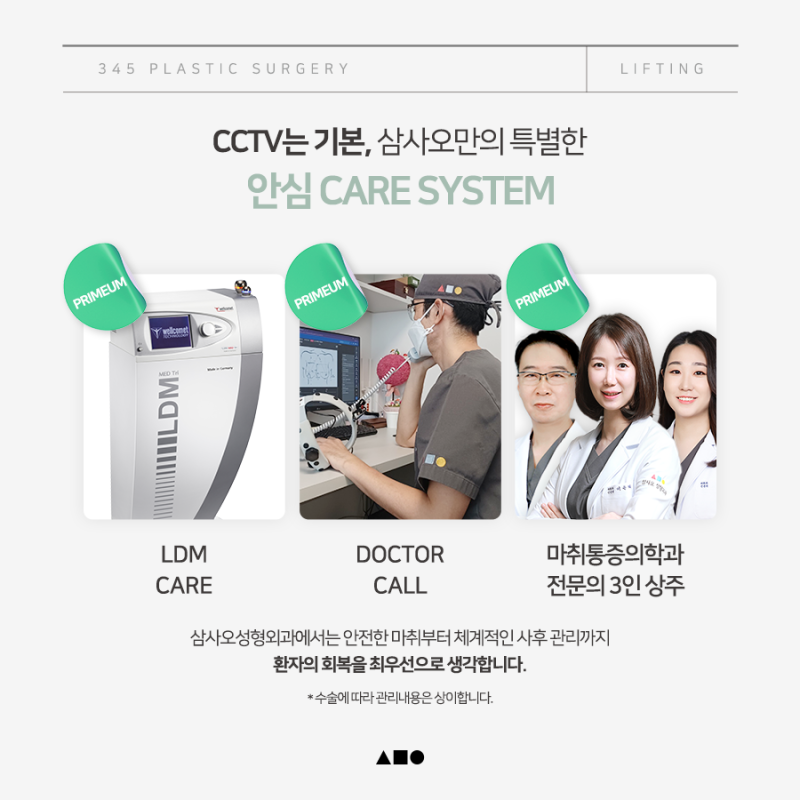
- In-house Anesthesiologist: Dedicated to the anesthesia process before, during, and after surgery to enhance safety.
- Doctor Call System: The attending surgeon personally checks your recovery status the day after surgery to answer any questions you may have.
- Transparent Operations: We provide a trustworthy surgical environment by installing CCTVs in the operating rooms.
If you are feeling a sense of loss due to a sagging face after dieting, the first priority is to accurately analyze your facial structure and elasticity status. We encourage you to find the most suitable lifting method for you through a thorough consultation with our experienced medical staff.
Frequently Asked Questions
Why does facial skin sag after dieting?
Yes, rapid weight loss causes fat to disappear, leading to a loss of skin elasticity. As the fat that maintained volume decreases and the skin cannot keep up with the changes, sagging phenomena such as hollowed cheekbones, jowls around the mouth, and double chin occur.
Can diet-related skin sagging be resolved with cosmetics?
No, there are limitations to improvement with simple home care or cosmetics alone. To effectively resolve deep sagging caused by dieting, a lifting approach is needed that corrects not only the skin surface but also the underlying fat layer, SMAS layer, and retaining ligaments.
How does SMAS rhytidectomy work?
It works by firmly lifting and fixing the SMAS layer beneath the skin. Rather than just pulling the skin surface, it corrects the SMAS layer and retaining ligaments, which are key structures determining facial elasticity, helping to restore a natural facial contour without an artificial look.
Does the method of rhytidectomy differ by age group?
Yes, it is customized according to age and degree of sagging. In their 30s, the focus is on refining the jawline and preventing initial sagging. In their 40s, the emphasis is on improving nasolabial folds and perioral wrinkles. For those 50 and older, sagging tissues such as deep jowls are removed to restore overall facial elasticity.
How are safety and post-operative care managed after surgery?
An anesthesiologist is always present, and the attending surgeon personally checks the recovery status the day after surgery. Samsaoh Plastic Surgery enhances safety by having an anesthesiology specialist manage the entire anesthesia process before and after surgery, and operates transparently and safely through a doctor call system and CCTV in the operating room.