2026-06-04
Facelift Review in Your 60s: Achieving Anti-Aging Results with an Endoscopic Forehead Lift
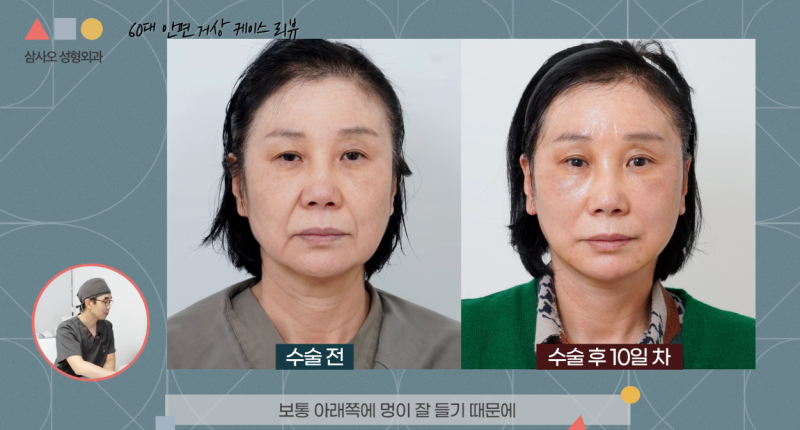
We introduce a detailed case of a combined facelift and endoscopic forehead lift for a woman in her early 60s. Discover the professional anti-aging process that simultaneously improves sagging and volume loss caused by aging while balancing the upper, middle, and lower face.
The Core of Anti-Aging in Your 60s: The Harmony of a Facelift and Endoscopic Forehead Lift
Hello. This is 345 Plastic Surgery. Today, we will look at a total anti-aging process combining a facelift and an endoscopic forehead lift through the case of a female patient in her early 60s. This case goes beyond a simple lifting procedure, organically improving both the upper and lower face to bring about a much more natural transformation.
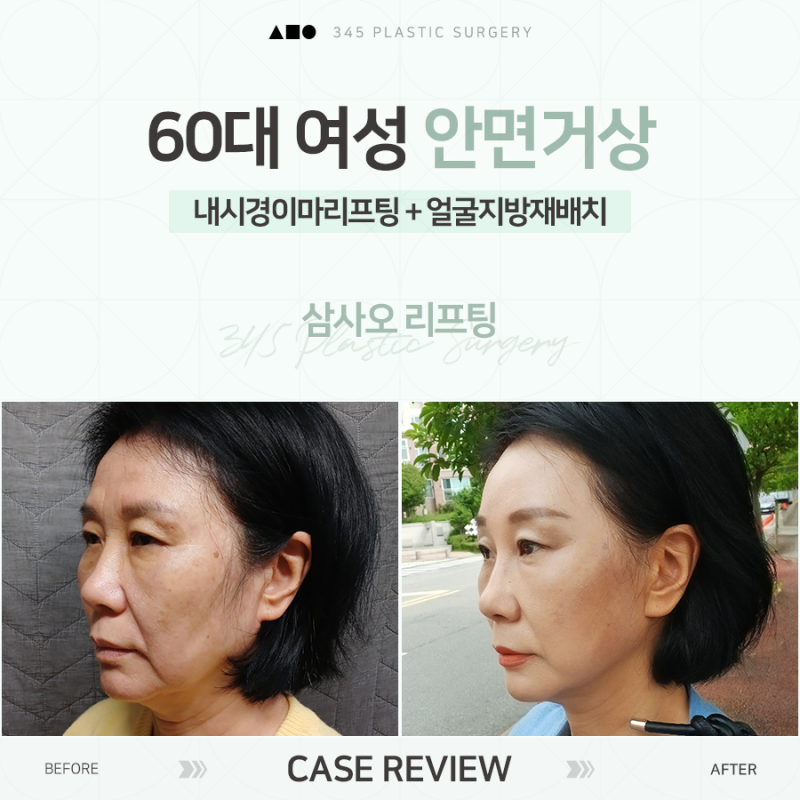
Pre-operative Diagnosis: The Complex Issue of 'Sagging' and 'Volume Loss' Due to Aging
The most common changes that appear on the face as we age are tissue 'sagging' and 'volume loss'. The patient was particularly concerned about changes around her eyes, mid-face, and jawline.
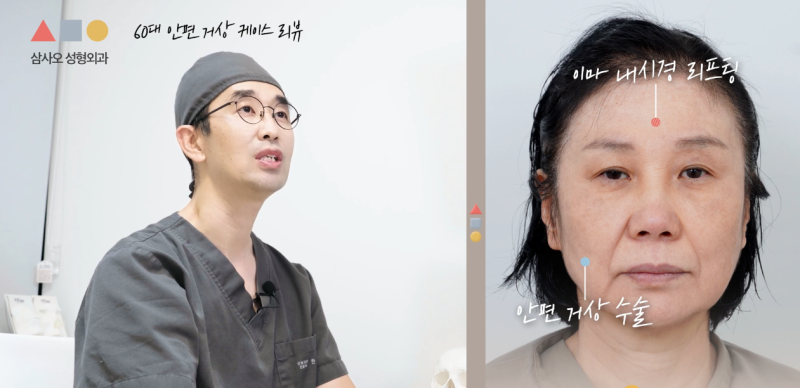
As a result of a precise diagnosis, rather than an issue with the eyes themselves, the eyebrows and forehead had descended, making her expression look heavy and tired. In such cases, even without performing separate upper or lower blepharoplasty, improvement can be expected simply by correcting the position of the forehead and eyebrows.
Personalized Surgical Plan: Total Lifting of the Upper, Mid, and Lower Face
Considering the overall facial balance, we planned the following multifaceted approach:
- Endoscopic Forehead Lift: Elevates the sagging eyebrows and forehead to improve heavy-looking eyes and overall expression.
- Facelift and Neck Lift: Repositions the sagging tissues of the mid and lower face and sharply defines the blurred jawline.
- Concurrent Fat Management: Completes a smooth facial contour through buccal fat removal, submental (under chin) liposuction, and facial fat grafting.
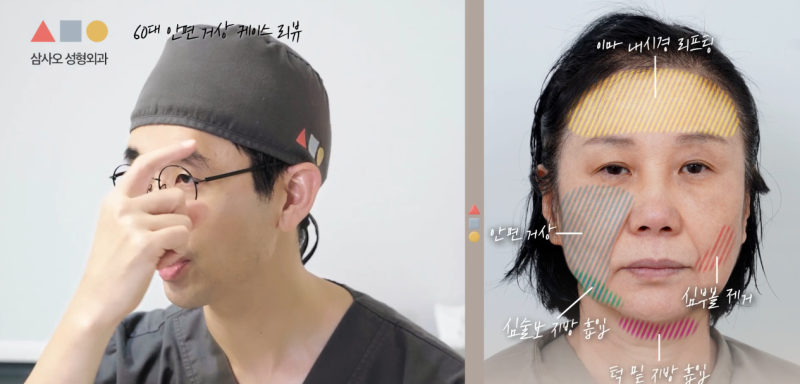
Particularly at 345 Plastic Surgery, buccal fat removal is performed concurrently in about 70-80% of lifting surgery cases. This is to enhance the quality of the procedure by simultaneously improving the deep fat layer, which is a fundamental cause of sagging.
Mid-face Improvement and Precise Incision Design
The core of a facelift is to pull the descended mid-face tissues in the correct direction, unlike the fixed outer tissues. Through this, deepened nasolabial folds and marionette lines around the mouth can be alleviated.
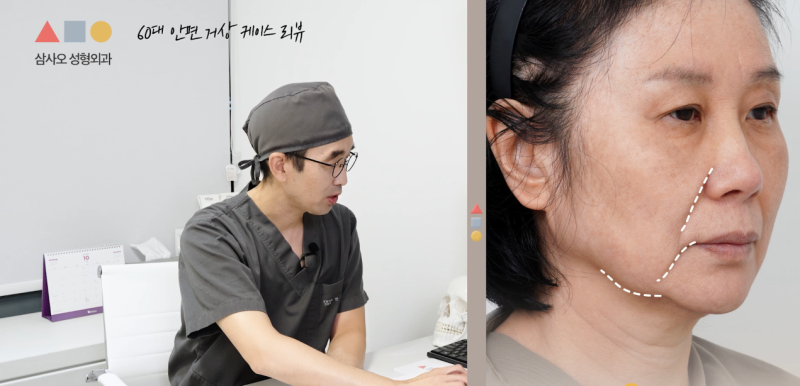
The surgery takes about 3.5 to 4 hours and was performed under twilight sedation for the patient's comfort. The incision line was delicately designed along the border of the 'tragus' in front of the ear to reduce the burden of scarring.
Recovery Progress: From Suture Removal on Day 10 to 6 Months Post-Op
Sutures are removed on the 10th day after surgery. During this period, some swelling remains, but it is a stage of stable recovery without severe bruising. It is also the time when the refinement of the jawline and mouth area becomes visibly apparent.
In the case of an endoscopic forehead lift, the incisions are made within the scalp, so there is little concern about external exposure. The facelift incision line also extends inside the scalp and behind the ear, making it easily concealable with everyday hairstyles.
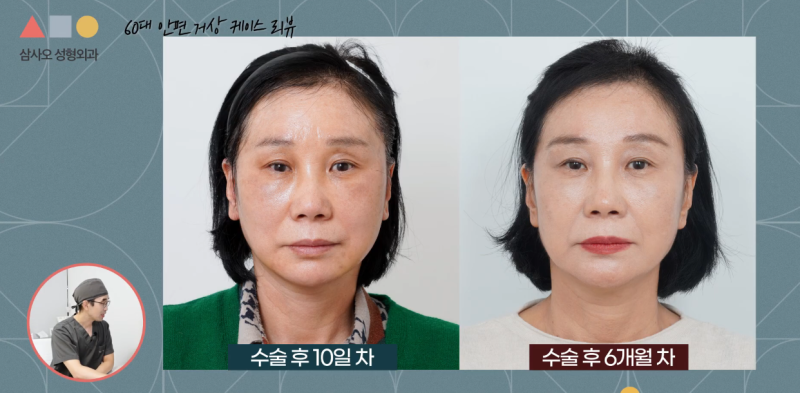
After 6 months, the swelling subsides sufficiently, and the natural results are complete. Over time, the incision scars fade to blend with the skin tone, becoming barely noticeable.
Conclusion: A Harmonious Transformation Beyond Simple Pulling
A lift is not simply a surgery that pulls the skin. It requires a customized solution that accurately analyzes the cause of sagging and considers the overall balance from the forehead to the neckline. If you are currently deeply concerned about facial aging, we recommend starting with an accurate diagnosis of your condition.



Frequently Asked Questions
How long does a facelift and endoscopic brow lift surgery take?
It takes approximately 3 hours 30 minutes to 4 hours. The surgery is performed under general anesthesia for the patient's comfort, and a total lifting of the upper, middle, and lower face is performed, considering the overall balance from the forehead to the neckline.
When are the stitches removed after surgery?
Stitches are removed 10 days after surgery. At this time, some swelling may remain, but it is a stable recovery stage without severe bruising, and you can visually confirm that the jawline and mouth lines have been refined.
I'm worried about significant scarring after a facelift.
Since the incision is made delicately along the tragal border in front of the ear, you can significantly reduce concerns about scarring. The incision line extends to the inside of the scalp and behind the ear, making it coverable with everyday hairstyles, and after 6 months, it becomes similar to skin color and is not easily noticeable.
My eyes look stuffy; do I need to get upper eyelid surgery separately?
You don't necessarily need to get it separately. If the heavy impression is due to sagging eyebrows and forehead rather than a problem with the eyes themselves, an endoscopic brow lift to correct the position of the eyebrows and forehead can sufficiently improve the stuffy eye shape.
Can deep cheek fat removal be done simultaneously with lifting surgery?
Yes, it can be done together. In the case of the hospital mentioned in the text, deep cheek fat removal is performed concurrently with lifting surgery in about 70 to 80 percent of cases. By improving the deep fat layer that causes sagging, the completeness of the surgery is enhanced.