2026-06-04
Worried About Cheek Sagging After Zygoma Reduction in Your 40s? Achieve Elasticity with Contour Lifting 'Gwang-fting'
When considering zygoma reduction in your 40s, the biggest concerns are decreased skin elasticity and cheek sagging after surgery. 345 Plastic Surgery's 'Double Adhesion Gwang-fting' is a specialized surgical method that performs zygoma reduction and lifting simultaneously, allowing you to expect both a smooth contour line and an elastic V-line.

Facial Contouring Concerns in Your 40s: How to Achieve Zygoma Reduction and Elasticity Simultaneously
Facial contouring, once considered exclusive to those in their 20s and 30s, has recently been gaining significant interest among individuals in their 40s and older. This is because prominent cheekbone lines and sagging skin that come with age can make one's impression appear harsh and tired. However, since skin elasticity in your 40s is different from your 20s, there is a concern that simply reducing the bone may worsen cheek sagging after surgery.
To resolve these concerns, 345 Plastic Surgery has devised 'Double Adhesion Gwang-fting', which combines zygoma reduction with powerful lifting. This is a method that simultaneously aims for two goals: a small, three-dimensional face shape and an elastic V-line.
The Principle of 'Double Adhesion Gwang-fting' That Alleviates Concerns About Cheek Sagging
Due to their anatomical characteristics, Koreans often have laterally protruding cheekbones (zygoma) and seek to soften their impression through zygoma reduction. Gwang-fting goes beyond simple bone surgery and focuses on preventing the sagging of soft tissues that can occur during the surgical process.
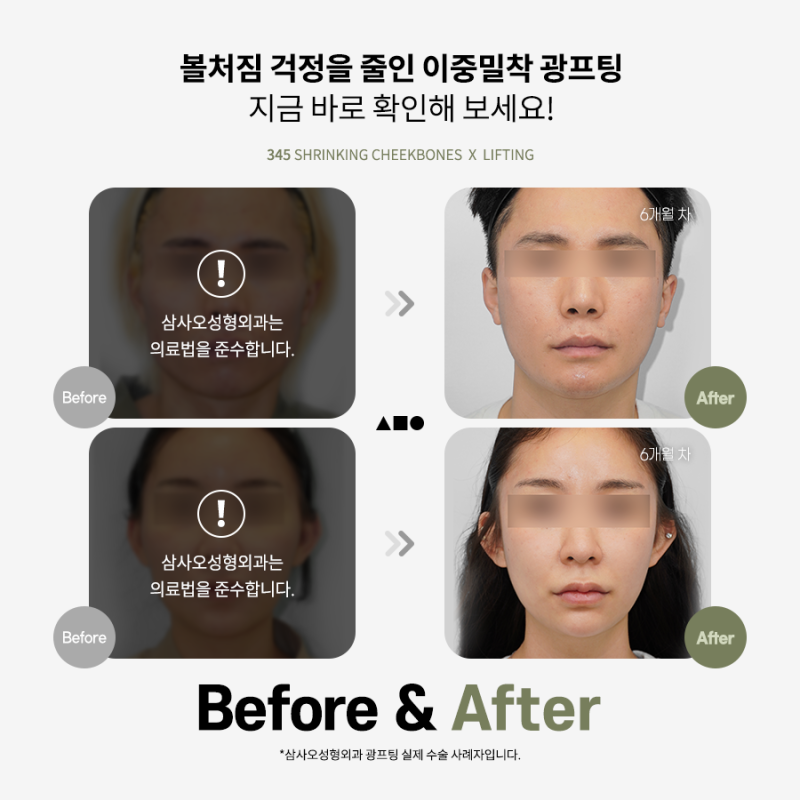
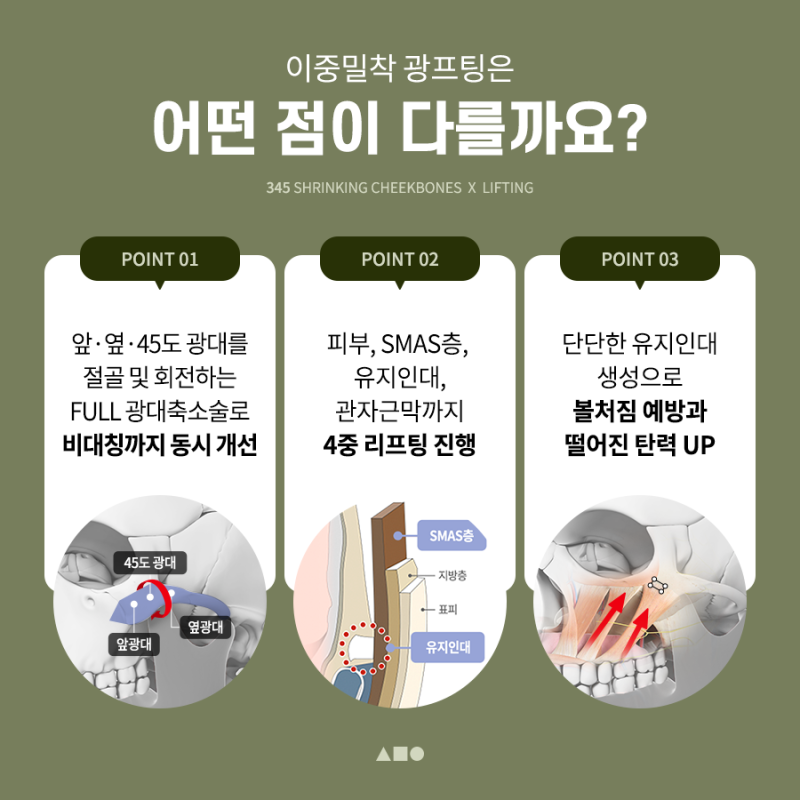
3 Differentiating Features of 345's Gwang-fting
- Complex Zygoma Improvement: It simultaneously adjusts the front cheekbones, side cheekbones, and 45-degree cheekbones to create a smooth line from any angle.
- 4-Step Lifting System: It secures powerful fixation by pulling not only the skin surface but also the SMAS (superficial musculoaponeurotic system) layer, retaining ligaments, and temporal fascia in a total of 4 steps.
- Induction of Artificial Retaining Ligament Formation: It induces the formation of firm retaining ligaments in the dissected area, helping to maintain elasticity for a long time after surgery.
Reasons for Combining Zygoma Reduction and Lifting, and Their Synergy Effects
Our facial bones and soft tissues (flesh) are closely connected. When the volume of the bone is reduced, the remaining skin tissue may sag downwards due to gravity. By fixing this upward with a lifting procedure, a much more harmonious result can be achieved.
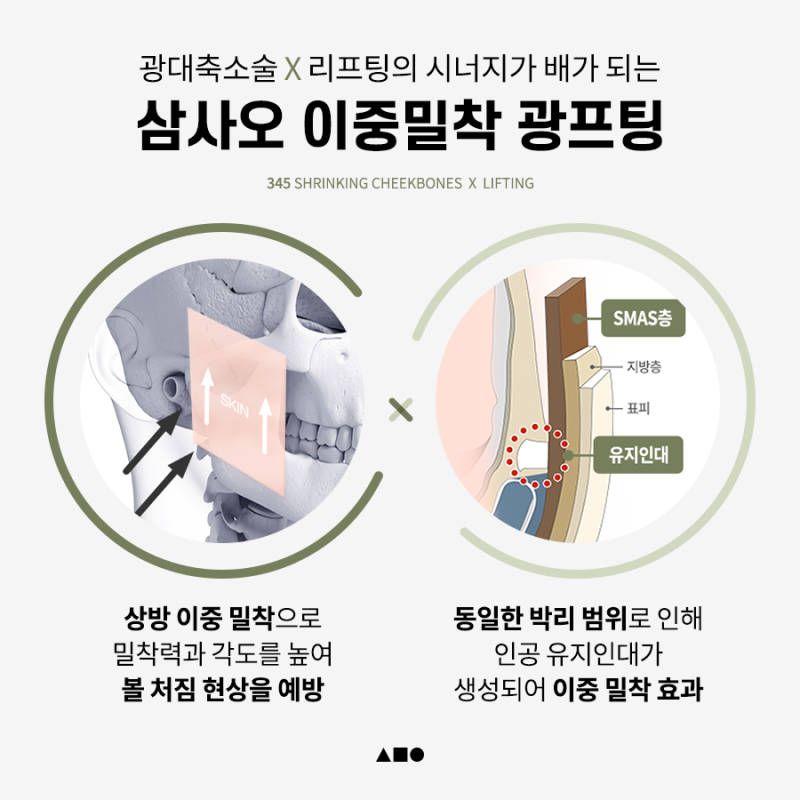
Gwang-fting uses an 'upward double adhesion' method to precisely control the adhesion and angle. Because lifting is performed concurrently within the same dissection range, you can expect a synergy where the adhesion effect is further enhanced during the process of artificial retaining ligament formation.
We Recommend 345 Gwang-fting to the Following Individuals

- Those who want zygoma reduction but are worried about cheek sagging after surgery
- Those whose impression appears harsh and strong due to protruding cheekbones
- Those whose face looks large due to a combination of large cheekbones and sagging skin
- Those who are older and concerned about recovery and decreased elasticity after contouring surgery
- Those who have sunken areas below the side cheekbones, giving a skeletal appearance
If you fall into any of these categories, it is important to consult with an experienced specialist to create a plan tailored to your bone structure and skin condition.
The Importance of Experienced Specialists and Safety Systems
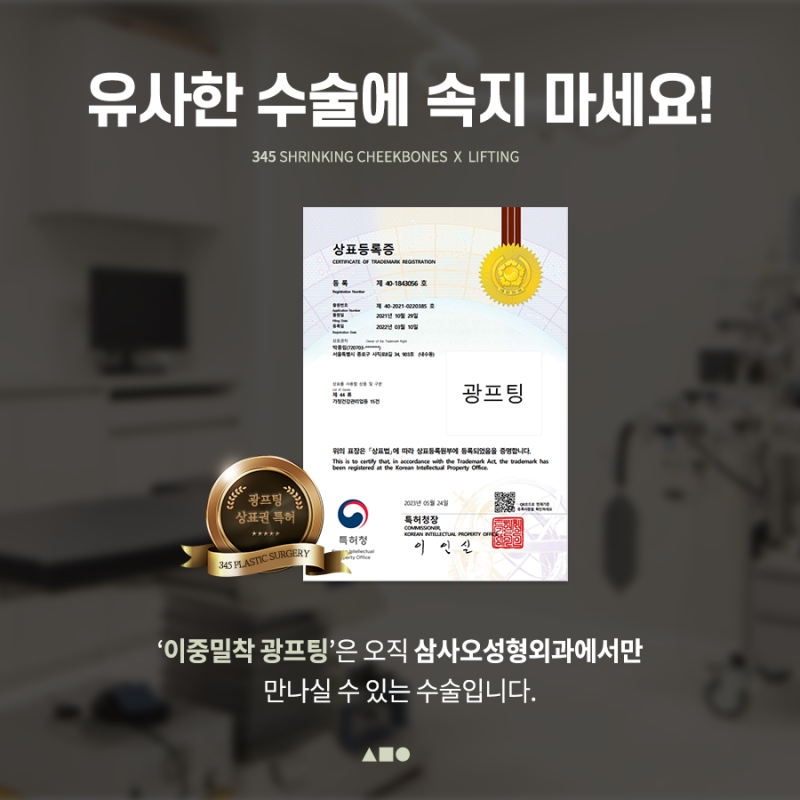
Gwang-fting is an exclusive surgical method for which 345 Plastic Surgery has officially registered a trademark. Through the collaborative treatment of specialists in each field, Chief Director Dr. Jong-lim Park (in charge of facial contouring) and Chief Director Dr. Kyu-nam Han (in charge of lifting), precise surgery is performed to address both bone and soft tissue simultaneously.
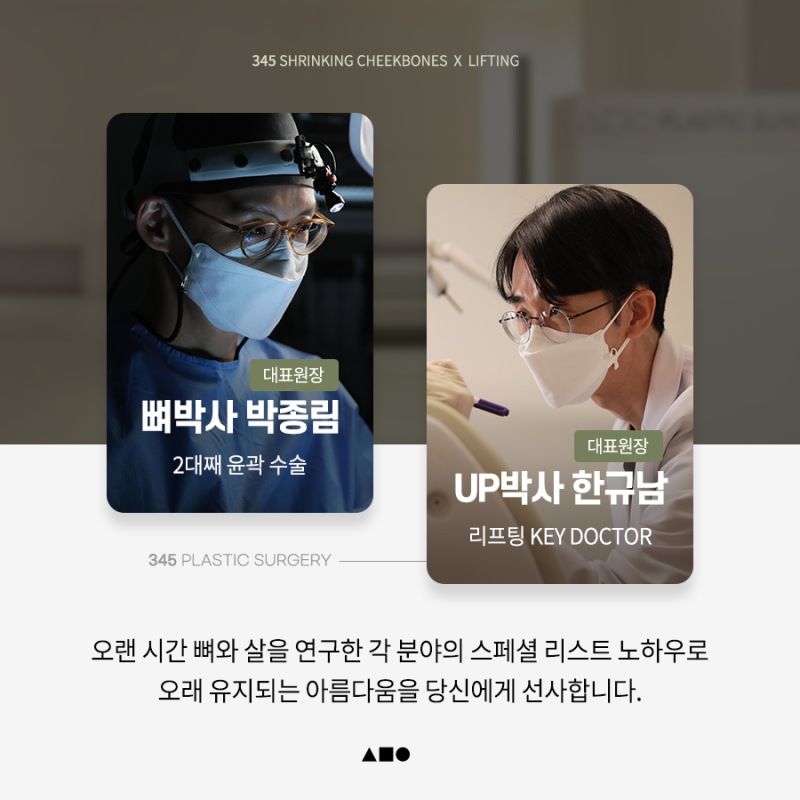
In addition, we have established a university hospital-level safety system to thoroughly monitor the entire anesthesia and surgical process, and we help patients recover well through systematic aftercare programs such as DOCTOR CALL. A slender face shape free from sagging concerns begins with an accurate diagnosis.


If you have any further questions, please contact 345 Plastic Surgery, and we will provide you with detailed information.



Frequently Asked Questions
If I undergo zygoma reduction surgery in my 40s, will my cheeks sag more severely?
Yes, compared to your 20s, skin elasticity is reduced, so if only the bone is reduced, there is a high possibility of cheek sagging. When the volume of the bone decreases, the remaining skin tissue can sag due to gravity, so it is recommended to combine it with lifting to prevent this.
How does 'Kwang-Pting' surgery work?
'Kwang-Pting' surgery combines zygoma reduction with a 4-stage lifting system. After adjusting the bone of the anterior zygoma, lateral zygoma, and 45-degree zygoma, the soft tissues are pulled upwards and fixed in a total of 4 stages, from the skin surface to the SMAS (fascia) layer, retaining ligaments, and temporal fascia, thereby preventing sagging and increasing elasticity.
Can I extend the duration of elasticity after 'Kwang-Pting' surgery?
Yes, it induces the creation of artificial retaining ligaments to help maintain elasticity for a longer period. Since lifting is performed within the same dissection range, you can expect a synergistic effect where the adhesion effect is further enhanced during the process of forming firm retaining ligaments in the surgical area.
Who is 'Kwang-Pting' recommended for?
'Kwang-Pting' is recommended for those who are concerned about cheek sagging after zygoma surgery, or those whose faces appear larger due to prominent cheekbones and sagging skin. It is also suitable for those who are older and concerned about recovery and loss of elasticity after contouring surgery, or those whose faces appear skull-like due to hollows below the lateral cheekbones.
Who performs the surgery?
The surgery is performed collaboratively by a specialist in facial contouring and a specialist in lifting. As it is a delicate surgery that deals with both bone and soft tissue simultaneously, the two chief surgeons, who are specialists in their respective fields, participate together to achieve safer and more harmonious results.