2026-06-04
Considering a Lifting Procedure in Your 30s and 40s? Features and Effects of Minimal Incision SMAS Lifting
The 30s and 40s are a time when skin elasticity begins to significantly decline, making nasolabial folds and sagging jowls more noticeable. We provide a detailed overview of the principles of minimal incision lifting—which pulls the deep SMAS (fascia) layer vertically to help achieve natural facial improvement without accentuating the cheekbones, rather than just pulling the skin surface—along with customized solutions for each age group.
Why Lifting is Needed in Your 30s and 40s: Aging of the Deep SMAS Layer
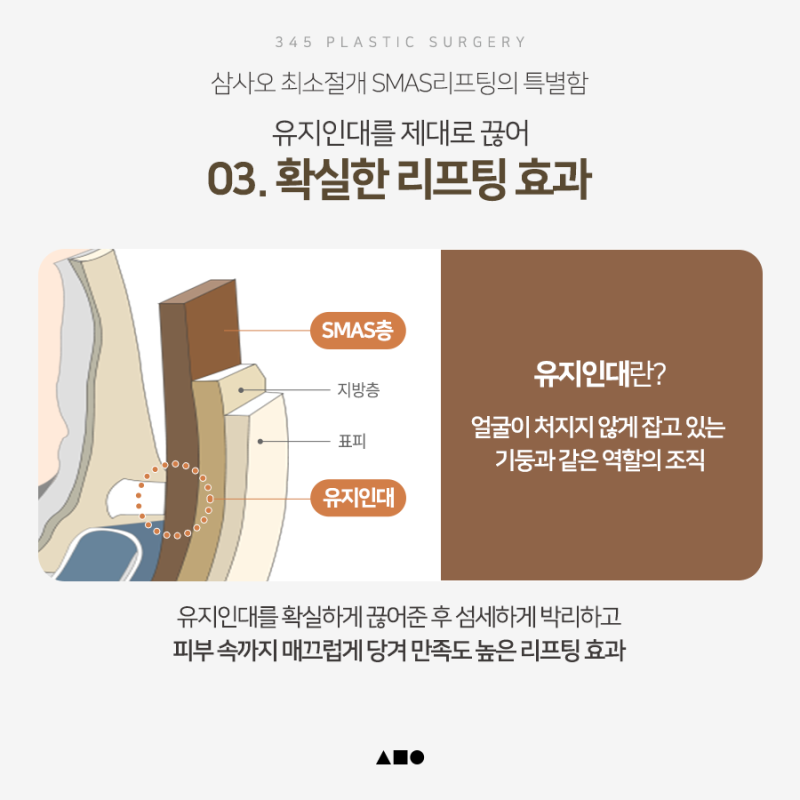
Our face is not simply made up of the outer skin (epidermis). Beneath the epidermis, dermis, and fat layers lies a thin membrane that wraps around the muscles known as the SMAS (Superficial Musculo-Aponeurotic System). As collagen and elastin decrease during the natural aging process, this fascial layer also loses its elasticity and begins to sag.
Therefore, if you want to improve noticeable wrinkles as you enter your 30s and 40s, the key is not just pulling the skin's surface, but lifting the deeper layers of the skin together.
3 Core Points of 345 Plastic Surgery's Minimal Incision SMAS Lifting
The minimal incision lifting performed at 345 Plastic Surgery aims for natural results through a more precise approach than conventional methods.
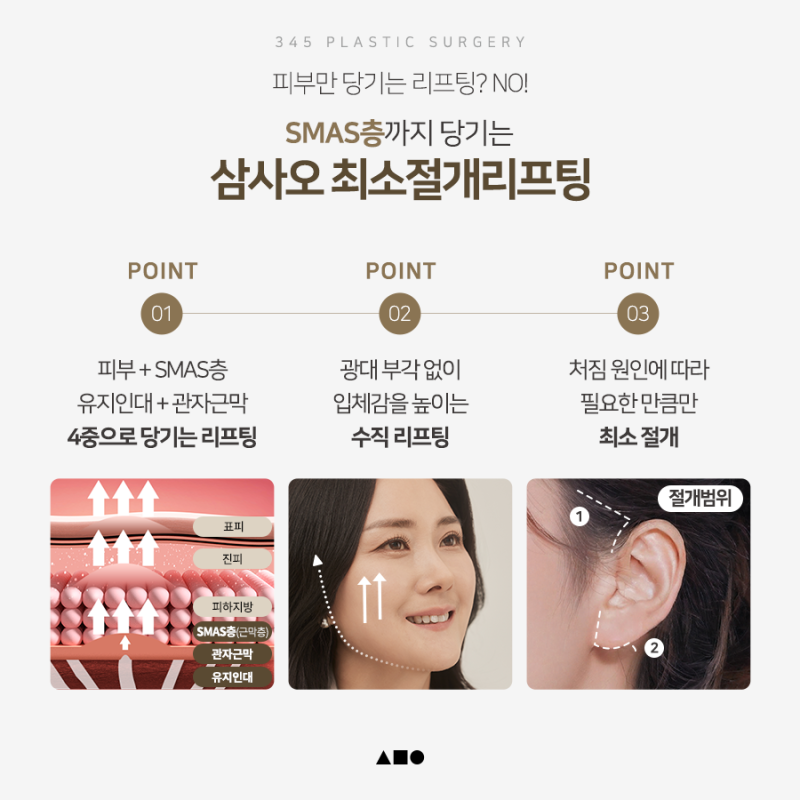
1. 4-Layer Lifting Including the SMAS Layer
If only the skin is pulled, the retention period can be short and the results may look unnatural. To compensate for this, we pull four layers—including the SMAS layer, retaining ligaments, and temporal fascia—to provide firm fixation and noticeable improvement effects.
2. 'Vertical Lifting' Without Worrying About Accentuating Cheekbones
Skin sagging occurs downwards in the direction of gravity. If it is only pulled horizontally (sideways), the cheekbones may appear more prominent. The 345 method pulls in a vertical direction, enhancing the three-dimensional contour of the face while preventing the cheekbones from looking larger.
3. Minimal Incision to Reduce the Burden of Scarring and Hair Loss
Incisions are selectively made in inconspicuous areas, such as inside the hairline or behind the ears. In particular, because the incisions are made avoiding the hair follicles, it reduces concerns about scarring or hair loss after the procedure, promoting a smooth recovery.
Customized Incision Points Based on Your Areas of Concern
It is important to have a custom design that applies different incision locations depending on the individual's state of aging and areas of concern.
- Nasolabial Folds and Wrinkles Around the Mouth: Intensively improves the mid-face through incisions inside the scalp and above the ears.
- Collapsed Jawline and Sagging Jowls: Clears up sagging skin in the lower face through incisions behind the ears to form a smooth V-line.
In particular, the retaining ligaments, which act as the pillars of the face, must be delicately dissected and released so that the pulling force is fully transmitted deep into the skin to complete a smooth line.
Recommended Lifting Solutions by Age Group
Since the progression of aging varies from person to person, a step-by-step approach is necessary.
| Age Group | Recommended Procedure | Features |
|---|---|---|
| 20s & 30s | Mini Lifting | Improves early aging and mild sagging |
| 30s & 40s | Minimal Incision Lifting | Improves full-fledged wrinkles and loss of elasticity |
| 40s & 50s | SMAS Volume Lift | Improves sagging while creating volume through fat repositioning |
| 50s and above | Full Facelift | Powerful improvement of deep wrinkles and overall skin sagging |
Even for the same lifting procedure, establishing a suitable plan for yourself through thorough consultation with experienced medical staff who have a high anatomical understanding is the first step toward safe and satisfactory results.
Frequently Asked Questions
What are the important considerations for lifting procedures in people in their 30s and 40s?
It is most important to lift not only the surface of the skin but also the deep fascial layer (SMAS). As collagen and elastin decrease due to aging, the fascial layer also loses elasticity and sags, so lifting the deep layers of the skin can achieve noticeable wrinkle improvement.
I'm worried that my cheekbones might look bigger after a lifting procedure.
Lifting in a vertical direction can prevent the cheekbones from appearing more prominent. If the skin is pulled only horizontally or sideways, the cheekbones may stand out, but pulling vertically can enhance the facial contours while preventing the cheekbones from looking larger.
Are there any risks of scarring or hair loss with minimally invasive lifting?
Yes, the burden of scarring and hair loss can be significantly reduced. Incisions are selectively made in inconspicuous areas such as inside the hairline or behind the ears, and specifically, the incisions avoid hair follicles, resulting in good recovery after the procedure and less concern about hair loss.
How are nasolabial folds and a sagging jawline surgically treated?
The surgical approach varies depending on the area of concern, with different incision locations. For nasolabial folds and perioral wrinkles, incisions are made inside the scalp and above the ears to improve the midface, while for a sagging jawline and jowls, incisions are made behind the ears to tighten the loose skin of the lower face and create a V-line.
What lifting procedures are recommended for people in their 40s and 50s?
For people in their 40s and 50s, the SMAS Volume Lift procedure is recommended. This procedure improves skin sagging while creating facial volume through fat redistribution, making it a customized solution suitable for this age group where significant aging is progressing.